
Happy midweek everyone! Wow. We are already halfway through the week. Today is the first Wednesday of June. Man, how time flies. Before we know it, we are nearly midway through they year. By the way, how is 2023 going for you? I hope that the year has been kind to everyone. If not, I hope you will experience a reversal of fortune in the coming months. More importantly, I hope everyone is happy and healthy, in body, mind, and spirit.
As it is midweek, it is time for a fresh WWW Wednesday update, my first this year. WWW Wednesday is a bookish meme originally hosted by SAM@TAKING ON A WORLD OF WORDS. The mechanics for WWW Wednesday are quite simple, you just have to answer three questions:
- What are you currently reading?
- What have you finished reading?
- What will you read next?

What are you currently reading?

After spending two months immersing myself in the works of Japanese writers, I am now pivoting toward the rest of the Asian continent. This is a journey that I am looking forward to especially after I realized how my literary journey across the continent is paltry at best. One part of the literary world that is underexplored – at least by me – is Indian literature. Most of the works of Indian literature I read were by a single writer: Salman Rushdie. Anyway, I was glad when I learned that Deepti Kapoor’s Age of Vice, one of the books in my 2023 Top 10 Books I Look Forward to List, is a work of Indian literature. I am basically hitting two birds with one stone with this book; it is my first book by Deepti and from my 2023 Top 10 Books I Look Forward to List. I have just started the book but somehow I have an iota of how the story will pan out. I hope I am wrong though. I will share more of my impressions on this week’s First Impression Friday update.
What have you finished reading?
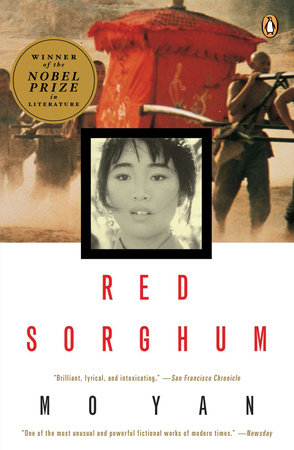
I hit the ground running as I managed to finish three books in the past week. What a way to start my foray into Asian literature I guess. Another part of the literary world that I have largely unexplored is Chinese literature. This was a realization I had last year. Despite having read over a thousand books, Nobel Laureate in Literature Mo Yan’s Red Sorghum is just the third book I read originally written in Chinese. Interestingly, I read all of these three books this decade. Two were also written by Nobel Laureates in Literature while the other one was an abridged version of one of the Four Classics of Chinese Literature.
Anyway, Red Sorghum was originally published in serial form in various magazines in 1986 before it was published as a single volume a year later. The novel chronicled three generations of the Shandong family between 1923 and 1976. While it was divided into five parts, a single voice narrates the family’s history. We read about the family’s trials and tribulations, from being successful distillery owners making sorghum wine to being resistance fighters during the Second Sino-Japanese War. I find the book rather brimming with violence. Bloodshed, death, and disputes between gangs and political rivals were prevalent in the story; they almost propelled the story. I am guessing this is the reason why the sorghum the family distilled was red. Rather, it turned red as it absorbed the blood of those who perished. There is a lot to unpack in the story as myth and superstition were woven into the lush narrative. Rabid dogs abounded the story. Overall, Red Sorghum was an interesting read although the dark and graphic elements can be a little overwhelming.
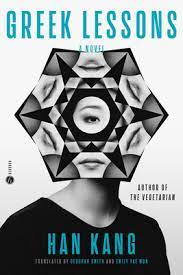
From Japan to China then to the Korean Peninsula, I guess I am having a sort of East Asian hangover, at least where literature is concerned. From an unfamiliar writer to a familiar writer, my literary journey took me to South Korean writer Han Kang’s latest translated novel, Greek Lessons which was released just this year. It was even listed by Time Magazine as one of the best books this year, so far. This is my fourth novel by the highly-esteemed writer, making her my most-read Korean writer.
Originally published in 2011, Greek Lessons follows two distinct threads. The first one is the story of an unnamed man who conveyed his story in his own voice. He came from Germany and returned to his native Seoul where he started teaching Greek lessons at a private academy. It was at one of his classes that he crossed paths with the novel’s second main character, an unnamed woman who recently lost her mother. She also lost custody of her son to her former husband. Before taking the lessons, she also started losing her voice, a condition that appears when she experiences deep trauma. Conversely, the male character started losing his eyesight, a hereditary condition. To be honest, my experience with Kang’s works has always been mixed. I liked Human Acts and The White Book. The Vegetarian and Greek Lessons, on the other hand, are books that I am having trouble fully appreciating although I did start appreciating the former a couple of years after I read it. Greek Lessons has bright spots but I feel like there was still something lacking.

While I am a Filipino, Philippine literature is another part of the literary world that I have rarely indulged in although I did promise to read at least one work per year since 2017. I failed last year which is why I am trying to make up for lost time with Ninotchka Rosca’s State of War. Overall, it is just the tenth work of Philippine literature I read, a testament to how underexplored this part of the literary world is. This is also the reason why I added State of War to my 2023 Top 23 Reading List.
In a way, reading the book is imperative, especially with the current state of political and social affairs in the Philippines. The story travels back in time. In painting the backstories of three main characters – Eliza Hansen, Adrian Banyaga, and Anna Villaverde – the book captured the history of the Philippines, from the pre-Spanish to the tumultuous contemporary. Honestly, the book was not an easy read. Sure, the writing was lyrical and descriptive but the story and the subjects it dealt with are not. We read about the Spanish era, the dawn of the American era, and even the Japanese era. The most palpable, however, was the book’s exploration of the Marcos regime, a dark phase in Philippine history. With historical revisionism becoming prevalent, books like State of War remind readers never to forget about history. It was a good read, even an imperative one for Filipino readers.
What will you read next?


From India, my literary journey will take me to its neighboring Bangladesh, with Shirshendu Mukhopadhyay’s The Aunt Who Wouldn’t Die. This will be my first novel written by a Bangladeshi writer and will also be my first originally written in Bengali. The book is rather short so I think it is a perfect way to contrast the over 500 pages of Age of Vice. I will be further extending my stay in South Asia as I travel from Bangladesh to Pakistan with Mohsin Hamid’s The Reluctant Fundamentalist. I have been encountering the book in must-read lists, including the 1,001 Books You Must Read Before You Die List. The book was also shortlisted for the 2007 Booker Prize. This is on top of a slew of accolades across the world.
From Pakistan, I will be moving further west with French-Iranian author Négar Djavadi’s Disoriental. Disoriental was originally written in French and, from what I understand, provides an evocative portrait of contemporary Iranian history and politics. That’s it for this week’s WWW Wednesday. I hope you are all doing great. Happy reading and always stay safe! Happy Wednesday again!
 The Pine-Scented Chronicles
Disoriental is one of my favourites and no one seems to talk about it. Can’t wait to hear your thoughts!
LikeLike