
Happy midweek everyone! Wow. We are already halfway through the week. I just realized that we are already in the second half of July. How time flies. How has the year been going for you so far? I hope that the year has been kind to everyone. If not, I hope you will experience a reversal of fortune in the coming months. More importantly, I hope everyone is happy and healthy, in body, mind, and spirit.
With the midweek comes a fresh WWW Wednesday update, my first this year. WWW Wednesday is a bookish meme hosted originally by SAM@TAKING ON A WORLD OF WORDS. The mechanics for WWW Wednesday are quite simple, you just have to answer three questions:
- What are you currently reading?
- What have you finished reading?
- What will you read next?

What are you currently reading?
Like June, I spent July reading works of Asian literature. Compared to Japanese literature, my exploration of Asian literature is limited. It has since been my goal to reduce the gap, hence, back-to-back Asian literature months. As expected, this literary journey not only took me across the continent but has also provided me deep insight into the culture, people, and history of the countries making up the largest continent in the world. It took me to countries that are familiar to me (in terms of literature) such as China, India, Pakistan, Turkey, and Vietnam. It also took me to countries I have not explored, literature-wise, previously such as Bangladesh and Israel.
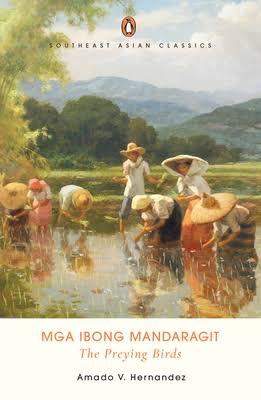
Currently, I am back in my home country with Amado V. Hernandez’s The Preying Birds. It was originally published in serial form before it was collectively published as a single volume in December 1968, carrying the title Mga Ibong Mandaragit. It was originally published in Tagalog, making it the first book originally written in Tagalog that I read. It was translated into English in 2022 as part of Penguin’s Southeast Asian Classics series. It is also the third book written by a Filipino I read this year; this is the most I read in a year, making up for the zero figure I had last year. I am more than midway through the book and I must say that it has strong echoes of the socio-political novels written by the Philippine national hero, Dr. Jose Rizal; in a way, the book’s hero, Mando Plaridel, was fleshed out of Rizal’s Crisostomo Ibarra/Simoun. The concerns Hernandez’s novel highlighted are also close to my heart. I can’t wait to see how the story pans out.
What have you finished reading?

In a way, the past week has been a productive reading week. I managed to complete three books. The first of these books was Amos Oz’s Judas, the second novel originally written in Hebrew that I read; the first one was David Grossman’s A Horse Walks into a Bar which I read earlier this month. These are also the first two books written by Israeli writers that I read. Oz, I learned is quite a figure in Israeli literature. He is always regarded as a candidate for the Nobel Prize in Literature. Interestingly, it was through the Big Bad Wolf sale that I first came across him and his novel, Judas. The title alone was enough to pique my interest.
Judas Iscariot is a figure many know. For millennia, he has been portrayed as the personification and quintessence of betrayal. Sure enough, Oz’s novel tackles betrayal through the story of its hero, Shmuel Ash. The setting was late 1950s Jerusalem. Ash quit university and took a live-in job as a companion to an elderly, incapacitated man, Gershom Wald. A third character, Atalia Abravanel, was the third occupant of the house. Atalia, a woman shrouded in mystery, enchanted Shmuel. It was through these three characters that Oz grappled with a plethora of subjects mainly involving Israel’s political climate; Ben-Gurion was a familiar presence in the story. Religion – as can be gleaned from the title – was also a vessel upon which these subjects were tackled. The story also had undertones of romance. But it was also a coming-of-age story. Judas is an interesting and insightful book that confronts universally accepted narratives.
From the Middle East, I traveled back to East Asia; I have stayed here more than in other parts of the continent. My literary journey took me back to South Korea, with Cheon Myeong-Kwan’s Whale. Whale is the third work by a Korean writer I read this year. Prior to this year, I have never come across Cheon nor have I read any of his novels. I first came across Cheon and his novel when Whale was announced as part of the 2023 International Booker Prize longlist. There has been a spate of Korean novels taking the world by storm; I am not complaining though. Thankfully, I was able to obtain a copy of the novel before July ends.
Whale was originally published in 2003 and was Cheon’s debut novel. It was a literary sensation in South Korea and is considered a contemporary classic of Korean literature. The novel mainly charted the story of Geumbok. Born in a mountain village, she moved to a coastal city to escape from her abusive father. The sea mesmerized her but the sight of a whale breaching out on the ocean awakened something in her. The story then followed her unusual effect on men and her various lovers, from a fishmonger to a Yakuza to a laborer. Her affair with the laborer brought her back to the mountains, to the village of Pyeongdae. Through Geumbok’s enterprising skills, she established a successful brickmaking business. The story of Pyeongdae’s sudden growth was reflective of the story of South Korea’s own exponential growth. The novel has several layers that make it a riveting read.
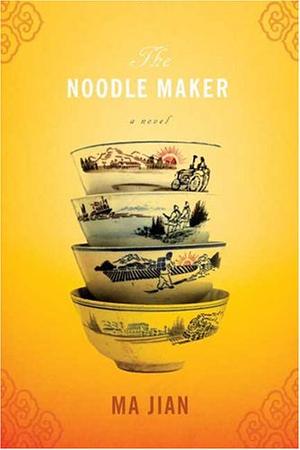
From South Korea, I didn’t have to travel that far for my next reading adventure. Ma Jian’s The Noodle Maker is the third novel by a Chinese writer I read this year; this also includes Nobel Laureate in Literature Mo Yan. As I have mentioned repeatedly, Chinese literature is a literature that is largely unexplored, at least by me, which is why I want to read more works by Chinese writers. It was also this goal that led me to The Noodle Maker and a slew of other works by Chinese writers. The Noodle Maker was originally published in 1991 as 拉面者.
Ma Jian is, I have learned, a vocally critical of China’s Communist government. As such, it comes as no surprise that The Noodle Maker is a complex narrative that satirizes the Communist Party. Rather than a straightforward narrative, Ma built the novel through the stories of an interesting and eclectic set of characters such as a professional writer, a professional blood donor, and even an actress. Through these characters, Ma provided a vivid portrait of the social and political concerns of modern China. Not only was the novel a work of social realism but it was also a work of magical realism. The novel provides an interesting window into contemporary Chinese society but the stories keep the readers at t distance. It was not emotionally engaging. The Noodle Maker, nevertheless, is an interesting story that provides the readers glimpses of the plights of modern China.
What will you read next?


 The Pine-Scented Chronicles