A Sophomore Slump?
It is not uncommon to find relatively unknown individuals rising above obscurity and hitting instant success. This can be observed in every facet of life. In music, for instance, one can easily find musicians who come out of nowhere to create music that is earworm. This immediate success makes listeners look forward to their succeeding musical releases. The expectations can be quite high. This creates undue pressure on musicians. At times, what ensues is a sophomore slump as they are not able to replicate their initial success. While there are singers and musicians who are able to hurdle this, it is also not common to find one-hit wonders: singers and musicians who were not able to consolidate their initial success. A second release is either a hit or a miss. Some are able to survive the slump but some packs it up.
These high expectations for sophomore works are also prevalent in the world of literature. Time and again, history showed how great the expectations are on relatively unknown writers who wrote sensational debut novels. This can be gleaned from the case of J.K. Rowling. The unexpected success of Harry Potter and the Philosopher’s Stone following several rejections by different publishers created quite a sensation. The pressure for Rowling to produce an equally exhilarating and magical novel doubled. She managed to live up to the expectations, something that she was able to pull off for five more books. Success for sophomore novels, however, is uneven. Was Donna Tartt able to pull off the same feat?
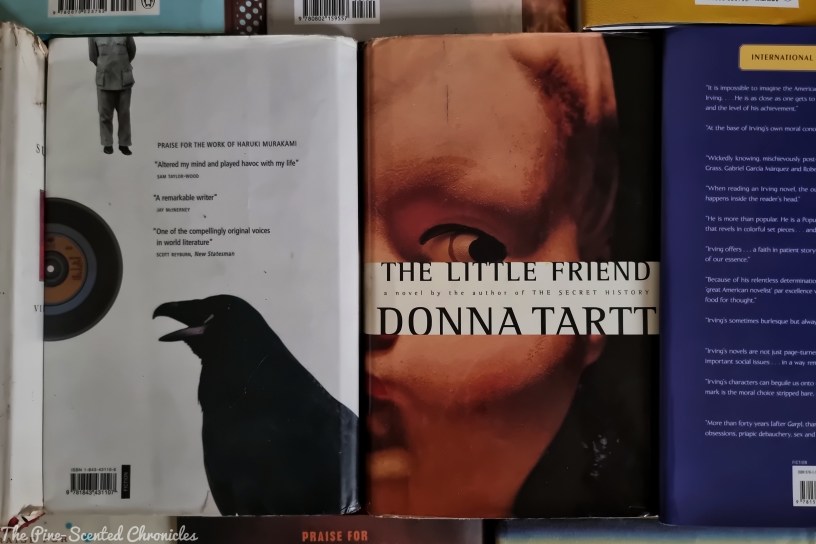
In 1992, Tartt made her literary debut, six years after graduating from Bennington College. Her debut novel, The Secret History, was a campus novel where murder and the appreciation for the beauty of Ancient Greece converged. The Secret History was warmly received by readers and literary pundits alike. It was an instant bestseller and received positive reviews. The novel was even listed as part of the 1,001 Books You Must Read Before You Die. The Secret History announced the rise of a new literary voice. With all the accomplishments achieved by her debut novel, expectations are high for Tartt’s succeeding works. Everyone is tuned in for her sophomore novel. Anticipation was high when news of her second novel made it to the headlines. It took a decade but in 2002, Tartt finally published her sophomore novel, The Little Friend.
“And – since this willful amnesia had kept Robin’s death from being translated into that sweet old family vernacular which smoothed even the bitterest mysteries into comfortable, comprehensible form – the memory of that day’s events had a chaotic, fragmented quality, bright mirror-shards of nightmare which flared at the smell of wisteria, the creaking of a clothes-line, a certain stormy cast of spring light.”
~ Donna Tartt, The Little Friend
Tartt’s sophomore novel opened in 1970s Alexandria, Mississippi where the readers are introduced to the novel’s main character, Harriet Cleve Dufresnes. Harriet was already twelve years old. She was living with her mother Charlotte and her sister, Allison. The Dufresnes family previously lived in an ancestral plantation home called Tribulation but they exchanged it for mediocre houses located in town. One of the drivers for the move involved Harriet’s older brother, Robin Cleve Dufresnes. However, Robin has already passed away over a decade ago. It was no ordinary death. Neither accident nor poor health caused his demise. Harriet’s memory of her brother’s untimely death was sketchy. She does, however, know the basics.
“Twelve years after Robin’s death, no one knew any more about how he had ended up hanged from a tree in his own yard than they had on the day it happened.” Before this, the family home was abuzz with activities as it was a hot Mother’s Day afternoon. Their mother, grandmother Edith (called “Edie” by her grandchildren), and grand-aunts Tat, Libby, and Adelaide have gathered at the ancestral home for dinner prepared by the Cleves’ housekeeper, Ida Rhew. Dixon, the family patriarch, went duck hunting. Meanwhile, Robin was outside playing. Allison, who was still a pre-schooler, and Harriet who was still an infant were also outside. The festivities of the afternoon were broken by the screams of their neighbor Mrs. Fountain. It was then that Robin’s body was found hanging on a black tupelo tree in the family backyard.
As expected from the unexpected death of a child, Robin’s death caused the unraveling of his family. His demise left a gaping hole that sucked the family into its vortex. Their father slowly withdrew – physically and mentally – from his family. He eventually moved out and moved to Nashville where he lived with his mistress. He has also not kept in touch with his children. Meanwhile, Charlotte started to sink into a listless depression. She became a recluse. And while she resented how Robin’s death has adversely affected the family, she felt helpless. She has long neglected her two daughters because of their inability to measure up to their brother. Practically orphans, Allison and Harriet were cared for by their domineering grandmother and great-aunts, with plenty of help from Ida.
Despite the passage of time, there was one question that loomed large in everyone’s minds: what really happened on that fateful Mother’s Day afternoon? The circumstances surrounding Robin’s death were wrapped up in a veil of mystery. It was a mystery that was never solved and because of this shroud of mystery, the locals referred to it as an accident. This was despite signs of strangulation discovered on the body of Robin. However, beyond this, there were no other clues to indicate any signs of foul play. Because of the lack of evidence, it was soon buried deep in the peripheries of everyone’s minds, including the family. The possibility of Robin being murdered, however, lingered.
“It would never wholly leave her, the vertigo of this moment; it would be with her for the rest of her life, and it would always be mingled inextricably with the dim toolshed—shiny metal sawteeth, the smells of dust and gasoline—and three dead Englishmen beneath a cairn of snow with icicles glittering in their hair. Amnesia: ice floes, violent distances, the body turned to stone. The horror of all bodies.”
~ Donna Tartt, The Little Friend
It was this small window that Harriet saw as an opportunity to revisit what happened to her brother. Allison, who witnessed the event, was unable to recall the details of what she saw. Unlike her younger sister, she showed very little interest in getting to the bottom of the mystery that hounded the family for over a decade. Harriet, on the other hand, was uncompromising and can be strong-headed. While she was bookish, Harriet was seen as a difficult child. She also had a fixation on secrets which eventually led to a fascination with her brother’s death, along with the history of her matrilineal heritage. The bulk of the book charged how Harriet tried to get to the bottom of the mystery. The book’s title also added another layer of mystery. Who is the titular little friend?
What ensued was an obsession-driven pursuit for answers and truth that often involved haphazard guesswork. Harriet believes that her brother was murdered and she was determined to unmask her brother’s killer. Her pursuit of the truth zeroed in on Danny Ratliff. Sans a shred of proof, Harriet believed that Danny was the perpetrator. The deeper she digs into Danny’s background, the more she became convinced that she had her suspect. For one, Danny descended from a redneck family with a long criminal history and whose patriarch was abusive. Danny was also helping his older brother Farish run the family’s illicit methamphetamine business; they run a drug laboratory on the outskirts of town. The damning piece of evidence that Harriet unearthed was a testimony from Ida who mentioned that a couple of days before his death, Robin quarreled with Danny. This removed every bit of doubt in Harriet’s mind.
With the novel’s prologue and also from Tartt’s previous novel, one can conclude that The Little Friend is a murder mystery. On the surface, it easily comes across as one, particularly with how the novel’s various elements were woven together by Tartt. However, Tartt’s sophomore novel was more than just a murder mystery. As the story moved forward, its other layers started floating to the surface. The murder mystery subtly shrouded a novel that deep dives into the atmosphere of the 1970s South. Born and raised in the South herself, Tartt’s astute observations of the climates of the period made the novel soar. As such, the novel was riddled with subjects that are familiar in the lore of the Deep South.
Family dynamics was one of the most prominent subjects the novel explored. Families, after all, are central in the Deep South society. In the story of the Cleves and the Ratliffs, we read about dysfunctional families. Both families are not without flaws but they were also comprised of colorful personalities. Harriet’s adventures also led her to unlock her own matrilineal family’s heritage; heritage is another subject the South is preoccupied with. In a way, these families mirrored each other. The Cleves, dominated by women, were raised by their grandmother while the Ratliffs, a household of men, were raised by their grandmother. But their stories were also windows to a world that were starkly different from each other.
“She did not care for children’s books in which the children grew up, as what “growing up” entailed (in life as in books) was a swift and inexplicable dwindling of character; out of a clear blue sky the heroes and heroines abandoned their adventures for some dull sweetheart, got married and had families, and generally started acting like a bunch of cows.”
~ Donna Tartt, The Little Friend
As the two stories run parallel to each other, the novel started branching out to seminal subjects that resonate with the contemporary. The sea of differences between classes was underscored by the story. The white townsfolk project themselves as if they are cut above the rest. They act as such and segregate themselves from the degenerate rednecks, the white trashes. This was complimented by their superficiality. Racial injustice was another seminal subject that was tackled by the novel. It was these social commentaries that were amongst the novel’s strongest suits. Race and class are among the novel’s central themes. Harriet’s adventures would also take her to the depths of true evil but as Harriet acts on her misguided impulses, the good muddles the bad. The distinction between the victim and the suspect starts to disintegrate.
Death was another prevalent theme in the story; after all, it started with one. Around this central theme, the story explored how some characters managed to evade certain death. Meanwhile, other characters were learning how to cope with tragedy and death. Each character had his or her own way of coping. Some were in denial. Some projected stability in the face of a family crisis. Some escaped from reality. Beyond these primary themes, the novel was also a coming-of-age story steered by a feisty, adventurous, and clever young girl. Outside the books that she consumed – among them were Robert Louis Stevenson’s Treasure Island, Rudyard Kipling’s The Jungle Book, and a fairy tale about the King of Snakes – Harriet’s real-world adventures taught her about betrayal and guilt. Elsewhere are religious undertones: “It says Hate in the Bible, the Lord hateth this and the Lord hateth that. It says it practically on every page.”
Through this literary labyrinth that Tartt guided her readers, what was showcased was Tartt’s skill for storytelling and writing. She was a compelling storyteller. Her prose wove all of the novel’s various elements together into a lush tapestry. She further peopled it with characters who added layers of complexity to the atmospheric story. However, the novel was undone by the weight of its ambition. Sure, ultimately the mystery remained a mystery in the end but it was lamentable how the promising story was plodded down by Tartt’s compunction for details. The premise alone was complex but it was further complicated by the intricacies of unnecessary details that did little to advance the story or the themes it tackled. It was verbose and ended on an ambiguous note.
With its flaws, it is fair to conclude that The Little Friend pails in comparison to its predecessor and even to its successor, the Pulitzer Prize-winning The Goldfinch. But for all its faults, The Little Friend reminded the readers of all the good things that make Tartt’s writing soar. Tartt crafted a multilayered story that incorporated murder, mystery, coming-of-age, and social commentaries. She tackled seminal subjects that persist in the contemporary such as racial injustice class oppression and even death. At the same time, Tartt painted a vivid backdrop upon which the story was juxtaposed. Tartt’s understanding of the South made for an atmospheric read. The execution was, ultimately, uneven.
“Even if it meant that she had failed, she was glad. And if what she’d wanted had been impossible from the start, still there was a certain lonely comfort in the fact that she’d known it was impossible and had gone ahead and done it anyway.”
~ Donna Tartt, The Little Friend
Book Specs
Author: Donna Tartt
Publisher: Alfred A. Knopf
Publishing Date: 2002
Number of Pages: 555
Genre: Mystery, Bildungsroman
Synopsis
The hugely anticipated new novel by the author of The Secret History – a best-seller nationwide and around the world, and one of the most astonishing debuts in recent times – The Little Friend is even more transfixing and resonant.
In a small Mississippi town, Harriet Cleve Dufresnes grows up in the shadow of her brother, who – when she was only a baby – was found hanging dead from a black-tupelo tree in their yard. His killer was never identified, nor has his family, in the years since, recovered from the tragedy.
For Harriet, who has grown up largely unsupervised, in a world of her own imagination, her brother is a link to a glorious past she has only heard stories about or glimpsed in photograph albums. Fiercely determined, precocious far beyond her twelve years, and steeped in the adventurous literature of Stevenson, Kipling, and Conan Doyle, she resolves, one summer, to solve the murder and exact her revenge. Harriet’s sole ally in this quest, her friend Hely is devoted to her, but what they soon encounter has nothing to do with child’s play: it is dark, adult, and all too menacing.
A revelation of familial longing and sorrow, The Little Friend explores crime and punishment, as well as the hidden complications and consequences that hinder the pursuit of truth and justice. A novel of breathtaking ambition and power, it is rich in moral paradox, insights into human frailty, and storytelling brilliance.
About the Author
To learn more about Donna Tartt, click here.
 The Pine-Scented Chronicles