
Happy midweek everyone! Wow. We are already halfway through the week. Today is also the last Wednesday of my birth month. How time flies. How has the year been going for you so far? I hope that the year has been kind to everyone. If not, I hope you will experience a reversal of fortune in the coming months. More importantly, I hope everyone is happy and healthy, in body, mind, and spirit.
With the midweek comes a fresh WWW Wednesday update, my first this year. WWW Wednesday is a bookish meme hosted originally by SAM@TAKING ON A WORLD OF WORDS. The mechanics for WWW Wednesday are quite simple, you just have to answer three questions:
- What are you currently reading?
- What have you finished reading?
- What will you read next?

What are you currently reading?

Admittedly, and also unfortunately, my foray into the literature of my own Philippines is measly at best. In terms of statistics, the number of books written by Filipino writers I have read lags behind the other major world literature, e.g. Japanese, Indian, and even French. As such, I have been trying to make up for lost time in the past few years. It was just unfortunate that I was not able to read any last year. Because of this, I decided to double my target for this year; it was my goal to read at least two works of Filipino literature every year. This was how I found myself headed to Criselda Yabes’ Crying Mountain, the fourth work of Filipino literature I read this year. This sets the record for the most works by Filipino writers I read in a year. I just started reading the book but I am astounded by the flow of words. It is lyrical; I also find myself in the Zamboanga peninsula, a part of the country I have never been to. Anyway, the book is rather short so I just might finish it by tomorrow. I am quite excited to finish the book.
What have you finished reading?
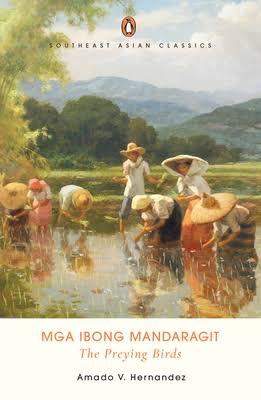
As the curtain slowly falls on July, I have slowly regained my reading momentum. In the past week, I was able to complete four books. The first of these books was my third book by Filipino writer, Amado V. Hernandez’s The Preying Birds. It was originally published in serial form before it was collectively published as a single volume in December 1968, carrying the title Mga Ibong Mandaragit. It was originally published in Tagalog, making it the first book originally written in Tagalog that I read. It was translated into English in 2022 as part of Penguin’s Southeast Asian Classics series.
Set in the Philippines during the twilight years and the years immediately following the end of the Second World War – the Philippines was occupied by the Japanese during the war – The Preying Birds is a scathing socio-political novel that strongly echoed the sentiments captured in the works of the Philippine national hero, Dr. Jose Rizal. In a way, the book’s hero, Mando Plaridel, was fleshed out of Rizal’s Crisostomo Ibarra/Simoun. Mando used to be a servant in the household of wealthy landlord Segundo Montero. During the war, Mando was betrayed and ended up becoming a guerilla. By a stroke of luck, Mando succeeded in retrieving the chest of jewels that was thrown into the sea by Simoun. Mando could have used it for his personal gain but instead, he used the treasure to seek social justice. But social justice is one that can hardly be attained in a society brimming with corrupt and greedy individuals. The same maladies underlined by Dr. Rizal in his novels were the same maladies captured by Hernandez but were updated to be in tune with the time. Nevertheless, these are concerns that remain prevalent in the present. The Preying Birds is, without a doubt, an incisive look at contemporary Philippine society.

By birth and heritage, Rebecca F. Kuang is Chinese. Her family moved from Guangzhou, China to the United States when she was still four years old. She has since established a reputation as a writer of fantasy fiction. She started working on her debut novel, The Poppy War when she was just eighteen; it was published when she was just twenty-two. It was through these works of fantasy that I first came across Kuang. However, it was her latest novel, Yellowface that grabbed my attention. The book was listed in several most anticipated 2023 book release lists, hence, its inclusion in my own.
After Deepti Kapoor’s Age of Vice, Yellowface is just the second book from my 2023 Top 10 Books I Look Forward To List. The premise of Yellowface piqued my interest. It followed the story of two young female writers. On one side was Juniper Hayward. She was white. On the other side was Angela Liu. She was Asian by birth. They became reluctant friends when they became dormmates and even classmates at Yale University; they both aspired to be writers. Juniper, however, descended into obscurity while Angela became the darling of the literary crowd. Both living in Washington, D.C., the young women remained friends. An interesting but unfortunate turn of events left Juniper with the transcripts of what was supposed to be Angela’s latest work. The novel examined several timely subjects revolving around writing and publishing, including cultural appropriation, cultural authenticity, and the tipping of the literary scale toward diversity. While some subjects were not fully addressed, Yellowface was, nevertheless, a riveting read.

From China, I moved back to Turkey. My literary journey across Asia brought me back to a name that has become very familiar. Elif Shafak first piqued my interest back in 2019 when I encountered her controversial novel, The Bastard of Istanbul. It was, however, with her 2019 Booker Prize-longlisted novel, 10 Minutes 38 Seconds in This Strange World that I started my exploration of her oeuvre. There is just something about her storytelling that I find compelling, hence, my fourth novel by Shafak, Three Daughters of Eve.
As the title suggested, the novel had three women at its core. However, it was Peri whose story occupied a huge chunk of the story. Born and raised in Istanbul, she has always been at odds with her religion. Her mother was a devout Muslim while her father was the polar opposite of her mother. The patriarch has a more liberal view of the world. It was this liberality that made him push for his daughter’s education at Oxford University where she met the rest of the titular daughters of Eve. The first one was Shirin. She had Iranian heritage but has long shirked her religion. Mona, on the other hand, was born and raised in Egypt. Mona was a devout Muslim. The three crossed paths in the class of the enigmatic Professor Azur. Professor Azur’s class has a very open view of religion and few students are allowed. Three Daughters of Eve, while it dragged in parts, is an insightful story about our own doubts, whether in our beliefs or not. It is also about loyalty, friendship, and coming of age.
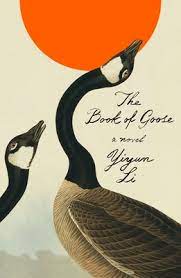
Capping this four-book stretch is another name whose oeuvre I have not explored previously. I have read several positive feedback on the works of the Chinese-born writer; she was born in Beijing before she moved to the United States in 1996. Li has since been publishing her works in her adopted language. I again crossed paths with Li in 2022 when her latest novel, The Book of Goose was released. As always, the book was lauded by both literary pundits and readers alike. It was even listed as one of the best books of the year. I was planning to read the book but it was only recently that I was able to obtain a copy of the book. Curious about what the book has in store, I included it in my foray into Asian literature.
In a way, The Book of Goose contained elements of Yellowface and Three Daughters of Eve. Set in the French countryside shortly after the conclusion of the Second World War, the novel charted the story of a pair of thirteen-year-olds, Agnès and Fabienne. They were close friends. One day, Fabienne concocted a plan to write a story. She will tell it and Agnès will write it. They also employed the assistance of a local postmaster who helped them edit the book – it was a collection of morbid stories about dead babies – and also find a publishing house. There was a catch: the book was credited to Agnès alone. Fabienne refused to have her name be attached to the book although the profit from the book was divided between the three of them. Agnès was then the darling of the literary crowd; she was a prodigy. Despite this, the novel’s preoccupation was the friendship of Agnès and Fabienne which was both affectionate and strange. There is a fairy tale quality to the story. It was a gripping and insightful story.
What will you read next?


 The Pine-Scented Chronicles
🩵
LikeLike
I’m excited to read Yellowface. It looks really good and I’ve heard a lot of good things about it too!
My WWW: https://bookbabenails.wordpress.com/2023/07/26/www-wednesday-jul-26-bookblog/
LikeLike
Reblogged this on Entirely consecrated beacon for secular existence's contemplation.
LikeLike