
First Impression Friday will be a meme where you talk about a book that you JUST STARTED! Maybe you’re only a chapter or two in, maybe a little farther. Based on this sampling of your current read, give a few impressions and predict what you’ll think by the end.

Synopsis:
It is April 1901 on the imaginary island of Mingheria – the twenty-ninth state of the Ottoman Empire – located in the eastern Mediterranean between Crete and Cyprus. Half the population is Muslim, the other half is Greek Orthodox, and tension is high between the two. When a plague arrives – brought either by Muslim pilgrims returning from Mecca or by merchant vessels coming from Alexandria – the island revolts.
To stop the epidemic, the Ottoman sultan Abdul Hamit II sends his most accomplished quarantine expert, an Orthodox Christian, to the island. Some of the Muslims, including followers of a popular religious sect, refuse to take precautions or respect the quarantine. And then a murder occurs.
As the plague continues its rapid spread, the Sultan next sends his niece, Princess Pakize, and her husband, an acclaimed doctor (and a Muslim), to manage the crisis. But the incompetence of the island’s governer and local administration, and the people’s refusal to respect restrictions, doom the quarantine to failure – and the death count continues to rise. Because of the danger that the plague might spread to the West, the people of Mingheria are cut off and let to defeat the plague themselves.
Steeped in history and rife with suspense, Nights of Plague is an epic story of love, politics, and a nightmarish plague that threatens to bring an end to an empire. It is a stunning work from one of our most essential writers.
Happy Friday everyone! The past few days have been a little damp here in the Philippines; little is quite an understatement as it rained profusely once the first raindrop falls. The northern part of the country was also battered by a near-supertyphoon. I hope and pray that the North will recover soon after this devastation. I hope that everyone is also doing well and are keeping warm in the comfort of their own homes. On another note, I hope that everyone is wrapping up the week on a high note. I hope that everyone’s day and week went well. If it went the other way around, I hope that you will spend the weekend recovering. I hope you get your groove back. More importantly, I hope everyone is doing well, in body, mind, and spirit.
But before I can ditch my corporate attires and don some comfortable articles of clothing, I will be sharing a fresh First Impression Friday update which, I just realized, is going to be my last for my birth month. In a couple of days, we will be greeting a new month. With the end of July also comes the conclusion of my two-month venture across the Asian continent for the best of its works of literature. It was a magical literary journey that provided me insights into the diverse culture and people of the continent. This has also allowed me to explore further parts of the literary world that I have long been neglecting; I read more works of Chinese, South Korean, and Filipino literature this year than in any other year.
To cap off this two-month journey, I have decided to read Nobel Laureate in Literature Orhan Pamuk’s latest novel, Nights of Plague. The novel is also my eightieth read for the year; it seems that I am on track to resetting my previous record of most books read in a year. Nights of Plague is also the fourth novel by the first highly controversial but equally esteemed Turkish writer; Pamuk was also the first Turkish writer to win the Nobel Prize in Literature. Pamuk’s latest novel was originally published in 2021 in Turkish with the title Veba Geceleri which literally translates as Nights of Plague.
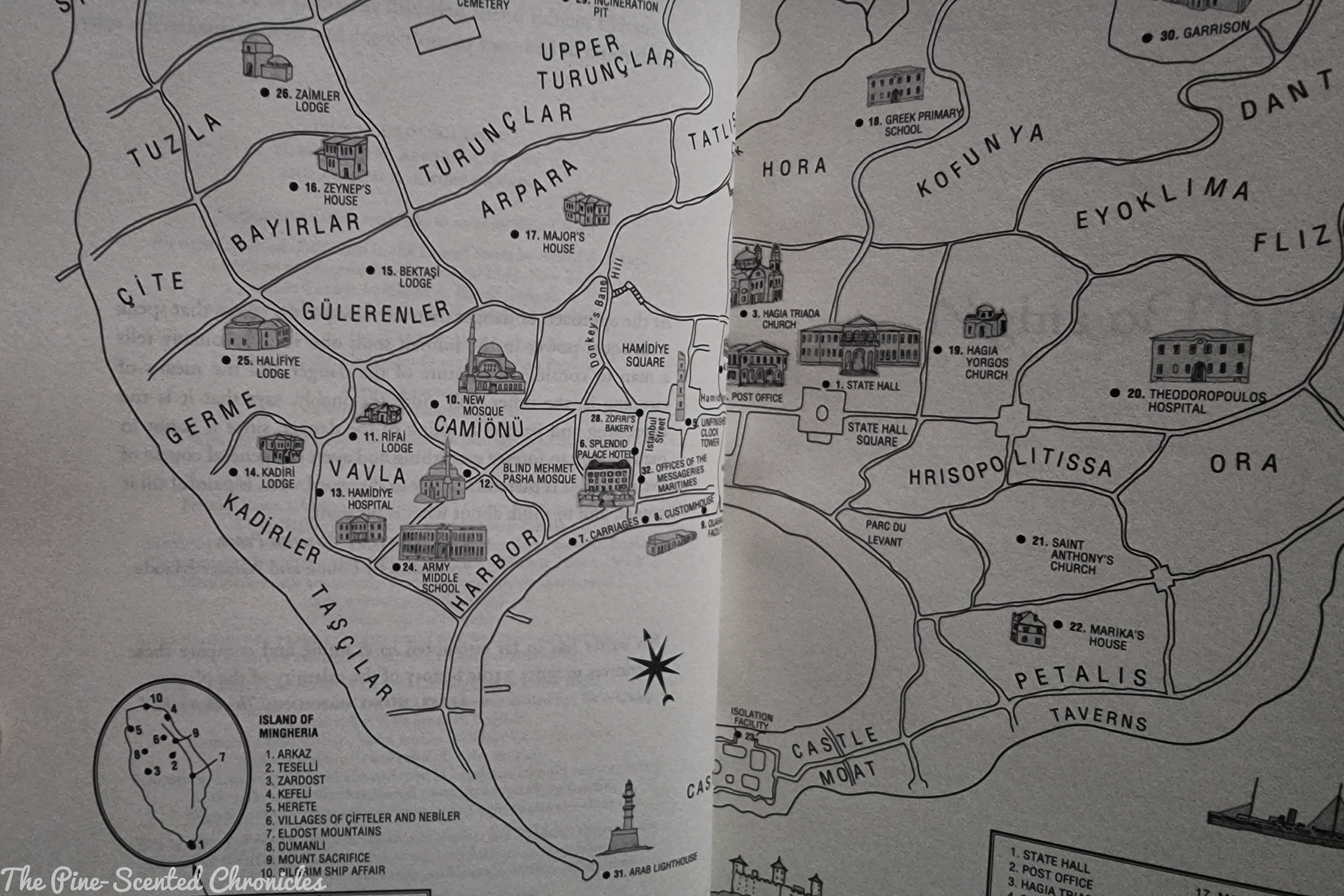
With the map at the start of the book and the preface by a pseudo-historian-cum-documentarian, one might think that the novel chronicles actual events. I guess not. Rather, the story transports the readers to the first years of the 20th century on a fictional island called Mingheria. The island is part of the Ottoman Empire with a population of roughly eighty thousand. This population is equally divided between Muslims and Greek Orthodox. This somehow calls to mind the island republic of Cyprus although the lighthouse at the opening of the bay reminds me of the Colossus of Rhodes. One thing about maps is that they are always interesting.
Anyway, when the story commenced, the readers meet Princess Pakize. Along with her husband, Prince Consort Doctor Nuri Bey, they were on their way to the island of Mingheria at the request of the Princess’s uncle, the Ottoman Abdul Hamit II. This was all done under the cloak of secrecy because the sultanate and the governor’s office did not want to stir panic; they were even accommodated in the most inconspicuous of accommodations. During this time, a pandemic was threatening parts of the West. It was suspected that it has made its way to the island. Doctor Bey, an accomplished doctor, was assisted by one of the Sultan’s most trusted quarantine experts.
When they reached the island It was reiterated that their mission was to be executed under the cloak of secrecy lest they incite panic among the island’s citizenry. For their part, the citizens feared that even the vestige of an outbreak can paralyze their trade. While the events covered by the story were from over a century ago, one can’t help but examine the novel under the pretexts of what has recently happened, i.e. the COVID-19 pandemic. With the spate of pandemic novels in the past two years or so, one cannot dismiss this observation. But I am expecting more from the novel. The period in which it was set was the twilight years of the once-powerful Ottoman Empire. All over the novel, signs of decay were manifesting. Are these two subjects – the pandemic and the decline of the empire – somehow connected? This is something that I am looking forward to.
Also, I just noticed the synopsis mentioning a murder. Moreover, the blurb also iterated that there are elements of detective fiction in the novel. I don’t think I have reached the part where the murder was perpetrated. This is another facet of the story that I am looking forward to. Since I just started reading the book earlier today, I haven’t gotten that far. I have completed a little under a hundred pages but it was enough to find my footing in Pamuk’s prose; the fact that it is a work of historical fiction I guess tips the scale in the novel’s favor. I still have quite a long way before finishing the novel; the book is on the hefty side. I am going to bide my time.
I can’t wait to see how the story pans out although I am suspecting that the story will meander here and there. How about you fellow reader? What book or books are you taking with you for the weekend? I hope you get to enjoy them. Again, happy weekend everyone!
 The Pine-Scented Chronicles
🖤
LikeLike