A Masterful Epic
In contemporary Indian literature, Vikram Seth is among the most celebrated. He is also one of the most recognized Indian writers globally. He was an economist by education, training, and vocation; he even received a master’s degree in economics from one of the most prestigious institutions in the world, Stanford University. However, it was in literature that he attained success. Shortly after completing his master’s degree, he made his literary debut in 1980 with the publication of his first book, Mappings, a volume comprised of his early works of poetry. It was in poetry that Seth started to make a name for himself. In fact, even his first novel, The Golden Gate, published in 1986, was written in verse form. Over the course of his career, Seth published about ten collections of poetry.
However, as many can attest, writer or not, it took time for success to come knock on the door. His first book was met with a lukewarm response. It was another form of text work, a humourous travelogue, that made him a household name. Published in 1983, From Heaven Lake: Travels Through Sinkiang and Tibet charted his adventurous hitchhiking from Nanking to New Delhi via Tibet. For this work, he received critical acclaim. He would eventually a diverse oeuvre that spanned various genres, from poems to prose to children’s books. For his diverse body of work, Seth received several literary awards such as the 1983 Thomas Cook Travel Book Award for From Heaven Lake, the 1985 Commonwealth Poetry Prize (Asia) for The Humble Administrator’s Garden, and the 1988 Sahitya Akademi Award for The Golden Gate.
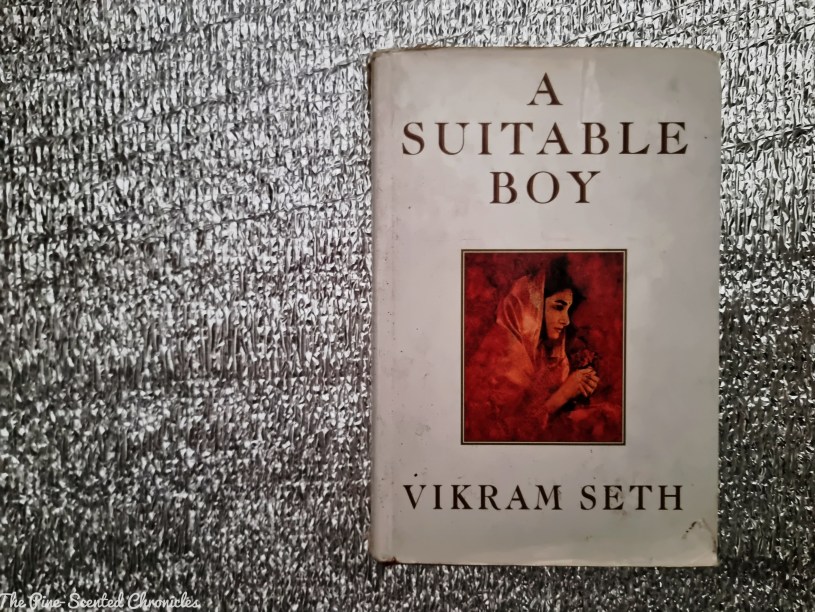
The first book that many would associate with the highly-heralded Indian writer, however, was his 1993 novel, A Suitable Boy. Around the time of its publication, Seth has already built a credible literary vita but A Suitable Boy propelled him to the center of the public limelight and, by extension, global recognition. It was his sophomore novel but it was his first venture into full prose. The novel would also be particularly known for one of its facets. With a whopping 1,300 pages, the novel is one of the longest novels published in a single novel. This alone can intimidate readers. Beyond its daunting length, there is more than meets the eye in this epic novel. It has gained critical acclaim across the world and is listed as one of the must-read books. Considered a modern classic, A Suitable Boy is also listed as one of the 1,001 Books You Must Read Before You Die.
“What I mean is it sprouts, and grows, and spreads, and drops down branches that become trunks or intertwine with other branches. Sometimes branches die. Sometimes the main trunk dies, and the structure is held up by the supporting trunks. When you go to the Botanical Garden you’ll see what I mean. It has its own life – but so do the snakes and birds and bees and lizards and termites that live in it and on it and off it. But then it’s also like the Ganges in its upper, middle and lower courses—including its delta – of course.”
~ Vikram Seth, A Suitable Boy
A Quest for Love?
“You too will marry a boy I choose,” thus commenced one of the greatest works of Indian literature. The year was 1951 and the setting was the fictional city of Brahmpur on the mighty Ganges River. The voice emanated from Mrs. Rupa Mehra who was addressing Lata, her youngest child. When we first meet the mother and daughter pair, we witness the marriage of Lata’s older sister, Savita to Pran Kapoor, a promising professor at the local university. The union was masterminded by Mrs. Mehra; she gave the pair her go signal mainly because Pran descended from a well–respected and wealthy family. The family patriarch, Raghubir Mehra, has long since passed away, thus, leaving the burden of arranging their daughters’ marriages on the shoulders of Mrs. Rupa Mehra; all over the story were her lamentations about this role.
The opening sentences of the novel immediately establish the heart of the novel: Lata, a 19-year-old and talented student attending the local Brahmpur University. With Lata knocking on the doors of young adulthood, arrangements for her impending marriage have become imperative; this was underlined by her mother during her older sister’s wedding. This reality was not also lost on Lata’s mind although she shrugged it off because she wanted to focus on her studies in English literature. Her daughter’s dismissal, however, has not disheartened Mrs. Mehra who soon enlisted the help of her friends and family. The goal was, as the title suggested, to find “a suitable boy” for her youngest child. Arranged marriages were ubiquitous back then and, to some levels, still persist today.
Choosing to focus on her studies did not mean that Lata gave up on the idea of romance. At the university, she met Kabir Durrani, one of her classmates who kept approaching her. He was good-looking and equally intelligent. His kindness made Lata fall further in love with him. They started meeting surreptitiously, away from the prying eyes of the public. Lata was cognizant of the fact that Kabir does not fall within her mother’s definition of a suitable boy for her. This was despite the fact that Kabir’s father was a prominent university professor. Getting in the way of the young couple’s romance was their religion. Kabir was born into a Muslim family while Lata’s family was Hindi. It also did not help Lata’s situation that her mother was fiercely traditional. Lata’s mother’s definition of a suitable boy is someone from the same caste hence, Mrs. Mehra was against the pairing when news of it reached her.
This situation placed Lata at an impasse. She must decide if Kabir is worth fighting for. The price is hefty as choosing Kabir entailed defying her domineering mother. Defying her mother also means being ostracized not only by her mother but by the upper crust of society they were part of. This was a setback for Mrs. Mehra but this did not stop her from her quest to find a suitable husband for her daughter. She reasserted her strict control by making Lata accompany her to Calcutta where they visited Arun and Varun, Lata’s older brothers. It was also in Calcutta that Mrs. Mehra set Lata up with different Hindi young men. However, this was all for naught as not a single one flourished.
“I’ve always felt that the performance of a raag resembles a novel – or at least the kind of novel I’m attempting to write. You know,’ he continued, extemporizing as he went along, ‘first you take one note and explore it for a while, then another to discover its possibilities, then perhaps you get to the dominant, and pause for a bit, and it’s only gradually that the phrases begin to form and the tabla joins in with the beat…and then the more brilliant improvisations and diversions begin, with the main theme returning from time to time, and finally it all speeds up, and the excitement increases to a climax.”
~ Vikram Seth, A Suitable Boy
A Suitable Boy is a multilayered epic that does not reduce itself to a mere matchmaking escapade. It was palpable that the quest for a suitable boy – almost reminiscent of Jane Austen’s novels – was the backbone of the story. It was the main frame upon which the novel’s other elements were anchored on. As the story moved forward, more threads started to manifest and more characters were introduced. From one family, three more families were introduced. Seth introduced the Kapoors, the Khans, and the Chatterjis. These families share a common connection: the Mehras. This web of connections also underlines the profound reality that Asian societies place an inordinate amount of emphasis on the importance of families and family dynamics. It was also through these families that the novel explored other seminal subjects.

The Young Indian Republic
The four families at the heart of the novel also share another connection: politics. The story was juxtaposed to the changing landscape of the young Indian Republic shortly after it gained its independence from Great Britain. As such, politics and history were at the forefront of the story; these seminal subjects were integrated with the Austenian search for a suitable partner. The years preceding the events captured in the novel were critical and pivotal in India’s contemporary history. Four years earlier, on August 15, 1947, the country gained its independence from Great Britain. This is a historic event that was covered in equally popular works of Indian literature such as Salman Rushdie’s Midnight’s Children.
Gaining independence, however, did not end the struggles of the subcontinent. At the same time that this historic event birthed a young republic, the subcontinent was politically divided between the Dominion of India which is the modern Republic of India; and the Dominion of Pakistan which was comprised of today’s Islamic Republic of Pakistan and the People’s Republic of Bangladesh. This event would be known in history as the Partition of India. However, it was no simple division of territories or maps as this event also highlighted important dichotomies. This exposed the gap between two important religions: Islam and Hinduism. With the partition came massive migration between the two dominions. In the wake of this unprecedented migration was a massive death toll that was estimated to be around 200,000 to 2,000,000.
Vestiges these historic and turbulent events resonated in the story. The partition has left an indelible mark. Communal violence persisted and families were separated. There still persisted a gap between members of the two major religions as they remain at odds with each other. Different forms of discrimination were prevalent in the story. Mrs. Merha’s disapproval of Kabir was one manifestation. Another instance of the growing divide involved the plan to build a Mosque near a Hindu holy site. This stirred the pot and cause a controversy that reached other parts of the country. The project was eventually abandoned after a series of deadly riots. Political, cultural, and cultural divides were prominently explored in the novel. Other political discourses encapsulate in the story included extensive discussions on land reforms, national elections, and the Congress Party.
“All over India, all over the world, as the sun or the shadow of darkness moves from east to west, the call to prayer moves with it, and people kneel down in a wave to pray to God. Five waves each day – one for each namaaz – ripple across the globe from longitude to longitude. The component elements change direction, like iron filings near a magnet – towards the house of God in Mecca.”
~ Vikram Seth, A Suitable Boy
The eighteen months that the novel covered, however, were relatively more peaceful than the first year of the Indian Republic. Jawaharlal Nehru’s India – he was the country’s first Prime Minister – was more tolerant and secular. It was a time of great change as traditions are slowly being dismantled in exchange for more liberal ideologies. Women, in particular, were starting to feel like they were gaining more liberty in choosing who their husbands are going to be. But as Lata would learn, change is going to take some time. Intermarriage among members of the two factions, however, was still a thorny subject. Muslims and Hindus, nevertheless, have learned to coexist.
Beyond Politics
Politics was among the novel’s underlying themes. Several of the characters were, to varying extents, also connected to politics. Mahesh Kapoor, the patriarch of the Kapoor household, was the state Minister of Revenue while the patriarch of the Khan household – also the only Muslim household among the four families – was a nawab, a Muslim nobleman or person of high status. Another character was the Home Minister. Several scions of these families were lawyers and politicians. In this lush tapestry subtly Seth wove cultural touchstones. One character was an internationally acclaimed poet and author while another character was a famed musician. George Eliot’s Middlemarch, an equally complex literary masterpiece, was also mentioned in the novel. Interestingly, A Suitable Boy often drew comparisons with this English classic.
Other details of modern Indian society also floated to the surface. The complex sexual morality that permeates Indian society was among them. One character, a playboy to boot, fell in love with a musical courtesan; a courtesan was a high-class prostitute. The courtesan’s sexually liberated lifestyle was a stark contrast to how a majority of Indian women – regardless of religious orientation – lived sheltered existences in the purdah. These young women were barred from showing their faces to men who were not members of their household. Courtesans, on the other hand, have little limitation as they perform for wealthy and powerful customers. A homosexual relationship gave the story more layers.
An Ambitious Undertaking
With its length alone, it is not lost on the readers that A Suitable Boy is an ambitious undertaking. Seth took a decade for the novel to be completed. The level and extent of his research were palpable in his first novel written in prose form. On the other hand, the story does have a tendency to meander. As the story toggles between Mrs. Mehra’s search for the titular suitable boy for her daughter and the escalating political tensions, one can easily get lost in the intricacies of the story. The story would also occasionally veer off course and explore the backstories of peripheral characters. They provided different textures if not layers of complexity to the story. With how the story flowed, it was palpable that Seth cared little about conforming to the conventions of storytelling and writing. He wrote about what he was interested in writing and he worked on it, no matter how intricate, no matter how verbose it is going to be.
In its meandering and unconventionality, the epic novel diverged from being a predictable romance story to a complex and intricate novel that explored fundamental themes and subjects in modern India, from its politics, culture, and people. The delineations, most of the time thorny, between these various components of modern India were evocatively captured by Seth in his lush tapestry. The novel’s wonderful elements were complemented by a diverse, eclectic, and Dickensian set of characters. A Suitable Boy is, without a doubt a remarkable and rich masterpiece that a single superlative cannot fully encapsulate. It is a literary classic deserving of the accolades it has earned.
“She had dispersed. She was the garden at Prem Nivas (soon to be entered into the annual Flower Show), she was Veena’s love of music, Pran’s asthma, Maan’s generosity, the survival of some refugees four years ago, the neem leaves that would preserve quilts stored in the great zinc trunks of Prem Nivas, the moulting feather of some pond-heron, a small unrung brass bell, the memory of decency in an indecent time, the temperament of Bhaskar’s great-grandchildren. Indeed, for all the Minsisster of Revenue’s impatience with her, she was his regret.”
~ Vikram Seth, A Suitable Boy
Book Specs
Author: Vikram Seth
Publisher: Phoenix House
Publishing Date: April 1993
Number of Pages: 1,349
Genre: Historical
Synopsis
‘It’s Lata,’ said Mrs. Rupa Mehra in a rush. ‘I want you to find her a boy at once. A suitable boy. She is getting involved with unsuitable boys, and I cannot have that.’
Vikram Seth’s novel is, at its core, a love story: the tale of Lata’s – and her mother’s – attempts to find this suitable boy, through love or through exacting maternal appraisal. Set in post-Independence India and involving the lives of four large families and those who orbit them, it is also a vast, panoramic exploration of a whole continent at a crucial hour as a sixth of the world’s population faces its first great General Election and the chance to map its own destiny.
About the Author
Vikram Seth was born on June 20, 1952, in Calcutta (now Kolkata), India. His mother, Leila Seth, a barrister by training, became the first female judge of the Delhi High Court and the first woman to become Chief Justice of a state High Court in India.
Seth was educated at The Doon School, an all-boys private boarding school in Dehradun. At Doon, he was the editor-in-chief of the school publication, The Doon School Weekly. Seth then attended Tonbridge School, England, to complete his A-levels. He earned a degree in Philosophy, Politics, and Economics at Corpus Christi College, Oxford in 1975. He moved to California to pursue a Ph.D. in Economics at Stanford University; he never completed it. From Economics, he veered off course and studied creative writing at Stanford University and classical Chinese poetry at Nanjing University.
In 1980, Seth made his literary debut with the publication of Mappings, a collection of poems. It attracted modest success. It was in 1983 when he received critical acclaim with his humorous travelogue From Heaven Lake. He followed it up with another collection of poems, The Humble Administrator’s Garden, in 1985. A year later, he published his debut novel, The Golden Gate: A Novel in Verse. He achieved greater global recognition with his 1993 novel, A Suitable Boy, one of the longest books published in a single volume. The novel gained critical success and earned Seth the WH Smith Literary Award and the Commonwealth Writers Prize (Overall Winner, Best Book).
Seth’s oeuvre also boasts a libretto, Arion and the Dolphin: A Libretto (1994), which was performed at the English National Opera in June 1994; children’s books Arion and the Dolphin (1994), and The Louse and the Mosquito (2020); and nonfiction books Two Lives (2005), and The Rivered Earth (2011). In 2001, Seth was awarded the Order of the British Empire, Commander.
Seth identifies as bisexual and currently divides his time between the United Kingdom and his family home in India.
 The Pine-Scented Chronicles
🧡
LikeLike
Thank a lot for all this info about Vikram Seth. We did read some of his books but didn’t know much of his background.
All the best
The Fab Four of Cley
🙂 🙂 🙂 🙂
LikeLiked by 1 person