Transcending Boundaries
A literary career, like most things in our lives, is, most often, not linear. Over the course of history, writers are known to experiment with their own writings. Some writers start their careers in one genre but branch out later on in their careers. Some writers start with one genre and later shift to another. There were also writers who established reputations for their genre-bending works and experimental style of writing. This can be observed in the works of esteemed writers such as Mario Vargas Llosa, Gabriel Garcia Marquez, and David Mitchell. Storytelling, after all, is vast and cannot be placed in a single box nor is it defined by a single genre.
Among the prominent names in contemporary American literature is Jennifer Egan. Egan has built a critically acclaimed literary career renowned for its diversity. Her road to success, however, was not as straightforward. Born in Chicago but raised in San Francisco, she originally wanted to be an archeologist. However, upon entering the University of Pennsylvania, she studied English literature instead. She then went to study at St. John’s College, Cambridge before settling in New York City in 1987. While learning to write, she took on a plethora of jobs including catering at the World Trade Center.
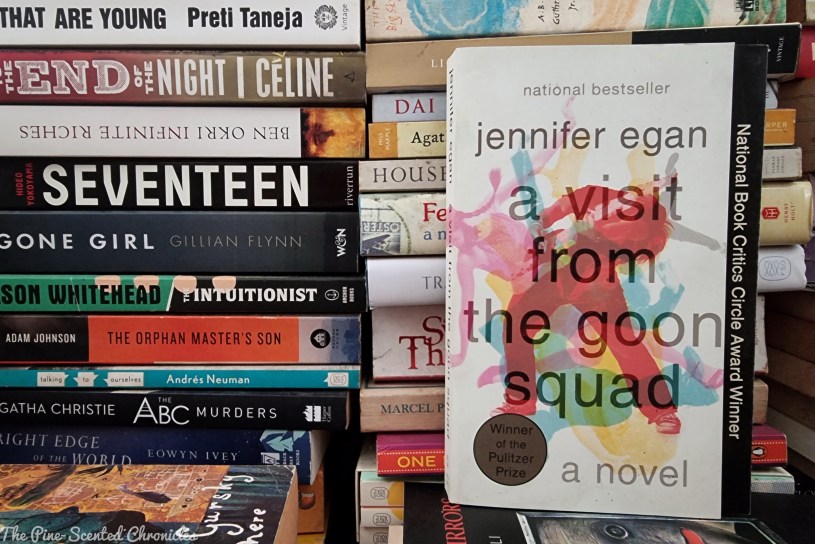
She also worked as a journalist, with her works occasionally published in the New York Times Magazine. She also wrote short stories which have appeared in prestigious publications such as New Yorker, Harper’s, Zoetrope: All-Story, and Ploughshares. By the time her first novel, The Invisible Circus – a novel inspired by her excursions across Europe while studying at St. John’s College – was published in 1995, Egan was already a well-established journalist. Her transition to full-length prose was smooth. Her sophomore novel, Look at Me (2001), was a finalist for the National Book Award. The Keep (2006) marked a change in direction in her storytelling. But in her oeuvre, one book stands tall. Published in 2010, A Visit from the Goon Squad further elevated Egan to global literary stardom.
“We stand there, quiet. My questions all seem wrong: How did you get so old? Was it all at once, in a day, or did you peter out bit by bit? When did you stop having parties? Did everyone else get old too, or was it just you? Are other people still here, hiding in the palm trees or holding their breath underwater? When did you last swim your laps? Do your bones hurt? Did you know this was coming and hide that you knew, or did it ambush you from behind?”
~ Jennifer Egan, A Visit from the Goon Squad
What distinguishes A Visit from the Goon Squad from Egan’s other works was its deviation from literary conventions. Defying traditional literary structures, Egan provided thirteen stories that were connected through recurring characters and themes. But as one sifts through the book’s layers, two main threads start to manifest. The first of these two threads charted the story of Sasha. In the book’s opening chapter titled Found Object, the readers meet her while she was on her first date with Alex. In the restaurant restroom, the thirty-four-year-old Sasha contemplated stealing the purse of a random woman. She would, later on, return the purse without any fuss but it underlined her compunction to take things that were not her own. She did, however, rationalize her act as a wanting to teach the woman a lesson. This only obscured a nagging reality that Sasha was grappling with.
“But this wish only camouflaged the deeper feeling Sasha always had: that fat, tender wallet, offering itself to her hand – it seemed so dull, so life-as-usual to just leave it there rather than seize the moment, accept the challenge, take the leap, fly the coop, throw caution to the wind, live dangerously (“I get it,” Coz, her therapist said), and take the fucking thing.”
As the story moved forward, details of Sasha’s past were slowly unveiled. She had a difficult childhood. She grew up in an abusive household in New York City. This eventually prompted her to run away when she was seventeen. She then traveled around the world, first to Asia then to Naples, Italy. After two years of traveling, she went back home and attended New York University (NYU). It was at NYU that she met Rob, a bisexual who would eventually be Sasha’s best friend and her “fake boyfriend”. Her college boyfriend was Drew but their paths diverged after a tragedy. Post-university, Sasha was an assistant for Bennie Salazar, a record company executive.
She was competent at her job but she was bored. It was in stealing that she found some semblance of thrill. She does not, however, profit from her illicit activity as she keeps the objects she steals as relics. Meanwhile, Drew became a doctor. He and Sasha would eventually reconnect years after attending NYU and rekindle their past romance. The novel’s second narrative arc chronicles the life of Bennie Salazar although when the readers first meet Sasha, she was no longer working for Bennie. Before becoming a record label executive, Bennie was a member of a band named Flaming Dildos, along with Scotty, Alice, Rhea, and Jocelyn.
The book’s third chapter, Ask Me If I Care, transported the readers to Bennie’s teenage years in 1980s San Francisco. The chapter detailed how the band came into existence. Bennie and Scotty were best friends but their friendship prematurely ended on a sour note. Years after the disbandment of the Flaming Dildos, Bennie has become a financially successful music executive. But despite his status, Bennie was plagued by insecurities. When the readers first meet Bennie, he was drowned by his anxieties. His life was slowly unraveling. His wife left him. He does not have a good relationship with his son Christopher. They were disconnected and were not able to communicate with each other. His music business was also falling apart. Life, as Bennie knew it, was falling apart.
“I looked down at the city. Its extravagance felt wasteful, like gushing oil or some other precious thing Bennie was hoarding for himself, using it up so no one else could get any. I thought: if I had a view like this to look down on every day, I would have the energy and inspiration to conquer the world. The trouble is, when you most need such a view, no one gives it to you.”
~ Jennifer Egan, A Visit from the Goon Squad
One of the book’s facets that stood out was its nonconformance to literary norms. This resulted in a longstanding discourse as to the book’s classification; after all, we have a proclivity to expound on things that upset the natural order of things. Is A Visit from the Goon Squad a collection of short stories or a novel? The writer herself was reluctant to classify it as either a novel or a short story collection. In writing the book, her goal was to avoid centrality. She wanted polyphony and polyphony it was. Literary history, after all, shows that genre-bending is not unnatural. Milan Kundera’s renowned work, The Book of Laughter and Forgetting, and even Italo Calvino’s If On A Winter’s Night A Traveller share this quality of not being bound by a specific literary genre. For readers who are not purists, such discussions rarely matter.
Each of the chapters that comprised the novel was narrated in different manners and from different perspectives. Out of Body, for instance, was narrated in the second-person point-of-view of Rob while the opening chapter was told in the third person from Sasha’s perspective. Another chapter, Great Rock and Roll Pauses by Alison Blake, was even presented as a PowerPoint presentation. The novel goads the readers to go beyond the limits of their imagination. For what is literature but to challenge these boundaries as we know it. These short stories also had no central characters, with Bennie and Sasha oftentimes peripheral. Nevertheless, more characters were introduced by these short stories and were, in one way or another, connected by an invisible thread.
Connection, and reconnection, indeed, were among the main themes of the novel. Lou Kline, a music producer in California, took in Bennie when he was a teenager as a protégé; his storyline also provided deeper insights into Bennie. Lou seduced Jocelyn who was loved by Scotty who dated Alice who Bennie had a crush on. Bennie eventually married Stephanie, a publicist working for Dolly. She was working on resurrecting the career of Bosco, a legendary rockstar in The Conduits. Jules Jones, Stephanie’s brother who was a celebrity journalist, was granted the sole right by Bosco to cover his farewell “suicide tour”. Jules was incarcerated for assaulting Kitty Jackson, a starlet, who was soon forced to take a job from Stephanie’s publicity mentor, Dolly. Dolly was working on improving the image of a genocidal Latin American tyrant. Alex, Sasha’s date in the opening chapter, would eventually be Bennie’s assistant. Lulu, Dolly’s daughter, will end up working with Alex. These various connections cast a vast web that can be convoluted. But it is this polyphony that also gave the novel its distinct texture.
As one goes through the story, the inevitable question arises: who is the titular “good squad”? This piques the readers’ minds further especially considering that Egan drew inspiration from the HBO series, The Sopranos. As one sifts through the novel’s several layers, it becomes palpable that there is no literal goon squad nor were there any mobsters. Soon enough, the identity of the titular goon squad was unveiled: time. At different points in the story, Soctty and Bosco said “Time’s the goon.” The novel reverberated with different instances of time. The novel itself was nonchronological, transporting readers across different periods, and even at one point, to the future. As time continually shifted, the characters’ tragic pasts and future disappointments rise to the fore.
“I felt no shame whatsoever in these activities, because I understood what almost no one else seemed to grasp: that there was only an infinitesimal difference, a difference so small that it barely existed except as a figment of the human imagination, between working in a tall green glass building on Park Avenue and collecting litter in a park. In fact, there may have been no difference at all.”
~ Jennifer Egan, A Visit from the Goon Squad
What makes time a goon? Time’s passage cannot be nipped. As such, it has the potential to both build and destroy. It can also cause anxiety, robbing us of our youth and innocence. The novel’s lush tapestry was woven with intricate details of these. Bennie, for instance, was anxious about aging. To defy the effects of aging on his body, Bennie took gold flakes in his coffee. Meanwhile, a character was dying of cancer while another character lied about her age in her dating profile. The changing tides brought about by the passage of time were also prevalent. When Lou and Bennie refused to conform to the changing landscape of the musical industry, they both suffered losses. Elsewhere, the profound search for happiness was explored. Some characters were able to find a semblance of happiness; hope springs eternal.
Even the changing dynamics of storytelling were also underlined with the chapter related primarily through PowerPoint presentation. Beyond time, music, particularly rock and roll music, played a seminal role in the story. While it was not the focus of the novel, it was a vessel used to further underline the changes brought about by time, mainly on aging and the loss of innocence. All of the novel’s elements were woven together by Egan’s capable storytelling. She was innovative and her vision made readers experience a wide array of emotions while, at the same time, challenging the limits of their imagination. While the story comes across as fragmented because of its unconventional structure, Egan’s brilliant storytelling and eclectic set of characters with complex personalities kept the readers engaged.
Winner of the prestigious Pulitzer Prize in 2011 and the National Book Critics Circle Award in 2010, A Visit from the Goon Squad is, without a doubt, a modern classic. It has also been cited by many literary publications as among the best works of fiction of the decade. In this genre-bending book that defied literary conventions, Egan explored a plethora of subjects such as loss of innocence, aging, human connections, disconnection, and memory. Time, the backbone of the story, is like a thief in the night that snatches everything we value: money, success, love, life, and even hope. Nostalgia also thrummed out in the story. A Visit from the Goon Squad, with its eclectic cast of characters and its shifting timelines, is a labyrinthine literary masterpiece capably engineered by one of the most innovative contemporary writers.
“Poets claim that we recapture for a moment the self that we were long ago when we enter some house or garden in which we used to live in our youth. But these are most hazardous pilgrimages, which end as often in disappointment as in success. It is in ourselves that we should rather seek to find those fixed places, contemporaneous with different years.”
~ Jennifer Egan, A Visit from the Goon Squad
Book Specs
Author: Jennifer Egan
Publisher: Anchor Books
Publishing Date: 2022 (June 8, 2010)
Number of Pages: 340
Genre: Literary, Postmodernism
Synopsis
Bennie is an aging former punk rocker and record executive. Sasha is the passionate, troubled young woman he employs. Here Jennifer Egan brilliantly reveals their pasts, along with the inner lives of a host of other characters whose paths intersect with theirs. With music pulsing on every page, A Visit from the Goon Squad is a startling, exhilarating novel of self-destruction and redemption.
About the Author
Jennifer Egan was born on September 6, 1962, in Chicago, Illinois but was raised in San Francisco, California. She attended Lowell High School. She dreamed of being an archeologist but she pursued English literature at the University of Pennsylvania. Post-university, she went to England to study at St. John’s College, Cambridge supported by a Thouron Award, where she earned an M.A. In 1987, she moved to New York City where she took on a wide array of jobs, including catering at the World Trade Center, while learning to write.
Egan’s literary career commenced with a series of short stories that appeared in prestigious publications such as the New Yorker, Harper’s, Zoetrope: All-Story, and Ploughshares. Her works of journalism were published in the New York Times Magazine. While studying at St. John’s, Egan traveled across Europe. It was these excursions that became the foundation for her first novel, The Invisible Circus (1995). The novel was adapted into a film in 2001. Emerald City (1996), a short story collection, was also inspired by her European travels.
More commercial and critical success followed with the publication of her sophomore novel, Look at Me in 2001. The book was a National Book Award finalist. In her third novel, The Keep (2006), Egan started to explore the limits of her storytelling by taking on a different direction Her fourth novel, A Visit from the Goon Squad, was effectively an extension of this shift. A Visit from the Goon Squad would also be Egan’s most popular work. It was awarded the 2011 Pulitzer Prize in Fiction and the 2010 National Book Critics Circle Award. Her fifth novel, Manhattan Beach, was published in 2017 and was awarded the 2018 Andrew Carnegie Medal for Excellence in Fiction. Candy House, a sequel to A Visit from the Goon Squad, was published in 2022.
Her 2008 story on bipolar children, The Bipolar Kid, won an Outstanding Media Award from the National Alliance on Mental Illness. Her 2002 cover story on homeless children received the Carroll Kowal Journalism Award. She was also the recipient of a Guggenheim Fellowship, a National Endowment for the Arts Fellowship in Fiction, and a Dorothy and Lewis B. Cullman Fellowship at the New York Public Library. She also served as president of PEN America.
Egan lives in Clinton Hill, Brooklyn with her husband and two sons.
 The Pine-Scented Chronicles