Finding Your Niche
The path to success, they say, is rarely straightforward. It is fraught with challenges, detours, and moments of doubt and uncertainties. The same can be said about Canadian writer Emily St. John Mandel’s journey before she finally made her literary breakthrough. Raised in Denman Island in the Canadian countryside, she was homeschooled until she was fifteen years old. Before pursuing a career in writing, she first dreamt of being a dancer. When she was eighteen, she left British Columbia for Toronto to pursue contemporary dance at The School of Toronto Dance Theatre on a scholarship.
After completing her studies, Mandel took on a variety of modestly paying jobs, such as working with independent choreographers, as an administrative assistant at a Manhattan law firm, and as an administrator at Rockefeller University. During her downtimes, she wrote on and off. She started writing her debut novel, Last Night in Montreal in 2002 while living in Montreal and working as a staff writer for The Millions, an online magazine. The novel was finally published in 2009. The response was decent but it barely made much of an impact. Two more novels followed, The Singer’s Gun (2010) and The Lola Quartet (2012).
Again, these two books achieved modest success. On the brink of giving up on her dreams of achieving literary success, she started working on Station Eleven. It was supposed to be a last-ditch attempt to break through the cutthroat world of writing. Lo and behold! Published in 2014, Station Eleven was an instant literary sensation, elevating Mandel to global recognition. The post-apocalyptic novel earned her several accolades, earning her nominations for the National Book Award, the PEN/Faulkner Award for Fiction, and the Baileys Women’s Prize for Fiction. The book was the winner of the Arthur C. Clarke Award and the Toronto Book Award.
“My point is, there’s always something. I think, as a species, we have a desire to believe that we’re living at the climax of the story. It’s a kind of narcissism. We want to believe that we’re uniquely important, that we’re living at the end of history, that now, after all these millennia of false alarms, now is finally the worst that it’s ever been, that finally we have reached the end of the world.”
~ Emily St. John Mandel, Sea of Tranquility
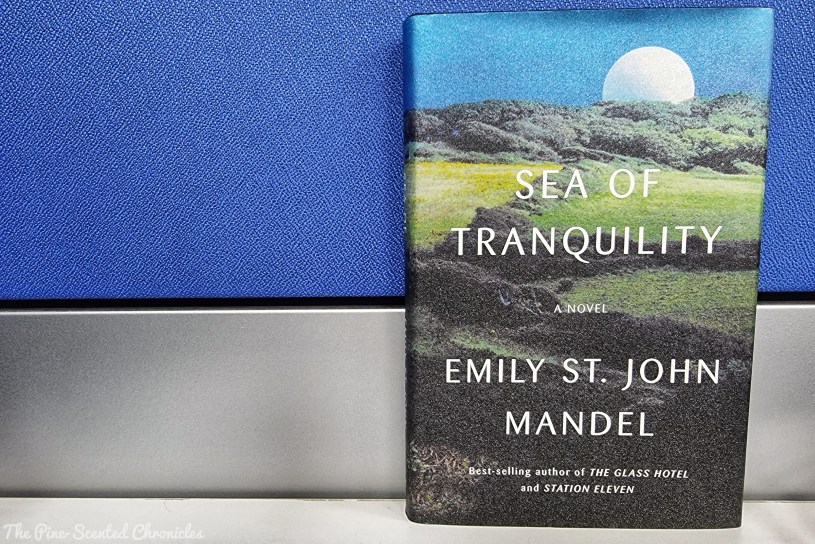
After publishing her fifth novel, The Glass Hotel in 2020, Mandel made her literary comeback in 2022. In what can be perceived as a return to form, Sea of Tranquility is a work of speculative fiction written during the height of the COVID-19 pandemic. Mandel’s sixth novel transported the readers across multiple time periods, with the story commencing in 1912 and introducing Edwin St. John St. Andrew, the youngest grandson of an English earl. Following criticism of the British Raj and colonial policies during a dinner party, Edwin was expelled from the family home and banished by his scandalized father.
Just eighteen years old, Edwin found himself alone in Canada as a remittance man. Remittance men refer to the prodigal sons of affluent and aristocratic British families who were sent to the colonies to prevent them from causing further trouble. They were sustained by the private income they received from their families. A drifter, Edwin traveled from coast to coast, from Halifax to Victoria, British Columbia. He then traveled to the fictional settlement of Caiette on Vancouver Island; Caiette was also the starting point of The Glass Hotel. While venturing into the woods, Edwin experienced an anomaly while underneath a giant maple tree. He felt like he was sucked into a vacuum where he heard a cacophony of sounds such as a violin and other inaudible sounds. Once out of the vacuum, Edwin came across a mysterious man named Roberts who questioned him about his unfathomable experience. Roberts retreated when Edwin caught on.
The story then jumped across time to the present, to January 2020. The readers again meet Mirella Kessler, the friend of The Glass Hotel’s Vincent Smith Alkaitis. The two friends drifted apart following a Ponzi scheme perpetrated by Vincent’s husband on Mirella’s husband. Mirella would cross paths with Vincent again when she attended a concert by Vincent’s brother, composer Paul James Smith. Upon catching up, Smith showed Mirella old footage of the same anomaly that Edwin witnessed; the video was taken by his sister. Smith also informed Mirella of his sister’s fate, devastating Mirella. Post-concert, a man named Gaspery-Jacques Roberts appeared and talked to Paul about the video. Mirella recognized having met him as a young girl in Ohio.
The mystery and intrigue would only deepen as the story moved forward. In the third part, a third character was introduced: Olive Llewellyn. Carrying on with the theme of time leaps, time moved further into the future. It was 2203 and Olive was born and raised in a Moon colony. When the readers first meet her, she is traveling around Earth for a weeks-long international book tour following the breakthrough success of her novel, Marienbad. Unbeknownst to her, while she was on tour, a pandemic was gripping the Earth. It was at this juncture that she crossed paths with a familiar name: Gaspery-Jacques. Interestingly, Gaspery-Jacques, now working as a journalist tasked to interview Olive, was also the first name of a character in Marienbad. One then begs the question, who is Gaspery-Jacques Roberts and why does he appear at uncertain times?
“When I wasn’t playing my violin in the airship terminal I liked to walk my dog in the streets between the towers. In those streets everyone moved faster than me, but what they didn’t know was that I had already moved too fast, too far, and wished to travel no further. I’ve been thinking a great deal about time and motion lately, about being a still point in the ceaseless rush.”
~ Emily St. John Mandel, Sea of Tranquility
Some of the answers were soon provided in the fourth part which focused on Gaspery. The year was 2401. He grew up near Olive’s house but was working as a hotel detective in another Moon colony. His sister, Zoey, was a physicist like their mother. She was currently investigating the phenomenon experienced by Edwin, Vincent, and Olive. While it was a confidential project, Zoey confided to her brother. This also piqued Gaspery’s interest, prompting him to want to investigate the anomaly. For years, he trained at the Time Institute, a government agency tasked with monitoring time travel. His training included learning about the three characters under record who experienced the anomaly. This is just the tip of the iceberg.
Sea of Tranquility derived its title from Mare Tranquillitatis, a lunar mare. It comes as no surprise that the moon is a recurring theme. However, the novel is, first and foremost, a pandemic novel. The COVID-19 pandemic marked the rise in pandemic novels such as Hanya Yanagihara’s To Paradise and Sequoia Nagamatsu’s How High We Go in the Dark. Sea of Tranquility, through the story of Olive, vividly captured the lockdown experience. We go through the motions of virtual meetings and school. We also get to relive the panic and the claustrophobic feeling of being stuck at home. Panic buying and stockpiling were also detailed in the story. It perfectly reminisced how it was to live during the height of the COVID-19 pandemic. Olive’s novel was also about a fictional flu pandemic.
In a way, Sea of Tranquility was a return to form for Mandel, a return to the niche that gained her global recognition. Details of speculative fiction enriched the tapestry of the novel; the novel further consolidated her status as one of the most promising voices of the genre. The most explicit exploration of this theme was time travel, a subject that is a staple in works of science fiction, whether in published text or in film. It is a phenomenon that is still a subject of debate, studies, and conspiracy theories. Further elucidation of the genre was captured in the novel’s incorporation of space travel, lunar colonies, and top-secret scientific organizations. During her lectures, Olive – who can be seen as an alter ego of the author – discussed the readers’ growing fascination with the genre.
In its integration of time travel elements, the novel explores the nature of reality and time. Gaspery, in his travels across the vast spectrum of time, often wondered what was real and what was not. Time traveling – this was, in itself a question of reality – also allowed him to explore different worlds that showed him different forms of reality, such as the natural world, i.e., the woodlands of Caiette, the simulated world, and the manufactured world. The last two worlds captured how the exponential advancement in the sciences and technology have complicated reality. As Gaspery realized, “How do you investigate reality?” Elsewhere, the story explores the consequences of our choices.
“It’s shocking to wake up in one world and find yourself in another by nightfall, but the situation isn’t actually all that unusual. You wake up married, then your spouse dies over the course of the day. You wake up in peacetime and by noon your country is at war; you wake up in ignorance and by the evening it’s clear that a pandemic is already here.”
~ Emily St. John Mandel, Sea of Tranquility
The worlds that Mandel conjured are quite fragmented and yet she was able to weave it together into a lush tapestry juxtaposed to an equally compelling background. While the subjects she tackled were fraught with technicalities typical in works of the genre, Mandel managed to explore them with deftness despite the shifting timelines which, at times, can be a bit of a challenge. Her adroit writing reels the reader in rather than pushes them back. Her writing captured the beauty of both the ordinary and the complex. The novel tackled grand themes but the minute details, from the understated beauty of a forest to the complex lunar colonies, elevated the story.
The recent spate of pandemic novels reminds us of our recent affliction. Sea of Tranquility is a welcome addition to this growing collection of pandemic novels. It contained vivid details of the pandemic experience. However, the novel goes beyond and above being a typical pandemic novel. Mandel’s sixth novel explored seminal subjects such as the nature of time and reality juxtaposed on space travel and advanced societies. Despite its grand subjects, the novel was, at its heart, a searing look at human experiences. The novel’s lush tapestry was subtly and astutely riddled with details of existentialism, loss, solitude, and the yearning for a sense of purpose. Sea of Tranquility was ambitious in scope but deft in execution. If Station Eleven established her as a new voice, Sea of Tranquility consolidated her status as one of the contemporary’s leading voices of speculative fiction.
“You write a book with a fictional tattoo and then the tattoo becomes real in the world and after that almost anything seems possible. She’d seen five of those tattoos, but that didn’t make it less extraordinary, seeing the way fiction can bleed into the world and leave a mark on someone’s skin.”
~ Emily St. John Mandel, Sea of Tranquility
Book Specs
Author: Emily St. John Mandel
Publisher: Alfred A. Knopf
Publishing Date: 2022
Number of Pages: 255
Genre: Speculative
Synopsis
Edwin St. Andrew is eighteen years old when he crosses the Atlantic by steamship, exiled from polite English society following an ill-conceived diatribe at a dinner party. He enters the forest, spellbound by the beauty of the Canadian wilderness, and suddenly hears the notes of a violin echoing in an airship terminal – an experience that shocks him to his core.
Two centuries later a famous writer named Olive Llewellyn is on a book tour. She’s traveling all over Earth, but her home is the second moon colony, a place of white stone, spired towers, and artificial beauty. Within the text of Olive’s best-selling pandemic novel lies a strange passage: a man plays his violin for spare change in the echoing corridor of an airship terminal as the trees of a forest rise around him.
When Gaspery Roberts, a hotel detective in the black-skied Night City, is hired to investigate an anomaly in the North American wilderness, he uncovers a series of lives upended: the exiled son of an earl driven to madness, a writer trapped far from home as a pandemic ravages Earth, and a childhood friend from the Night City, who, like Gaspery himself, has glimpsed the chance to do something extraordinary that will disrupt the time line of the universe.
A virtuoso performance that is as human and tender as it is intellectually playful, Sea of Tranquility is a novel of time travel and metaphysics that precisely captures the reality of our current moment.
About the Author
To learn more about Emily St. John Mandel, click here.
 The Pine-Scented Chronicles