
First Impression Friday will be a meme where you talk about a book that you JUST STARTED! Maybe you’re only a chapter or two in, maybe a little farther. Based on this sampling of your current read, give a few impressions and predict what you’ll think by the end.
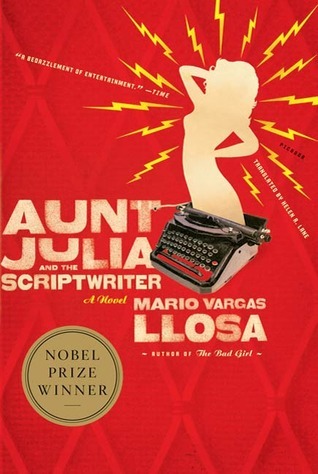
Synopsis:
Mario Vargas Llosa’s masterful, multilayered novel is set in the Lima, Peru, of the author’s youth, where a young student named Marito is toiling away in the news department of a local radio station. His young life is disrupted by two arrivals.
The first is his aunt Julia, recently divorced and thirteen years older, with whom he begins a secret affair. The second is a manic radio scriptwriter named Pedro Camacho, whose racy, vituperative soap operas are holding the city’s listeners in thrall. Pedro chooses young Marito to be his confidant as he slowly goes insane.
Interweaving the story of Marito’s life with the ever-more-fevered tales of Pedro Camacho, Vargas Llosa’s novel is hilarious, mischievous, and masterful, a classic named one of the books of the year by The New York Times Book Review.
Happy Friday everyone! That is another workweek in the books. I hope you were able to end the workweek on a high note. I hope you accomplished all the tasks you set at the start of the week. Compared to last week, this week was a little lax for me at the office even though I still have a lot on my plate due to the change in my role. Nevertheless, I am looking forward to the new things I will learn in my new role. Today is Friday the Thirteenth. Some superstitious people believe Friday the Thirteenth is ominous and abounds with misfortunes. Personally, I am grateful that today has been uneventful. However, I cannot say the same for the rest of the world, especially in the Middle East where the tension between Palestine and Israel escalates. I am one with the world in praying for a peaceful resolution to this conflict.
Gee, I just realized that we are nearly midway through October. How time flies. How has the year been, so far? I hope it has been kind. I hope it will even be kinder as it closes out. I hope that your hard work gets repaid before we turn in a new year. More importantly, I hope everyone is doing well, in body, mind, and spirit. With the end of the workweek comes the weekend. However, before I can fully enjoy the weekend, I will be capping the workweek with a fresh First Impression Friday. I am currently in the midst of a literary journey across Latin America. It has been two years since I last hosted one. Now, I am back and looking forward to an even more exciting journey although I am a little sad that it will be a short stay as I will be focusing on books in my reading challenges for the rest of the year.
My foray into Latin American literature has brought me to Peru, for the first time, with 2010 Nobel Prize in Literature awardee Mario Vargas Llosa’s Aunt Julia and the Scriptwriter. Vargas Llosa’s seventh novel, Aunt Julia and the Scriptwriter was first published in Spanish in 1977 with the title La tía Julia y el escribidor. Interestingly, this is my third novel by the Peruvian writer but this is the first time that he is taking me to his home nation; The War of the End of the World was set in Brazil while The Feast of the Goat was set in the Dominican Republic. Set in 1950s Peru, the novel was narrated by an 18-year-old university student named Marito Varguitas. Marito aspired to be a writer and was working at a radio station, Panamericana, writing news bulletins.
The object of his fancy was the titular Aunt Julia. They are not biologically related but she was the sister-in-law of one of Mario’s biological uncles, Uncle Lucho. Aunt Julia was thirty-two years old and was a divorcee. Following her divorce, she moved to Peru and moved in with Lucho and her sister, Olga. It was during one of his visits to his uncle’s house that Marito met Aunt Julia. He didn’t have a favorable impression of her at first. However, Marito’s opinion of Aunt Julia slowly changed the more time he spent at his uncle’s house. Mariot and Aunt Julia soon started going to the movies together, sparking a secret affair even though they were aware of the gap between their ages. They were also cognizant that Marito’s family would disapprove of their romance.
At around the same time that Mairot met Aunt Julia, he struck a friendship with Pedro Camacho, the titular Scriptwriter; I initially thought that Marito was the Scriptwriter. Pedro wrote radio serials. While Marito struggled to finish a compelling story, Pedro had no such trouble. Pedro is able to write scripts for up to 18 hours a day, daily. Pedro’s devotion and dedication to his craft were among the qualities that Marito admired in Pedro. Pedro’s storyline formed the second of seemingly two halves of the book. His part of the book was interspersed with discourses and details of the plots of Pedro’s radio serials. There were sexual overtones to some of these plots. Some were also witty and funny, rendering the novel different textures.
I can glean that while the novel packages itself as a romance story – an illicit love affair in its midst – the novel will explore the plights of writing and the nature of storytelling. It is going to be interesting to see how Vargas Llosa weaves all of these elements together into a cohesive piece. Aunt Julia, however, still feels like a cipher. She was an antithesis of Marito who was like an open book. I was just reminded how the novel’s long and descriptive paragraphs mirror that of the first two Vargas Llosa novels I read. He is a verbose writer, that is without a doubt. Not that I am complaining. Apparently, the novel borrowed elements from Vargas Llosa’s life. Parts of the novel were inspired by his first marriage to Julia Urquidi.
With under 200 pages more, I am looking forward to finishing the book over the weekend. How about you fellow reader? What book or books are you taking with you for the weekend? I hope you get to enjoy them. Again, happy weekend everyone!
 The Pine-Scented Chronicles