Of Beauty and Madness
There are times, countless in fact, in our existence when we just sit down or lie down and stare blankly into the oblivion before us. Amidst the silence that wraps itself around us, we find ourselves contemplating. A plethora of thoughts seize us, from the profound to the complex. We ruminate about the past. We reevaluate our actions in the present. We unconsciously fill our minds with anxieties about the uncertainties of the future. We philosophize. We reflect. We contemplate. At times, our minds lead us down labyrinths, places we normally wouldn’t find ourselves in. Questions fill our minds, prompting us to seek answers, may it be in our quotidian existence or in other convoluted realities.
While there are times that our compunctions lead us to trace the contours of our existence, there are times when our minds take us down familiar albeit less traveled alleys. Sure, we reflect on our lives in general. These momentary meanderings also make us observe our surroundings, cajoling us to take it all in the details. We notice tiny details, some invisible to the naked eye, and yet we notice them. We start to appreciate the beauty that surrounds us, from the subtle to the vivid, from the candid to the ostentatious. Undoubtedly, there is so much beauty surrounding us. However, we tend to forget about this beauty because of the ugly realities that surround us. If only we take the time to peel off these ugly layers that shroud beauty.
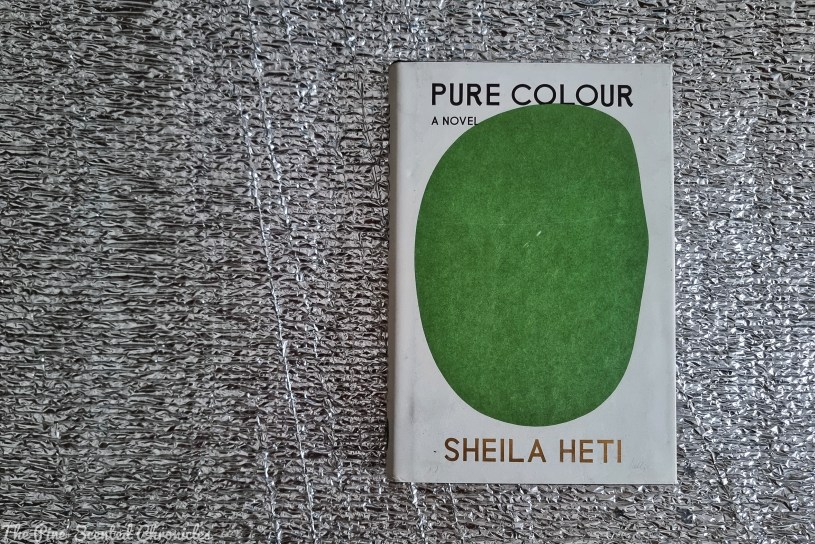
Beauty takes center stage in Canadian writer Sheila Heti’s newest novel, Pure Colour (2022). With an oeuvre that boasts plays, short fiction, and novels, Heti has established a reputation as one of Canada’s new literary stars; with a literary heritage that includes Nobel Laureate in Literature Alice Munro and multi-awarded icon Margaret Atwood, the future of Canadian literature is anything but assured. Heti made her literary debut in 2001 with the publication of The Middle Stories, a collection of short stories. Her breakthrough, however, came in 2010, with the publication of the novel How Should a Person Be? She has since gained momentum, building a credible literary career brick-by-brick. Pure Colour is an addition to this growing oeuvre.
“There is a ruthlessness to life. It seems to lack balance – and in its particulars it does. None of us is able to stand far back enough from life to see the balance that somehow exists. The child is never who the parent wants them to be, and they must not be. Even if a daughter accepts the lessons of her father, she will turn into a creature he didn’t expect. But that is entirely necessary. That is how the world changes, how values and criticisms evolve and change. A child must follow the rules of her own being. A parent can never truly understand and what those values or rules are. A child is an alien to the parent, which hurts the parent a little. The child’s whole life can feel like a betrayal. But life is not a betrayal of life.”
~ Sheila Heti, Pure Colour
Heti’s tenth book and latest novel commenced interestingly, albeit strangely enough as she elucidates on God and creation. “After God created the heavens and the earth, he stood back to contemplate creation, like a painter standing back from the canvas,” thus the novel opened. Heti then regaled the readers with her mythology of how God the universe through His vision. He was an artist who painted His “first draft” which is the world we are currently occupying. While He was proud of the aesthetic of His creation, it did not take long for Him to realize that His creation was flawed, prompting Him to go at creation a second time, “hoping to get it more right this time.“
This is where things get complicated, more complex, and perhaps more interesting. The second draft resulted in the creation of three critics in the sky: “a large bird who critiques from above, a large fish who critiques from the middle, and a large bear who critiques while cradling creation in its arms.” Each birthed eggs from which people were born. This strange division also defined the distinct personalities of each group. “People born from these three different eggs will never completely understand each other.” It is from these three highly distinct groups that the rest of the story is anchored. Among those who were sprouted from a bird egg was Mira, the novel’s central character. Her individual thread formed the other half of the novel and it ran parallel to the story of the creation.
In the opening pages of the novel, the readers are apprised of Mira. She was a young adult who was working in a store that sold “Tiffany lamps and other lamps made of coloured glass.” She then entered a college called the American Academy of American Critics. It was described as an elite school which accepts a very limited number of students. It was at the Academy that Mira’s life started to unravel. During a visit to a woman’s apartment with a group of friends, she met Annie, a standoffish orphan living above a bookstore. She immediately captured Mira’s fancy. It was the proverbial love at first sight and Mira can’t exactly explain how: “A person can waste their whole life, without even meaning to, all because another person has a really great face.”
The second seminal relationship that sustained Mira was her relationship with her ailing father. His death left a gaping hole in Mira’s existence. This was despite the fact that Mira was not capable of responding to her father’s bearish affections; her birdly qualities manifested. However, amongst her group of birds, Mira’s birdly qualities were superficial at best. For sure, her birdly qualities were a source of sorrow, confusion, and even frustration for Mira. Annie, who belonged to the group of fishes, was also unable to reciprocate Mira’s love. Annie’s fish qualities had her focus divided and was also strongly self-sufficient, a personality borne out of her orphanhood. Ironically, those born from the bird egg were described to be the most grateful.
“An artist is driven to make art by the spirit inside them, making an artwork like a signal or flare calling out, beckoning its kin to come near. This is why an artist never tires of their task. A bird finds it hard to attend to one person, and this is the reason why: because they have a desperate need – to create an aesthetic surface to put between themselves and the world, to make the spirits whole.”
~ Sheila Heti, Pure Colour
The death of Mira’s father was a major turning point in her life. While she was not particularly affectionate toward her father, Mira keenly felt her father’s absence. She was bereft, with her world feeling “stripped of any arrows, any direction, any sense.” It was also at this juncture that she underwent a transformation, with her father’s spirit entering her. After all, it is widely believed that a spirit never leaves a room as it occupies a place familiar to its memory. “Don’t think that in death you go far from the earth,” someone says; “you remain down here with everything—the part of you that loved, which is the most important part.” Their consciousness merges into a leaf in a manner that is not fully explained. If there was another quality that defined the novel was its abstract nature and concepts. It is this quality that distinguishes it from the conventional novel, thus, making it stand out.
In a way, the two consciousnesses getting trapped in a leaf was a form of metaphor. Like most of us, Mira bottled her sorrow, thus, it manifested in other forms. Grief and sorrow were among the subjects the novel grappled with. Indeed, beauty was at its forefront – interestingly, Mira gravitated more toward beauty than Annie – but Mira’s story confronts the reality that beauty also coexists with ugliness. As we grow up, it has been inculcated into us that we should learn to take the ugly with the beautiful. We should, rather we must learn to appreciate the ugly realities that surround us. These contrasts are constant, profound realities that wrap themselves around us. These are realities Mira and, consequently, we must deal with. There were insinuations, albeit vague, of incestuous abuse.
Mira’s leaf form occupies a major section of the novel. In the merging of two personalities, Mira’s thoughts meandered, leading her down toward alleys where she considered strange philosophical musings and conclusions. She contemplated art, exploring the nature of criticism; this comes as no surprise as Heti examined life from the perspective of an art critic. Beyond art and beauty, the novel explored the contours of consciousness. Love and God were also central subjects. Heti repeatedly reminds readers that the current world, filled with flaws, is His first draft and that a second draft is due. But despite its flaws, the first draft has its redeeming qualities. Heti takes the readers to a time just recent and yet long forgotten. It was a time when we appreciated simplicity, a time when life was bereft of the levels of toxicity that have pervaded every layer of our existence.
“Was there something wrong with her father’s spirit going into her after he died? More of what had oppressed her in her living? The life in him had always wanted to join her, and in his death, it finally did. For many years, his desire to be so close had been a bit of a problem, but in death it had become the most beautiful thing. In life, he had given her his entire life, but this had been a problem. In death, he had given her what remained of his life, and this was the most beautiful thing.”
~ Sheila Heti, Pure Colour
Pure Colour also vividly explored social and political concerns. She vividly captured our current realities, from the melting ice caps to the slow extinction of various species, among other socio-political concerns. Angry energy proliferated the atmosphere. People are envious and dropping dead in the streets of a new thing every day. Heti vividly captured how social media has taken the forefront of our lives, reminiscent of Patricia Lockwood’s No One Is Talking About This. We have become virtual citizens of the World Wide Web. It has come to dominate our lives. But social media are also windows to a world brimming with hate and conceit from strangers we never met: “There were so many ways of being hated, and one could be hated by so many people.”
Heti’s latest novel, however, is not a book that will suit everyone’s literary tastes. The novel really had no robust plot to speak of which can be a deal-breaker for literary purists. It was a book that does not pigeonhole itself among the typical. Pure Colour was more of a book of philosophical musings rather than a conventional novel. It was also not a character-centric story and it lacked dialogue. So what was it then? What came across was an abstract story related through episodes seminal in the primary character’s life. To her credit, Heti’s writing soared when she grappled with the abstract although she bordered on the maudlin. Nevertheless, the beauty of her language and writing complemented the philosophical nature of the story.
Receiving several accolades in Heti’s native Canada, Pure Colour is not your typical prose. It contains a strange mix of cosmic, philosophical, and mythological, explored through the story of Mira. Her musings covered a plethora of subjects ranging from grief to death to art to the dynamics of families. There were also implied sapphic elements. Each of these elements rendered the story a distinct landscape, enriched by the lyrical quality of Heti’s writing. With its eclectic mix and, at times strange musings, the novel coaxes its readers to examine the world around them, to consider large, even abstract questions. Pure Colour is an elusive but ambitious novel of ideas although, in certain portions, it crumbles under the weight of its ambitions.
“But doesn’t it all workout in the end, no matter which face you get? Yes, people with ugly faces can lead beautiful lives, and people with beautiful faces can lead ugly ones, and a beautiful face can draw you right down deep into the world’s greatest ugliness. But in the next draft of existence, they will not understand this; how one person’s beautiful face could pull another person deep into their greatest sorrow.”
~ Sheila Heti, Pure Colour
Book Specs
Author: Sheila Heti
Publisher: Alfred A. Knopf Canada
Publishing Date: 2022
Number of Pages: 216
Genre: Literary
Synopsis
Here we are, just living in the first draft of creation, which was made by some great artist, who is now getting ready to tear it apart.
In this first draft, a woman named Mira leaves home for school. There, she meets Annie, whose tremendous power opens Mira’s chest like a portal – to what, she doesn’t know. When Mira is older, her beloved father dies, and she enters the strange and dizzying dimension that true loss opens up.
Pure Colour tells the story of a life, from beginning to end. It is a galaxy of a novel: explosive, celestially bright, huge, and streaked with beauty. It is a contemporary bible, an atlas of feeling, and a shape-shifting epic. Sheila Heti is a philosopher of modern experience, and she reimagined what a book can hold.
About the Author
Sheila Heti was born on December 25, 1976, in Toronto, Canada to Hungarian Jewish immigrants. Heti attended St. Clement’s School and then studied playwriting at the National Theatre School of Canada; she left the program after a year. She then studied art history and philosophy at the University of Toronto. She graduated from North Toronto Collegiate Institute in Toronto.
Heti made her literary debut in 2001 with the publication of The Middle Stories, a collection of thirty short stories. In the same year, she founded the Trampoline Hall lecture series with Misha Glouberman. Her novella, Ticknor was released in 2005. While her earlier works received their fair share of recognition, it was her 2010 novel How Should a Person Be? that elevated her to global recognition. It was longlisted for the Women’s Prize for Fiction and was cited by Time as “one of the most talked-about books of the year.” She followed it up with The Chairs Are Where the People Go (2011) and a children’s book, We Need a Horse. Women in Clothes (2014) is a work of non-fiction about women’s relationship to what they wear.
Her 2018 novel, Motherhood, is autobiographical. It was shortlisted for the 2018 Scotiabank Giller Prize. It was also named by LitHub as a Favorite Book of 2018 and by the New York Times as a Critics Pick of 2018. Her 2022 novel, Pure Colour was also critically received. It was the winner of the 2022 Governor General’s Award for English-language fiction. Her latest book, Alphabetical Diaries is slated to be released in February 2024. She is the current Alice Munro Chair of Creativity at Western University in London, Ontario. In 2022, she was the Franke Visiting Fellow at Yale and an Associate Research Scholar and Lecturer in Religious Studies.
From 2010 to 2014, Heti served as Interviews Editor at The Believer magazine. Among her interview subjects were Joan Didion, Elena Ferrante, Agnes Varda, Sophie Calle, Alanis Obomsawin, Dave Hickey, Daveed Diggs, and John Currin. Her fiction and criticism have appeared in The New York Review of Books, The London Review of Books, Bookforum, n+1, The Paris Review, The New Yorker, Granta, and elsewhere. Heti is currently residing in Toronto.
 The Pine-Scented Chronicles