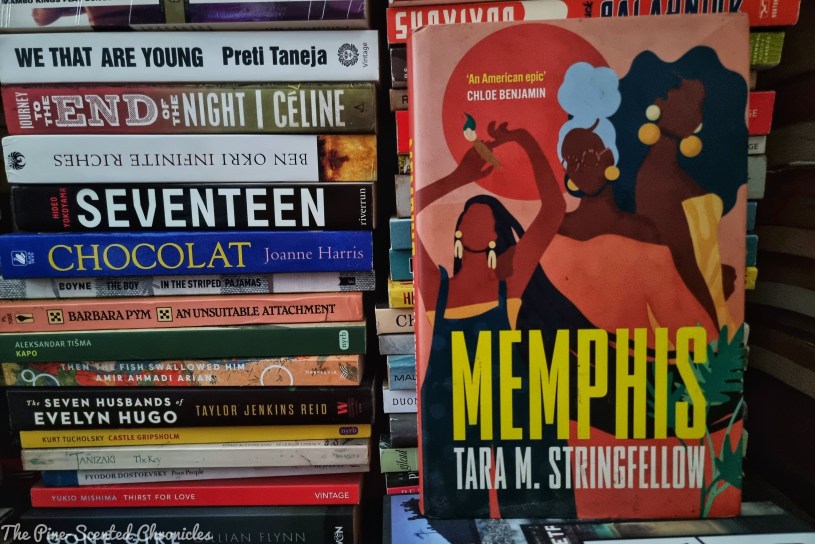
Strong, Independent Women in a Tumultuous World
Situated along the mighty Mississippi River is the fabled city of Memphis. Named after the ancient Egyptian capital city, Memphis (meaning “Place of Good Abode”) was founded on May 22, 1819, on land previously inhabited by Chickasaw Indians. The Chickasaw ceded their Western Tennessee territory to the United States after signing the Treaty of Tuscaloosa, signed in October 1818 and ratified by Congress on January 7, 1819. Among the city’s founders was Andrew Jackson who would eventually be elected as the seventh president of the United States. It didn’t take long for the city to hit the ground running. From a quaint frontier town, the city rapidly grew, its expansion inevitably tied up with the exponential growth of the cotton growing industry in the South.
Memphis’ strategic location also made it a critical transportation and logistics hub. It is a railroad hub. Its international airport is the second busiest cargo airport in 2021. The International Port of Memphis is the fifth busiest inland port in the United States. All of these contributed to Memphis becoming the second-largest city in Tennessee and twentieth in the entire country. Beyond this, the city is also renowned for its historic music scene. The city has become synonymous with Elvis Presley. The late singer’s estate, Graceland, is situated in the city and is a major attraction. Beale Street, home to several blues clubs, is another major tourist drawer. The famed Beale Street is the birthplace of the unique Memphis blues sound, earning the city its moniker, Home of the Blues.
But Memphis has not only been critical in the region’s economic growth and its cultural significance. The home to Tennessee’s largest African-American population, the city has played a seminal role in the region’s, and consequently, the country’s racial history. In the mid-19th century, thousands of enslaved African Americans were sold at the market owned by Nathan Bedford Forrest; he would eventually become the first Grand Wizard of the Ku Klux Klan. During the height of the American Civil Rights Movement, the city again played a seminal role. In support of the city’s maintenance workers’ strike, Martin Luther King Jr. went to Memphis and preached “I’ve Been to the Mountaintop.” The day after delivering his speech, Martin Luther King Jr. was killed on the balcony of the Lorraine Motel by a sniper’s bullet. The motel became the National Civil Rights Museum in 1991.
“I had always coveted darker-skinned women their color. There was a mystery to their beauty that I found hypnotizing, Siren-like. They were hardly ever in Jet or Ebony or Essence, the magazines we subscribed to, unless they themselves were famous—the mom from The Fresh Prince of Bel Air, Whoopi Goldberg, Jackie Joyner, Oprah. Most of the Black women the public pronounced beautiful looked like Mama. Black Barbies. Bright. Hair wavier than curly. Petite figures.”
~ Tara M. Stringfellow, Memphis
It is upon this lush backdrop – enriched by details of her own family’s history – that Tara M. Stringfellow juxtaposed her debut novel, Memphis. At the heart of the novel was an African-American family, the Norths. Spanning almost seven decades, from the years shortly before the Second World War to the war in Afghanistan, the novel charted the trials and tribulations of the family, primarily through three resilient matrilineal generations. Moving from one perspective to another of these women – the family’s matriarch, Hazel; her daughters, Miriam and August; and her granddaughter Joan – the novel also captures how their fortunes were connected with the story of the city and the country they were living in.
The novel opened in the summer of 1995 when Miriam returned to her ancestral home which was now occupied by her sister, August, and August’s son, Derek. Along with her, Miriam brought her two daughters: ten-year-old Joan and seven-year-old Mya. Miriam. In returning to her childhood home, she was hoping to secure her children’s future and safety. Her arrival in her childhood home also provided Miriam with the opportunity to reconnect not only with her sister but also with her maternal roots. The arrival of Miriam and her reunion with her sister marked the commencement of the most important section of the novel: the eight years that they all lived together under one roof.
As the story moved forward to the future, it also traveled back to the past; the novel was non-linear and weaved in and out of different timelines, sometimes without a preamble. In traveling to the past, Stringfellow provided more details about the characters and what made them tick. The readers first meet the matriarch, Hazel, in 1937, when she was still sixteen. Like her mother, she became a quilter and eventually fell in love with Myron. Born in the 1920s, Myron served during the Second World War. Upon his return to the city of his birth, he became the city’s first Black homicide detective. By hand, Myron built the family’s ancestral home “that spanned out in all directions in a wild, Southern maze” located in the historically Black neighborhood of Douglass.
The family’s ancestral home would form the core of the story, bearing witness to the bevy of events and changes that swept the family with time. It bore witness to the growth of the characters, of them forming their own dreams. Hazel’s dream was to live a long and stable life with the love of her life. It was a dream her daughter Miriam shared. The novel charted how she fell in love with Jaxon, a war veteran who, on the surface, seemed like the perfect husband material. As a mother, she wanted to create a safe space for her daughters while pursuing her own professional endeavors. August, on the other hand, was a stubborn but loyal sister. She was also a talented singer who was, in the present, running a hair salon adjacent to their home.
“I didn’t want that, either — poverty and the shame it brings — but I was willing to risk being chronically poor the rest of my life so that I could draw. Art mattered more to me than anything else. If there was a chance I could make it work, that I might make a living off it, however meager, I had to try.”
~ Tara M. Stringfellow, Memphis
In stark contrast, the house also witnessed the crosses that the characters had to bear. We read about the personal tragedies that would haunt them during their lifetime. Hazel, for one, found herself a widow with two daughters in tow after Myron was lynched. One character was the victim of domestic violence. Another character was sexually abused when she was barely a child while another made several sacrifices for her emotionally damaged child. The beauty that was initially promised was stained by death, violence, and absence. But it is in these dire moments that the women of the North family found their strength. The novel, in the absence of a robust plot, transforms into a vivid character study that draws the readers into the world of the four women.
Hazel, Miriam, August, and Joan all demonstrated indomitable strength in the face of adversity. At its heart, the novel was about resilience and finding the voice to succeed in a world fraught with trauma and tragedy. The four women found strength from within. Following the untimely demise of her husband, Hazel worked hard and became Mount Zion Baptist Hospital’s first African-American nurse. Despite the odds, she was able to raise her two daughters while, at the same time, establishing stability in a period of racial strife. Miriam, on the other hand, was able to muster the courage to finally flee from North Carolina where she spent most of her married life. In running away from North Carolina, she was also getting away from the horrors that beset her.
For Joan, confronting her past trauma – with the story vacillating across timelines, memories play a prominent role – entailed finding beauty in other pursuits. Through art, she was able to process some of the trauma she experienced growing up. She was a talented visual artist whose talent was praised by her teachers. However, she lacked confidence in her own abilities, doubtful of the prospects of success in her chosen field. Meanwhile, her mother had other aspirations for her. Miriam wanted her eldest daughter to be a doctor, believing that in pursuing being a doctor, Joan would never rely on the help of men. A stereotypical argument ensued between mother and daughter: “Name me one successful artist with a dark face. With breasts. Name one Black woman famous artist. Go on. I’ll wait.”
The individual stories of the four women were interwoven with the history of the city upon which the book earned its title. Stringfellow evoked a sense of place, subtly but brilliantly making Memphis a seminal character in the story. The Black neighborhoods came alive with every stroke of Stringfellow’s prose. She made readers walk down its streets and alleys, and experience its atmosphere. The smell of food permeated the air. The readers stepped into salons where women did not only have their hair fixed but also caught up with each other. The streets were teeming with violence. The locals experience systemic racism and discrimination. Still, it was a community that did not hesitate to come together in the light of a tragedy. We read about beauty and joy derived from the quotidian.
“It’s a sight, ain’t it? And after all these years, I can’t get used to it. Mountains. How did they even come to be? Sometimes I sit in that shop all day wondering. Don’t make no sense to me how a fella can question the existence of God waking up to mountains like that every morning. All the proof I need.”
~ Tara M. Stringfellow, Memphis
Stringfellow’s impressionistic writing captured a city whose landscape was slowly transforming. The history of Memphis was brilliantly imbibed into the stories of the characters. Important and pivotal historical events such as the assassination of Martin Luther King Jr., the September 11 attacks, and the war on Afghanistan provided mantles upon which the characters examined themselves. These historical events underlined a history that was riddled with violence and brutality where justice is but a concept. These themes, however, were not limited to Memphis as they resonate on a national scale. Elsewhere, a narrative arc was a redemptive story of forgiveness and an engrossing coming-of-age story.
All of the novel’s wonderful elements were woven together by Stringfellow’s beautiful language and evocative storytelling. She redeemed the lack of a robust plot with the quality of her storytelling. Her writing and language were lyrical and beautiful, offshoots of her original poetic endeavors. Her debut novel was also an affectionate character study that draws the readers into the world of the four women. As the novel oscillated between the different perspectives of the characters, Stringfellow evocatively captured their psychological profiles. There were, however, plotholes that undermined the story. The scrambled chronology poses a challenge. With the fixation on resilience, Stringfellow was not fully able to address the complications and lasting marks that sexual abuse and incest can leave on the victims.
In her debut novel, Stringfellow, through the stories of four resilient women, captured the intricacies of African-American culture, painting beauty that was stripped by life’s brutality. Deceptively thin, the book examined seminal subjects such as systemic racism, trauma, domestic violence, and sexual abuse. Interspersed were a redemptive story of forgiveness, the wonderful albeit complicated relationships between women, and family dynamics. Amidst all of this, Stringfellow’s storytelling flourishes, breathing life not only into her fully realized characters but also into the city that bore witness to some of the most historic events in recent memory. Parts family saga, parts historical fiction, and parts coming-of-age story, Memphis is a multifaceted story about women, a group of people, and the city they keep finding themselves going back to.
“ The anger I had felt for years at my father was what I had had instead of him. It was all I had of him. So, I carried it with me always, like a rose quartz in my palm. And it was slowly disappearing, my quartz. Growing tiny. I was hardly feeling the rough edges of it anymore. I realized, as time passed in the kitchen, the grandfather clock in the parlor having sung its swan song three times now, that love was wearing me down. Love, like a tide, just washing over and over that piece of rock. And I believed that only God — and maybe Miss Dawn — could change a tide.”
~ Tara M. Stringfellow, Memphis
Book Specs
Author: Tara M. Stringfellow
Publisher: John Murray
Publishing Date: April 27, 2022
Number of Pages: 245
Genre: Historical, Literary
Synopsis
Joan was only a child the last time she visited Memphis. She doesn’t remember the bustle of Beale Street on a summer’s night. She doesn’t know she’s as likely to hear a gunshot ring out as the sound of children playing. How the smell of honeysuckle is almost overwhelming as she climbs the porch steps to the house where her mother grew up. But when the front door opens, she does remember Derek.
This house full of history is home to the women of the North family. They are no strangers to adversity; resilience runs in their blood. Fifty years ago, Hazel’s husband was lynched by his all-white police squad, yet she made a life for herself and her daughters in the majestic house he built for them. August lives there still, running a salon where the neighbourhood women gather. And now this house is the only place Joan has left. It is in sketching portraits of the women in her life, her aunt and her mother, the women who come to have their hair done, the women who come to chat and gossip, that Joan begins laughing again, begins living.
Memphis is a celebration of the enduring strength of female bonds, of what we pass down, from mother to daughter. Epic in scope yet intimate in detail, it is a vivid portrait of three generations of a Southern black family, as well as an ode to the city they call home.
About the Author
Tara M. Stringfellow was born in 1985 on a military base near Kansas City, United States. When she was ten years old, she moved to Tennessee as her family was stationed in Japan. In 2003, Stringfellow started attending Northwestern University where she earned a Bachelor of Arts, in English Language and Literature/Letters. In 2010, she enrolled at Chicago-Kent College of Law, Illinois Institute of Technology where she studied Doctor of Law and Family Law. In 2015 she went to Northwestern University and received a Master of Fine Arts in creative writing.
Prior to pursuing a career in writing, Stringfellow worked as a Law Clerk at the Law Offices of Michael R. DiBenedetto, a 7-11 Law Clerk with the Office of the Public Guardian-Domestic Relations Division in Chicago, an Associate Attorney for Robert J. Semrad and Associates LLC, and as a Real Estate Specialist/Attorney at Law at Crown Castle. She started writing poetry when she was still at school. In 2008, her first collection of poetry entitled More than Dancing was published. Her poems have appeared in Collective Unrest, Jet Fuel Review, Minerva Rising, Women’s Arts Quarterly, Transitions, and Apogee Journal, among others.
In 2022, she published her debut novel, Memphis. Stringfellow was nominated twice for the Pushcart Prizes, as well as Best of the Net. She also taught English at Shelby County School and at KIPP Memphis Collegiate Schools. In 2017, she worked as a Writer for Penguin Random House. She divides her time between Memphis and Italy.
 The Pine-Scented Chronicles