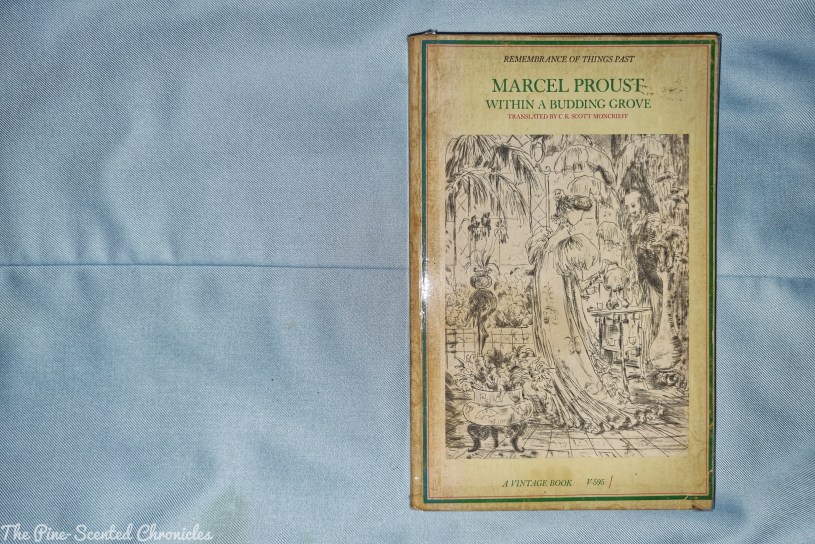
Of Romantic and Sexual Awakening
In the world of literature, the contributions of French literature can never be underestimated. It has a long-standing tradition of gifting the world with literary masterpieces. Some of the world’s most revered literary masterpieces that have transcended time and even geographical boundaries were written by French writers. These books, including Victor Hugo’s Les Miserables, Alexandre Dumas’s The Three Musketeers, Antoine de Saint-Exupéry’s The Little Prince, and Gustave Flaubert’s Madame Bovary, among others, remain relevant in the contemporary. The passage of time did little to dim their lights. Their influences can never be exaggerated as they are integral parts of present-day literary discourses, whether in French literature or literature in general.
Another influential work of French literature is À la recherche du temps perdu, a literary masterpiece that stands in the vaunted halls of literary classics. Shortly referred to in French as La Recherche, it is easily one of the most revered titles in French literature and was written by Valentin Louis Georges Eugène Marcel Proust, more popularly known as Marcel Proust. The book is divided into seven volumes with a page count that totals a whopping 3,200. The first six volumes were first translated into English by C.K. Scott Moncrieff who gave the novel the title Remembrance of Things Past. The task of translating the seventh book was taken by other translators after Moncrieff’s untimely demise. The book was later revised and the title changed to In Search of Lost Time, the literal translation of the book’s French title.
However, the success and popularity that Proust and his magnum opus was not done overnight. The road to the zenith is fraught with challenges, as he would eventually learn. Du Côté de chez Swann (Swann’s Way), the first of the seven volumes, was rejected by several publishers before it was finally published in 1913. Publishers and literary pundits, including Nobel Laureate in Literature André Gide, were not convinced about the potential of the book. They were in for a surprise. Left with no other recourse, Proust personally financed the publication of the book. As the old adage goes, the rest was history. It was a literary sensation and even the naysayers were prompted to apologize for their refusal. Gide personally wrote a letter to Proust, apologizing for his role in the refusal of the publishers, calling it one of the most serious mistakes in his life.
“In the case of the solitary, his seclusion, even when it is absolute and ends only with life itself, has often as its primary cause a disordered love of the crowd, which so far overruled every other feeling that, not being able to win, when he goes out, the admiration of his hall-porter, of the passers-by, of the cabman whom he hails, he prefers not to be seen by them at all, and with that object abandons every activity that would oblige him to go out of doors.”
~ Marcel Proust, Within A Budding Grove
But just when Proust expected smooth sailing, turbulence over the horizon threatened the publication of the second book in the septet. The onset of the First World War was a huge setback for Proust. This unexpected development prompted him to push back the publication of À l’ombre des jeunes filles en fleurs. The book was eventually published in 1919. It was an immediate literary sensation, further elevating Proust to literary stardom. The book even earned Proust the highly coveted Le prix Goncourt (The Prix Goncourt), considered the most prestigious and popular French literary award. The original English translation of the book carried the title Within a Budding Grove. Succeeding translations carried the title In the Shadow of Young Girls in Flower the literal translation of the book’s French title.
Within a Budding Grove picks up from where the first volume ended. The narrator – widely accepted by pundits as the author himself – has now grown up. There was a swift but noticeable change in Marcel’s perspective of the world. He has now ditched the innocent lenses from which he captured the first volume; the first volume was brimming with musings from his childhood, including his interests, his family, and even his health. One thing, however, has not changed: his fascination for the Swanns. The first of the two parts comprising the book, titled Madame Swann at Home, was essentially a continuation of the concluding pages of Swann’s Way. At the end of the first volume, Marcel forged a friendship with Gilberte, the daughter of Odette de Crécy and Charles Swann. Because of this growing friendship, Marcel became a regular attendee at the Swanns’ home in Champs-Élysées.
Marcel becoming a part of the Swanns’ social circles was the realization of an aspiration; there was a section in the second volume where he ruminated on his desire to get to know the Swanns when he was younger. The first part of the book was essentially an extension of the first book in the septet. Marcel, both the writer and the narrator, takes the readers into the heart of the Parisian bourgeoisie. In this new world, Mme. Swann turned into a popular hostess whose invitation list included marquee names such as Mme. Bontemps. For his part, Charles boasted about his wife and her success. It was Charles’ desire for the aristocracy to welcome his Odettem once excluded from high society. Meanwhile, Marcel’s feelings for Gilberte were starting to take a firmer shape; he was falling in love. However, her parents do not trust Marcel around and for their daughter.
Despite her parents’ disapproval, the book’s hero endeavored to win Gilberte’s affection. However, the more interest he showed in her, the more that she pushed him back. She was growing irate at his attention and his presence; with the passage of time came a change in their relationship. A quarrel ensued, creating a chasm between the two friends. As fate would have it, their paths diverged. To preserve his peace, he decided to step back. He, nevertheless, still hoped for a reconciliation. Two years later, Marcel and his grandmother and Françoise, her faithful, stubborn maid, traveled to the seaside town of Balbec. One of Marcel’s childhood dreams was visiting Balbec. The journey commenced in the second section of the book, Place-Names: The Place.
“It comes so soon, the moment when there is nothing left to wait for, when the body is fixed in an immobility which holds no fresh surprises in store, when one loses all hope on seeing–as on a tree in the height of summer one sees leaves already brown–round a face still young hair that is growing this or turning gray; it is so short, that radiant morning time, that one comes to like only the youngest girls, those in whom the flesh, like a precious leaven, is still at work.”
~ Marcel Proust, Within A Budding Grove
During his stay at Balbec, Marcel’s understanding of the complexities of social conventions started to shape up. Friendship, including the oft-called friendship with benefits, was the leitmotif of the novel. It was in Balbec that Marcel got acquainted with some members of the aristocracy. They encountered Marquise de Villeparisis, an old friend of Marcel’s grandmother. Mme. de Villeparisis was soon joined by her great-nephew Robert de Saint-Loup, an army officer. Their small group was soon disturbed by the arrival of Palamède, Baron de Charlus, Robert’s unruly and eccentric uncle. Marquise de Villeparisis, Robert, and Baron de Charlus, Marcel would later learn, all descended from the distinguished aristocratic Guermantes family. Robert and Marcel would strike up a friendship. Finding himself immersed in the circles of an elusive circle brought delight to Marcel. Marcel’s old friend Albert Bloch and his family also traveled to Balbec.
The novel, however, went beyond exploring basic social dynamics. The world of aristocrats was one layer of the novel but it was another group that caught Marcel’s attention. He became infatuated with a “group “little band” of girls strolling on the seaside that captured his fancy: “As in a nursery plantation where the flowers mature at different seasons, I had seen them, in the form of old ladies, on this Balbec shore, those shriveled seed-pods, those flabby tubers, which my new friends would one day be. But what matter? For the moment it was their flowering time.” In another scene, a group of country girls alongside the road aroused in him different emotions. As such, the literary microscope placed the highlight on both Marcel’s romantic and sexual awakenings. The girls he met in Balbec were catalysts in his development as a lover, particularly when he started orbiting their circle.
Through his friend Elstir, a painter first as a foolish young man belonging to Madame Verdurin’s “little clan” in Swann’s Way, introduced Marcel to one of the girls he was acquainted with. Elstir introduced Marcel to Albertine Simonet, a dark-haired beauty. Albertine, who was mentioned in passing in Swann’s Way, was the niece of Mme. Bontemps. Marcel and Albertine struck a friendship; Marcel also became friends with her friends Andrée, Rosemonde, and Gisèle. The quartet frequented the countryside. Meanwhile, Marcel found himself soaked in his musings; philosophical intersections abounded in the book. He reflected on the nature of love. It is the second volume that Marcel’s theories on love started to develop: “This is not to say that a genuine love, if we have one, cannot survive in such conditions. But we feel so unmistakably, as though in a new atmosphere, that unknown pressures have altered the dimensions of that sentiment that we can no longer consider it in the old way.”
Love as probed by Marcel, however, was not limited to romantic love. The understated love that existed between a grandparent and a grandchild was subtly and repeatedly underlined in scenes between Marcel and his grandmother. While love can be obsessive, it can be complicated and cruel too, as Marcel would experience. He also realized that we keep on falling in love with the same image over and over again. Take the case of the girls of Balbec. They evoked a sense of nostalgia, reminding Marcel of someone; memory is one of the primary themes of Remembrance of Things Past and it was also prevalent in Within A Budding Grove. It is soon palpable that Marcel saw in them reflections of Gilberte. They aroused in him the same yearning and romantic inclinations he felt toward Gilberte. It was still the same kind of love but over a different package. It was practically a futile search of a lost time.
“Sunrise is a necessary concomitant of long railway journeys, just as are hard-boiled eggs, illustrated papers, packs of cards, rivers upon which boats strain but make no progress. At a certain moment, when I was counting over the thoughts that had filled my mind during the preceding minutes, so as to discover whether I had just been asleep or not (and when the very uncertainty which made me ask myself the question was about to furnish me with an affirmative answer), in the pale square of the window, above a small black wood, I saw some ragged clouds whose fleecy edges were of a fixed, dead pink, not liable to change, like the colour that dyes the feathers of a wing that has assimilated it or a pastel on which it has been deposited by the artist’s whim.”
~ Marcel Proust, Within A Budding Grove
Proust’s reflections, however, were neither absolute nor perfect. His discourses are debatable but he did a remarkable and convincing job of crafting his arguments that one can hardly disagree with his musings. Every detail was beautifully observed and wonderfully captured by Proust’s descriptive writing. Balbec and the sea came alive with Proust’s descriptions; they provided contrasts to the more tedious sections of the book. Proust was resplendent in capturing domestic scenes such as parties and sunsets. Interspersed amongst Marcel’s deep ruminations were moments of humor and wit. He also did an astounding job of laying out the details of the development of every facet of a person, from love to self-awareness.
A seminal facet of the book was Marcel’s beliefs and appreciation of the nature of the arts. Over the course of the story, it was built, shattered, and reinforced. The painter Elstir, whom he became friends with in Balbec, played a key role in the development of Marcel’s aesthetic sense. Elstir, a naturalist, was able to make Marcel appreciate the beauty of nature, such as the sunset and the sea. Meanwhile, Marcel’s writing endeavors still stumbled upon an obstacle: his waning motivation. Nevertheless, through the Swann’s social circles, he became acquainted with Bergotte, a renowned writer whom Marcel admired since he was a child. However, his encounter with his literary hero came with disillusionment. He was far from the man he imagined him to be. His disappointment was a human reflex action.
Within A Budding Grove was no easy read; Proust was not only a descriptive writer but he was also a verbose one. It commanded the readers’ full attention, the same way that Swann’s Way did. Gone was Marcel’s innocent gaze. In its stead is a growing awareness of the realities of the world. His coming-of-age is slowly taking shape. He experiences romantic love and its extremes, obsession. Along with it is his sexual awakening; woven into the story were subtle homosexual overtures. Not only was his emotions taking a firmer shape, but also his appreciation of the arts. Negative emotions, such as rejection and disillusionment, were also woven into the lush tapestry of the book. Proust’s vivid portrait of French society further underlined his impressionistic talent. Within A Budding Grove was a resplendent sequel to the first book.
“When we are in love, our love is too big a thing for us to be able altogether to contain it within us. It radiates towards the beloved object, finds her a surface which arrests it, forcing it to return to its starting-point, and it is this shock of the repercussion of our own affection which we call the other’s regard for ourselves, and which pleases us more than on its outward journey because we do not recognise it as having originated in ourselves.”
~ Marcel Proust, Within A Budding Grove
Book Specs
Author: Marcel Proust
Translator (from French): K. Scott Moncrieff
Publisher: Vintage
Publishing Date: February 1970 (1919)
Number of Pages: 386
Genre: Literary, Coming-of-age
Synopsis
“First published in 1919, Within a Budding Grove was awarded the Prix Goncourt, bringing the author immediate fame. In this second volume of Remembrance of Things Past, the narrator turns from the childhood reminiscences of Swann’s Way to memories of his adolescence. Having gradually become indifferent to Swann’s daughter Gilberte, the narrator visits the seaside resort of Balbec with his grandmother and meets a new object of attention—Albertine, “a girl with brilliant, laughing eyes and plump, matt cheeks.” (Source: Goodreads)
About the Author
To learn more about the French writer Marcel Proust, please click here.
 The Pine-Scented Chronicles
📖
LikeLike