Another Feline Journey
As one journeys across Japanese literature, it is impossible not to take note of the prevalence of cats in the works of Japanese writers. There is seemingly a symbiosis between cats and Japanese literature. Cats are a familiar presence in the Japanese literary landscape. The devout readers of works of Japanese literature have, at any point in time, encountered at least one of these works. Perhaps one of the most recognized titles is Natsume Sōseki’s I Am a Cat (吾輩は猫である, Wagahai wa Neko de Aru) which many a literary pundit considers one of the foundations of contemporary Japanese literature. It also played a key role in the advent of cat literature as it was eventually succeeded by other books that featured cats.
Recently, more Japanese writers have become enamored by the stoic four-legged creature. Cats featured prominently in Takahashi Hiraide’s The Guest Cat (猫の客, Neko no kyaku), Sōsuke Natsukawa’s The Cat Who Saved Books (本を守ろうとする猫の話, Hon o mamorō to suru neko no hanashi), and Genki Kawamura’s If Cats Disappeared from the World (世界から猫が消えたなら, Sekai kara Neko ga Kieta nara). Even Haruki Murakami, perhaps the most globally recognized of the living Japanese writers, is known to include cats in his works. There is certainly a growing love affair between Japanese writers and cats. It has withstood the test of time; the passage of time only strengthened this bond.
Another Japanese writer who recently lent her voice to this growing literary movement is Hiro Arikawa. She made an international breakthrough in 2019 when her 2012 novel, 旅猫リポート (Tabi neko ripōto) was made available for anglophone readers as The Travelling Cat Chronicles. With its equally heartwarming and heartbreaking story, The Travelling Cat Chronicles easily made its way into the hearts of thousands of readers across the world, whether they love animals or not. It earned words of praise from both readers and critics alike. The novel not only elevated Arikawa to global literary stardom but it also established her name as one of the up-and-coming Japanese writers to watch out for.
“The kind of story where you relied on others – where someon else was sure to rescue the kitten if you didn’t – that would never make a convincing manga. It was the mindset of a person who’d take the initiative and crush the box. A person who wasn’t a hero would have nothing to do with the tangerine box and would therefore not discover the kittens inside.”
~ Hiro Arikawa, The Goodbye Cat
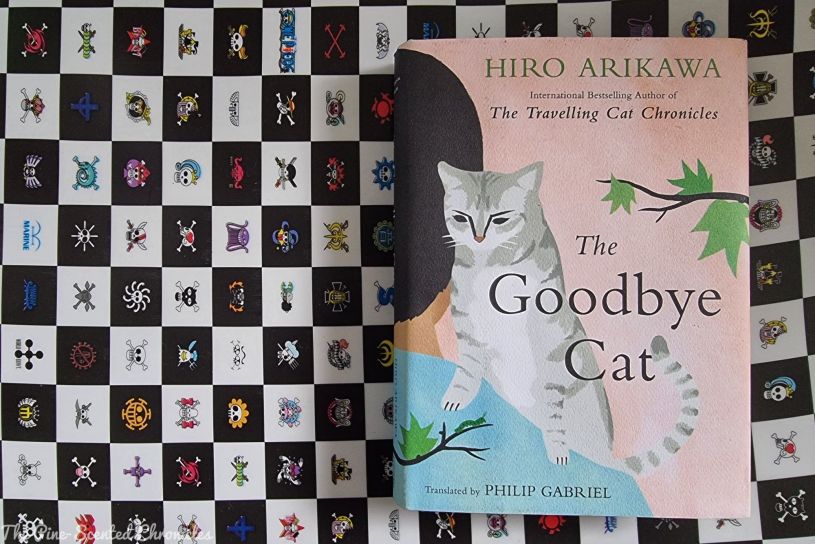
Four years after her international literary breakthrough, Arikawa made her long-anticipated literary comeback. Her 2021 book みとりねこ (Mitori neko) was made available for anglophone readers in 2023 as The Goodbye Cat, with translation by Philip Gabriel. The Goodbye Cat is a collection of seven stories that individually take the readers to familiar landscapes. All of the seven stories comprising the book revolve around the relationship between humans and their pet cats that figured prominently in their lives. The premises of these stories immediately evoke memories of The Travelling Cat Chronicles which charted the story of Satoru and Nana, a stray cat he adopted.
The first of the seven stories, The Goodbye Cat, gave the collection its title. It introduced the Sakuraba family, a family of four. Following the birth of their second son, Hiromi, they decided to adopt a second cat they named Kota. Kota joined the family’s aging cat named Diana. The story commenced with Kota placing his paw into a little dish of soy sauce and then leaving paw prints on the tablecloth. As the story moved forward, this was symbolic as Kota was trying to perfect his stamp, rather, his paw seal. He was hoping that by mastering his stamp, he would turn into a nekomata, an immortal supernatural spirit. He aspires to be one because he doesn’t want to be separated from his human family by death and so that he can look after Hiromi and his older brother Masahiro. It was an aspiration he shared with Diana:
“There had to be some procedure, was Diana’s opinion. Whenever there was a change in a human’s life, they had to go through procedures at the city hall, she said. Like when someone was born, or they died, or got married.”
All the while, Hiromi and Masahiro grew up. They both left the family home; the story covered two decades of the Sakuraba family. However, Hiromi was a constant presence in the family home as he kept being a companion to their parents. The first story sets the tone and the tempo for the succeeding stories. The second story, Bringing Up Baby, introduces Keisuke Tsukuda, a “midlevel anga artist who contributed to a monthly boys’ magazine.” He was married to Kaori. He was also about to become a father, something that further complicated his life because beyond being a manga writer, he didn’t feel competent in other aspects. When his wife spent a month with their baby Shiori at her parents’ home, Keisuke brought home a kitten without his wife’s permission. Through the cat he named Spin, Keisuke slowly learned how to be a hands-on father.
Parenthood, in particular the dynamics of being a father, was a prevalent subject in the short stories. Arikawa built on the momentum of the story of a clumsy father by introducing a different kind of father in the third story, Good Father / Bad Father. She painted the portrait of a domineering father who was an enigma to his children. He was indifferent to his children who grew up barely caring for their father. However, they were perplexed when their new cat showed affection toward their father. “It wasn’t that he even liked cats that much – he didn’t – but in his later years, he had taken his family completely aback with his surprise comment, Every cat in the world is cute.”
“The sand along the alleyways lay quite thick, and we couldn’t glide down as on a paved road. On both sides, our tires would sink into the sand, making ruts and slowing us down. We were heading to a particular beach that was said to have a lot of cats. It was about five minutes by bike from our house. Once we’d got out of the village, we emerged onto a paved road that encircled the island. Over time this road, too, had begun to crack and weeds were shooting up.”
~ Hiro Arikawa, The Goodbye Cat
Elements of magical realism distinguished the fourth story, Cat Island, from the other stories which were mostly realistic. The story was set on a small island in Okinawa known for its large cat population. Japan is dotted with islands crowded with cats and, recently, these islands have been developed into tourist attractions. It was to this Okinawan cat island that Ryo’s father and stepmother Haruko brought him to bring the family together. Ryo was unable to wrap his mind around the idea of having a stepmother following the death of his mother. Ryo’s father, a photographer, was also on the island to take pictures of cats for the cat feature his magazine is working on.
What makes Cat Island stand out from the other stories is the sense of place that Arikawa imbued to the story; it was the only story that featured the place as much as it featured the cats. Details of Okinawan folklore gave the story more texture. Ryo also met an old woman who knew his father and Haruko back when they first met on the island; it was on the island that Ryo’s father sought retreat following the untimely demise of his first wife. The old woman also told Ryo about the concept of mapui, or one’s soul: The idea that the soul could fall away was a concept unique to Okinawa, where they believed it could be triggered by a great shock or surprise. In that event, you had to pick up the fallen soul and return it to the body. If you didn’t, you’d become depressed, your body would start to ache and, in the worst case, you could become seriously ill.
The last two stories of the collection – also two of the most affectionate – bring back familiar characters. In a way, Finding Hachi and Life Is Not Always Kind are prequels to the events of The Travelling Cat Chronicles. The former takes the readers on a trip down memory lane. We meet Satoru as a young boy; this story provides more insights into his childhood. As a young boy, Satoru has always had a heart for cats which made him adopt an abandoned kitten he named Hachi. Abandoned animals have certainly proliferated the collection. It is without coincidence that most literary cats are stray cats who eventually endeared themselves to their owners. Cat lovers and by extension, animal lovers, can find heartwarming moments in these stories they can relate to.
“Allow me to introduce myself. I am a cat. The name is Nana – ” Thus commenced Life Is Not Always Kind. It was a form of homage to Natsume Sōseki’s I Am a Cat, with Nana referring to the anonymous cat in the literary classic as the “greatest-ever cat in Japan.” The collection comes full circle with the re-introduction of Nana and Satoru. The last story expounded on one of the episodes in The Travelling Cat Chronicles. Satoru was on a mission to find a new home for Nana and one of those who he thought would be able to take care of Nana (he is a he) was Hisashi Kubota, his former university professor. In Nana’s voice: “Unavoidable circumstances meant Satoru could no longer look after me.”
“Nowadays with digital cameras you can take as many photos as you like and curate them later, but at the time analog cameras were what most people used, and you wouldn’t know how well the photos you had taken would turn out until they were developed. Each photo cost monty, so it wasn’t so easy to continuously click the shutter. Photographers showed their stuff when they captured the perfect moment.”
~ Hiro Arikawa, The Goodbye Cat
Professor Kubota was a symbolic father figure for Satoru during his stay at the university. The Professor looked after his protege. Things would go south for the professor and Satoru. A disagreement between the two prematurely ended their friendship. In one of the most heartwarming moments in the collection, a reconciliation took place between former mentor and protege. Apart from forgiveness, the final story highlighted some of the recurring subjects in the collection: fatherhood, loss, and grief. In a way, the last story foreshadows the events of The Travelling Cat Chronicles. The last two stories in the collection are welcome additions to the novel as they probed more into Satoru.
With cats being prominently featured in The Goodbye Cat, it is no surprise that cat qualities were prevalent in the stories. The qualities of loyalty, wisdom, love, and devotion reverberated all throughout. The stories were suffused with heartwarming moments that easily appeal to the heart. Sure, the stories are primarily about love between man and animals. Still, these are stories about making indelible connections with our fellow men, may it be between a stepson and his stepmother, a clumsy father and internet forums, or a former student and his professor. They are all heartwarming but there are also tear-jerking and heartbreaking moments. The stories in The Goodbye Cat effortlessly activate a wide range of emotions.
The Goodbye Cat is a heartwarming and bittersweet follow-up to The Travelling Cat Chronicles. The seven stories comprising the collection will not fail to strike the chords of the heart. They examined a plethora of subjects, such as parenthood, family dynamics, finding meaning, and establishing connections with those around us. They also tackled softer emotions such as love, forgiveness, and devotion. There were also contemplations on life and death. Some stories will leave ephemeral impressions but some stories will also leave the readers yearning for more. But like its predecessor, these stories will warm the heart as these stories appeal to a wide range of emotions, whether we are cat or animal lovers or not.
“It’s only natural he used the same words. Those are the only last words a child wants to say to a parent, if they are loved – thank you and I love you. Don’t you think so?”
~ Hiro Arikawa, The Goodbye Cat
Book Specs
Author: Hiro Arikawa
Translator (from Japanese): Philip Gabriel
Publisher: Berkley
Publishing Date: 2023 (2021)
Number of Pages: 278
Genre: Short Stories, Literary
Synopsis
Seven cats weave their way through their owners’ lives, climbing, comforting, nestling, and sometimes just tripping everyone up, in this heart-tugging and inspiring collection of tales by Hiro Arikawa, international bestselling author of The Travelling Cat Chronicles.
Against the backdrop of changing seasons in Japan, we meet Spin, a kitten rescued from the recycling bin, whose playful nature and simple needs teach an anxious father how to parent his own human baby; a colony of wild cats on a popular holiday island show a young boy not to stand in nature’s way; a family is perplexed by their cat’s undying devotion to their charismatic but uncaring father; a woman curses how her cat will not stop visiting her at night; and an elderly cat hatches a plan to pass into the next world as a spirit so that he and his owner may be in each other’s lives forever.
Bursting with love and warmth, The Goodbye Cat exquisitely explores the cycle of life, from birth to death – as each of the seven stories explores how, in different ways, the steadiness and devotion of a well-loved cat never let us down. A huge bestseller in Japan, this magical book is a joyous celebration of the wondrousness of cats and why we choose to share our lives with them.
About the Author
To learn more about Hiro Arikawa, click here.
 The Pine-Scented Chronicles