The History of Slavery
Slavery is a very sensitive subject in the ambit of the history of the United States. It was said to have started in 1619 when privateer The White Lion transported 20 enslaved Africans in the British Colony of Jamestown, Virginia. The enslaved Africans were seized from the Portuguese slave ship Sao Jao Bautista. The rest, they say, was history. The European settlers, rather, colonists in North America preferred enslaved Africans as a cheaper alternative labor source compared to indentured servants, the majority of whom were poor Europeans. Slavery has become more prevalent in the American Deep South following the rapid expansion of the cotton industry driven by the invention of the cotton gin. For centuries, enslaved Africans tended to the vast cotton plantations of the Deep South.
By the mid-19th century, several seminal movements, such as the abolitionist movement, led to the reexamination of the institution of slavery. It was a thorny issue that took center stage during the American Civil War. The victory of the Union resulted in the dismantling of the institution and the freeing of millions of slaves. Despite this, the legacy of slavery influenced and continues to influence several aspects of American life, including the Civil Rights Movement and, more recently, the Black Lives Movement. This dark phase of American history has also been a staple in the ambit of American literature. Novels such as Harriet Beecher Stowe’s Uncle Tom’s Cabin, Toni Morrison’s Beloved, Alice Walker’s The Color Purple, and Colson Whitehead’s The Underground Railroad all prominently tackled this subject.
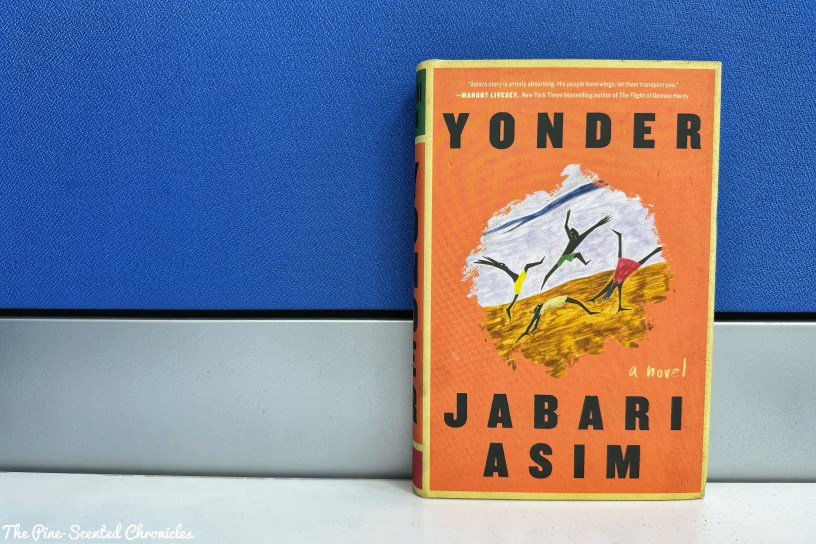
Another writer contributing his voice to this subject is Jabari Asim, a prolific writer whose oeuvre includes a plethora of genres such as short stories, poetry, novels, and even children’s stories. While his career started in nonfiction and poetry, it didn’t take long before he ventured into fiction. In 2022, he published his second novel, Yonder. The novel transports the readers to the slavery era Deep South. The setting was an ill-named plantation called Placid Hall. The plantation was one of three plantations owned by Randolph “Cannonball” Greene; he also owned Pleasant Grove and Two Forks. As one character would describe him, Cannonball was a man “with too much money, too much land, and too much idle time.”
“Without words of our own, we’d have no choice but to see the world as they saw it. And even though we witnessed life unfold through very different eyes, we shared with our captors a need to believe that names could affect the turn of events. We called them Thieves; they called themselves God’s Children. We called ourselves Stolen; they called us niggas. Our language, our secret tongue, was our last defense.“
~ Jabari Asim, Yonder
Asim’s preoccupation, however, was not with the owner of the plantation. Rather, the heart of the story was the enslaved who tilled the plantation owned by Cannonball. In their own perspective, these characters gave harrowing accounts of how they were forcefully plucked from their homeland and ended up on Cannonball’s plantation. Due to the circumstances surrounding how they ended up being in Placid Hall, they collectively referred to themselves as the “Stolens,” and their captors were aptly referred to as Thieves. The novel’s opening sequence detailed how William found himself in Placid Hall. William was captured by a Thief named Norbrook. While in the company of Norbrook, William witnessed a horrific scene involving Stolen children, a precursor to the fate that awaited him and his fellow Stolen.
William was eventually sold to another Thief who brought William to his neighboring plantation where William grew up and met his fellow Stolens. It was there that he fell in love with Margaret who, as a child, watched in horror while her mother was sold away from her. Margaret also had the unenviable position of being the primary child producer on the plantation. It is in her ability to conceive children that she finds value in Cannonball. The children she bears, however, are, in turn, stolen by Cannonball. A dire consequence awaits Margaret should she fail to conceive; she will be offered to one of the Stolen men. It doesn’t take much to figure out that Cannonball was no merciful landlord or slave owner. Violence was his primary means of instilling discipline among
Due to the horrors he witnessed at a young age, William was reluctant to impregnate – “bigged” in the novel’s colloquial – Margaret lest they bring into the world children who will suffer the same fate as their parents: forcefully separated from them by the Thieves who declared ownership over them upon their birth. Another Stolen who had to bear witness to the same injustices at Placid Hall was Cato. The horrors they witnessed made Cato and William friends although in a world like Placid Hall, friendship is a luxury. Like his friend, memories haunted Cato. His life was riddled with the ghosts of yesterday, particularly of his beloved who was sold away. Nevertheless, he was endeavoring to move forward. He refused to be shackled by the past. Unlike his friend, Cato was freer-thinking.
Pandora, meanwhile, has had her own fair share of injustice. She was raised as a pet to her half-sister. Unlike the others, she was raised in relative comfort. However, when her half-sister died, she was sold by her mother to a pimp. At Placid Hall, Pandora is a house slave who experiences abuse from Cannonball’s wife whom the Stolens refer to as Screech Owl; Greene lusts after Pandora. To survive her circumstances, Pandora escapes into a world of princesses and fairytales. Pandora’s beauty also has not escaped the notice of Cato who, despite his past, was willing to open up his heart again for her. Pandora, however, was a woman who It was these compelling voices, haunting the pages of the book, that reeled in the readers.
“Cradling his head in my hands, I pressed my face to his. Before, even as I was drawn to his gentle manner and his wonderful hands, I had harbored doubts about the weight he struggled under. I questioned how much of it I could pile onto my own shoulders. As I knelt beside him absorbing the signs of his renewal, my uncertainties melted away in the warm glow of morning. I knew then that we could carry each other.“
~ Jabari Asim, Yonder
The horrors of enslavement were the core of the novel, examined through the alternating perspectives of the four main characters. From the moment they were taken by Thieves, the lives of the Stolen were a constant cycle of violence and abuse. They wake up and sleep in the same situation. Placid Hall was a hell beyond superlatives. Oppression was ubiquitous and it was not local to Placid Hall. The realities witnessed at Placid Hall are prevalent across the land. The words happiness and comfort were not part of their vocabulary. The Stolens have no agency of any kind as their actions are dictated by their masters and captors. In Pandora’s words: “What moved Thieves most was the cold fact of our vulnerability: Our men couldn’t protect us. Nor could we protect ourselves.”
Not only did Stolens have agency, but they were also kept from earning any sense of education by their captors. They were cut off from the rest of the world. On top of the violence that they had to deal with every day, the Stolen had to deal with other nuisances such as sweltering heat and the stench of death that permeated the atmosphere at the plantation, the details of which were vividly captured by Asim’s descriptive prose. Some have become reluctant to fall in love. They fear that any flashes of emotion will be exploited and abused. Some have become averse to the idea of establishing connections. All relationships are temporary as such alliances can be severed at any moment. Even Cannonball, who purported himself as an expert on Black slaves, believed that the slaves were incapable of any form of emotions.
The circumstances at Placid Hall were indeed harrowing. It was all dehumanizing that some of the Stolen have become oblivious to these brutal realities. Despite these dark realities surrounding them, there were still some Stolen that had not run out of hope. Most of the Stolen had formed a sense of community. There was resilience and even moments of tenderness. Placid Hall was not entirely devoid of joy. We read about the emotional and psychological gymnastics the Stolen had to perform to escape the realities before them. They still held on to every sliver of humanity they could hold on to, believing that hope and freedom lie “yonder.” For William, Cato, Margaret, and Pandora, hope lies in Canada, a place they believed was within their reach. The final pages of the book chronicled their odyssey.
“The ground beneath our feet turned unreliable, threatening to betray us whether we moved or paused. It felt as if we were descending from high ground, down, down toward the center of the earth. Then we were climbing up again, scrambling and struggling to avoid sliding back into a formless void. On we trudged, knowing one another by the rhythm and violence of our breath. Huff. Puff. Stumble. Pause. Stumble. My muscles conspired against me, and my eyes burned from the effort to see.”
~ Jabari Asim, Yonder
Memorable secondary characters populated the novel and gave it distinct textures. Ransom was a rarity in a world brimming with Stolen. He was able to escape from bondage and become a free Black man. He was an itinerant preacher who introduced the concept of yonder to the Stolen. He planted the idea of a world beyond what the Stolen has known. Cupid, meanwhile, was the conduit of Cannonball. He was the Placid Hall’s ruthless and cruel Black foreman. He perpetrated some of the horrors witnessed by the characters. Silent Mary manned the kitchens and did not utter a word since her child was forcefully taken from her. Milton was a talented artist whose canvas was the plantation’s dirt. In their midst was Little Zander, one of the younger Stolens. He was on the cusp of manhood. His innocence and enthusiasm were a breath of fresh air.
With the chapters alternating between the points of view of the different characters, Asim was able to make the readers understand the motivations and the story of each character. He made the readers inhabit the character’s minds. By providing glimpses of the character’s innermost thoughts, fears, and hopes, Asim creates an intimacy between the readers and the characters. This also allowed Asim to navigate the horrors of slavery – oppression, humiliation, violence, heartbreak, and everything in between – while keeping the characters’ dignity as human beings. Contrary to what Cannonball believed, the Stolens were capable of loving and showing flashes of emotions. They wanted to learn and they yearned for freedom. Theirs is a story that must be told and must be heard.
Yonder is a compulsive read. With Asim’s unfiltered lenses, the readers are transported to Placid Hall where they get to witness the complexities and the legacy of enslavement. It was a world devoid of hope where horrors, abuses, injustices, and violence were the main currency. The novel was bereft of a robust plot but Asim conjured characters that take the readers on an emotional roller coaster ride. The Stolen had to deal with different shapes of inhumanities. Still, amidst this sea of bleakness, there were moments of joy and tenderness. The Stolens were capable of dreaming and hoping. They yearn for liberty while finding comfort in words and storytelling. Yonder lies hope. Yonder lies freedom.
“I don’t know how long I ly there, inert and unmindful of the world’s mad whirling. When I could finally open my eyes without wishing for death, I found myself staring at the stars. Behind them the sky was awash in blackness, cool comfort after the sweltering sunlight that had tormented me all day.“
~ Jabari Asim, Yonder
Book Specs
Author: Jabari Asim
Publisher: Simon & Schuster
Publishing Date: January 2022
Number of Pages: 255
Genre: Historical
Synopsis
The Water Dancer meets The Prophets in this spare, gripping, and beautifully rendered novel exploring love and friendship among a group of enslaved black strivers in the mid-nineteenth century.
They call themselves the stolen. Their owners call them captives. They are taught their captors’ tongues and their beliefs but they have a language and rituals all their own.
In a world that would be allegorical if it weren’t saturated in harsh truths, Cato and William meet at Placid Hall, a plantation in an unspecified part of the American South. Subject to the whims of their tyrannical and eccentric captor, Cannonball Greene, they never know what harm may befall them: inhumane physical toil in the plantation’s quarry by day, a beating by night, or the sale of a loved one at any moment. It’s a cruel practice – the wanton destruction of love, the belief that Black people aren’t even capable of loving – that hurts the most.
It hurts the reserved and stubborn William, who finds himself falling for Margaret, a small but mighty woman with self-possession beyond her years. And it hurts Cato, whose first love, Iris, was sold off with no forewarning. He now finds solace in his hearty band of friends, including William, who is like a brother to him; Margaret; Little Zander; and Milton, a gifted artist. There is also Pandora, with thick braids and long limbs, whose beauty calls to him.
Their relationships begin to fray when a visiting minister with a mysterious past starts to fill their heads with ideas about independence. He tells them that with freedom comes the right to choose the small things – when to dine, when to begin and end work – as well as the big things, such as whom and how to love. Do they follow the preacher and pursue the unknown? Confined in a landscape marked by deceit and uncertainty, whom can they trust?
In an elegant work of monumental imagination that will reorient how we think of the legacy of America’s shameful past, Jabari Asim presents a beautiful, powerful, and elegiac novel that examines intimacy and longing in the private quarters of the enslaved while asking a vital question: What would happen if an enslaved person risked everything for love?
About the Author
Jabari Asim was born on August 11, 1961, in St. Louis, Missouri where he was also raised. He was a product of the public education system and earned a Bachelor of Arts at Northwestern University.
Asim’s literary career started in poetry. His poetry has been published in African American Writers: A Literary Reader, as well as in the anthologies Role Call: A Generational Anthology of Social & Political Black Literature & Art (2002), Beyond The Frontier: African-American Poetry for the 21st Century (2002), Boyd’s The Harlem Reader: A Celebration of New York’s Most Famous Neighborhood from the Renaissance Years to the 21st Century (2003), and in From the Black Arts Movement to Furious Flower: A Collection of Contemporary African American Poetry (2004). He published his first poetry collection, Stop and Frisk, in 2020.
Asim’s debut work of fiction, A Taste of Honey, a collection of short stories, was published in 2009. His first full-length prose, Only the Strong, was published in 2015. His second novel, Yonder, was published in 2022. Asim has also written several nonfiction books such as We Can’t Breathe: On Black Lives, White Lies and the Art of Survival (2018). It is a collection of essays that was a Finalist for the 2018 PEN/Diamonstein-Spielvogel Award for the Art of the Essay. His oeuvre also includes a long list of children’s stories.
He is also a playwright and a professor of writing, literature, and publishing at Emerson College in Boston, Massachusetts. He is the former editor-in-chief of The Crisis magazine. In February 2019 he was named Emerson College’s inaugural Elma Lewis ’43 Distinguished Fellow in the Social Justice Center. In September 2022 he was named Emerson College Distinguished Professor of Multidisciplinary Letters. He served as an editor for 11 years at the Washington Post. He received a 2009 Guggenheim Fellowship in Creative Arts. Most recently, he has taught at the University of Illinois at Urbana-Champaign, where he was a scholar-in-residence.
Asim lives near Boston, Massachusetts, with his wife and children.
 The Pine-Scented Chronicles