Technology, Memory, and Nostalgia
The younger Jennifer Egan did not dream of becoming a writer. Born in Chicago but raised in San Francisco, she originally wanted to be an archeologist. She even took a gap year between high school and college to go on an archaeological dig. But lo and behold! Life and its little surprises made Egan reevaluate her dreams. When she entered the University of Pennsylvania, she studied English literature. The recipient of a prestigious Thouron Scholarship, she spent two years earning a master’s in literature at St. John’s College, Cambridge before settling in New York City in 1987 to pursue her dreams. It didn’t take long before reality hit her and hopes quashed by the big city. The glitz and glam of the Big Apple belied obstacles that block the path to success.
Egan had to work her way up. While honing her writing skills, she took on a plethora of jobs including catering at the World Trade Center. She also started working as a journalist, with the 1996 New York Times Magazine cover story “James Is a Girl,” a piece about 16-year-old model James King, among her first major journalism assignments. At the same time, she wrote short stories that appeared in prestigious publications such as New Yorker, Harper’s, Zoetrope: All-Story, and Ploughshares. In 1995, she published her debut novel, The Invisible Circus. It marked the ascent of a rising voice. Her sophomore novel, Look at Me (2001), was a finalist for the National Book Award. But in her oeuvre, one book stands tall. Published in 2010, A Visit from the Goon Squad won the prestigious Pulitzer Prize in 2011 and elevated Egan to global literary stardom.
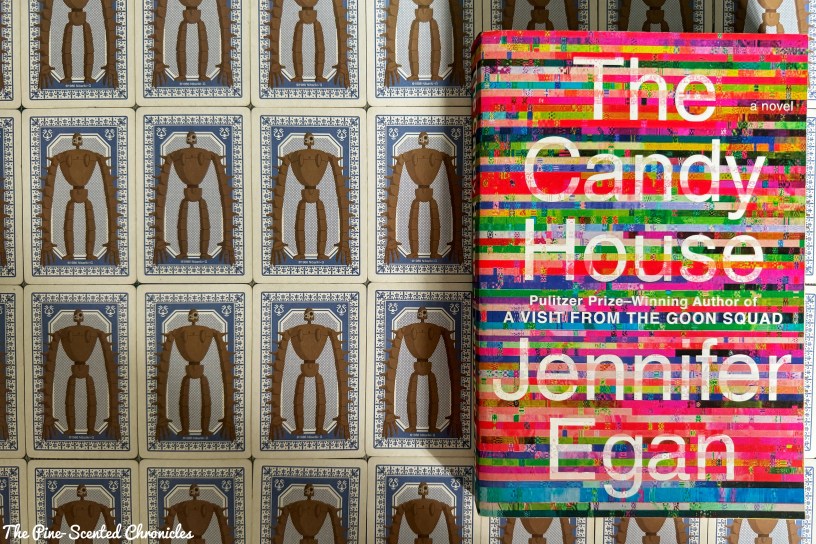
A dozen years after A Visit from the Goon Squad became a literary sensation, Egan revisited her modern classic and built around it its sequel, The Candy House (2022). The Candy House, Egan’s seventh novel, chronicles the fortunes of the characters initially introduced by its predecessor. At its heart, the latest book provided an update on the main characters in the Goon Squad. Some of them have grown up and pursued careers of their own. Some lost their charm while some gained renewed confidence. Taking a cue from its predecessor, The Candy House defies traditional literary structures. It deviates from established literary conventions. Innovation is something that Egan knows a thing or two about. Interestingly, or perhaps not, innovation and technology take center stage in Egan’s latest novel.
“There is nothing original about human behavior. Any idea I have is likely occurring to scores of others in my demographic categories. We live in similar ways, think similar thoughts. What the eluders want to restore, I suspect, is the uniqueness they felt before counting like ours revealed that they were an awful lot like everyone else. But where the eluders have it wrong is that quantifiability doesn’t make human life any less remarkable, or even (this is counterintuitive, I know) less mysterious—any more than identifying the rhyme scheme in a poem devalues the poem itself. The opposite! Mysteries that are destroyed by measurement were never truly mysterious; only our ignorance made them seem so.“
~ Jennifer Egan, The Candy House
Bix Bouton, once a minor character in Goon Squad, was reintroduced in the novel’s first chapter, The Affinity Charm. He was a virtuoso of technology who rose from the ranks to be the CEO of the social media company Mandala. As a graduate student in the 1990s, Bix already saw the wonders of the World Wide Web, even indoctrinating his classmates about its potential benefits. An African American, Bix envisioned the virtual world as a “new metaphysical sphere” where “Black people would be delivered from the hatred that hemmed and stymied them in the physical world.” Now it is 2010 and Bix has become a cultural and technological icon mentioned in the same breath as Facebook’s Mark Zuckerberg and even Apple’s Steve Jobs; interestingly, Egan once dated Jobs.
However, Bix has run out of ideas. Craving intellectual and existential stimulation, he donned a disguise as a graduate student to infiltrate a small Columbia University discussion group comprised of academics. After overhearing a conversation about experiments externalizing the memories of animals, a vision sparked in him. This vision became the “Own Your Unconscious,” a technology that allows users to externalize and store their consciousness on a cube. By preserving their memories, users can revisit and reexperience their past. These memories can also be uploaded and shared with an online collective. On the downside, anyone can access the anonymized memories of other users: “By uploading all or part of your externalized memory to an online ‘collective,’ you gained proportionate access to the anonymous thoughts and memories of everyone in the world, living or dead, who had done the same.”
This collective consciousness and other similar technologies, however, do not bode well for some; they are referred to as the “eluders.” It earned the ire of Miranda Kline whom the readers first met as Mindy in Goon Squad. She has since become a reclusive but brilliant anthropologist. She lived with a remote Brazilian tribe which allowed her to develop algorithms that predicted “patterns of affinity.” These patterns pertain to “what made people like and trust one another.” Such patterns emerge once a database of individual stories is developed. However, such algorithms have been weaponized by social media companies such as Mandala. Ironically, it was Kline’s book and social science principles that laid the groundwork for Bix’s brainchild. Bix’s son Gregory was another eluder who refused to share his private thoughts with strangers.
While Goon Squad prominently explored the music scene, The Candy House probed into the rise of technology and the prevalence of social media. It cannot be denied that in today’s world, where connectivity is within the palm of our hands, social media and technology have become an essential commodity, even a need. Technology’s exponential growth made the seemingly impossible possible. Everything can be accessed through the comfort of our phones. We can order food through our phone. We can shop through our phone. We can conduct meetings through our phone. On the other hand, through social media, we can update everyone on our most important life events. We can do virtually everything, anywhere, anytime. The only things we need are stable internet and a cellphone.
“Any idea I have is likely occurring to scores of others in my demographic categories. We live in similar ways, think similar thoughts. What the eluders want to restore, I suspect, is the uniqueness they felt before counting like ours revealed that they were an awful lot like everyone else. But where the eluders have it wrong is that quantifiability doesn’t make human life any less remarkable, or even (this is counterintuitive, I know) less mysterious—any more than identifying the rhyme scheme in a poem devalues the poem itself. The opposite! Mysteries that are destroyed by measurement were never truly mysterious; only our ignorance made them seem so.“
~ Jennifer Egan, The Candy House
The influence of technology on our lives has recently been again highlighted. With the advent of artificial intelligence and technologies such as Chat GPT, we can perform tasks without exerting much intellectual labor. The concept of creating a collective consciousness is not very far off. Egan built a case for the technology throughout the story. It is the answer to humanity’s dream of being able to enter another person’s mind. But as we all know, any form of technology comes at a steep price. In retrospect, we are already moving towards Collective Consciousness. Social media and mobile applications all collect our personal data. Almost all transactions conducted through our phones require personal information. The World Wide Web is a vacuum of information waiting to implode.
Egan’s preoccupation was not entirely with technology or its influence on our lives. Rather, technology served as a backdrop for the rest of the story; she skirted on the heady stuff. After all, they are realities we are currently dealing with. The core of the story was memory. The Candy House extensively probes how memory can create and mold our identity, and that of our community. Memory is essential in the stories of the novel’s characters as it is a means for them to understand themselves and the trajectory of their lives. Bix’s technology was a vessel upon which this was explored. Lou’s daughter, Charlie Kline, for instance, used Own Your Unconscious to access her father’s memories. She hoped that by accessing it, she would finally be able to identify with her father. For other characters, memory is a form of escape.
But memory does not always have all the answers, as the characters would soon realize after plowing through their or their loved one’s memories. The inherent trickiness of memories precludes us from completing our missions. Memories can also be repressed and even altered. Some characters struggle to rebuild their own because they soon realize that they have unreliable memories. No amount of getting back into that moment can resuscitate the same memory. Unlocking memory can also unpack a can of worms. A fond memory, once revisited, is no longer a fond one as new truths are unveiled. Interestingly, Own Your Unconscious was repeatedly used by children chasing memories of distant and absentee baby boomer fathers.
The novel derived its title from the house in the popular children’s story, Hansel and Gretel. It also pertains to the Faustian bargain wherein one willingly sacrifices their moral compass to obtain undue advantage or convenience. Elements from Goon Squad trickled into The Candy House. Both books shared several attributes, such as their digression from the traditional literary structure; Goon Squad featured a chapter related through a PowerPoint presentation. In The Candy House, there were the standard narrative-type chapters. Interspersed among them is a chapter related entirely through text messages, as if to iterate our growing reliance on technology. Another chapter was comprised of short, terse directives.
“You’ll recall your mother rocking you in her arms when you were a child. You’ll recall that she has always loved you fiercely and entirely. You’ll discover that you have forgiven her. You’ll understand that she concealed your paternity out of faith that her own infinite love would be enough. The wish to tell your mother that you forgive her is yet another reason you must make it home alive. The thought that your father will never know what he has lost is another reason you must make it home alive. The need to tell him what he very nearly lost is another reason you must make it home alive. You will not be able to wait, but you will have to wait.“
~ Jennifer Egan, The Candy House
The novel also tackled the quest for authenticity and happiness. With social media’s influence slathered all over, we create digital persona; this has become imperative. As a result, some of us have lost our genuine selves. In these heaps of online persona, how does one find his or her genuine self? We hide behind our keyboards and monitors. With our growing presence online and increasing reliance on virtual reality, is an authentic persona even needed? Still among us, some individuals refuse to fully conform to this idea of online persona. One character, an academician, even wrote a dissertation on “authenticity in the digital era.” Another character’s approach was more radical. Growing intolerant of the fakery surrounding him, he started shrieking on public transportation to elicit genuine responses.
On the subject of happiness, some characters escape to the past to remind themselves how it is to be happy, to unshackle themselves from the things that are holding them back, such as their addiction. In the story, it was not only substance that can be addicting but also nostalgia. Nostalgia can be a very powerful and dangerous drug. Beyond the novel anti-chronological structure – the story weaves in and out of the past, the present, and even the future – the novel also finds strength in its cast of richly complicated characters. They are never monochromatic. Most of them were introduced in Goon Squad and most were the children of the main characters in Goon Squad. Many of them are damaged. Some were drawn to substance abuse while some had illicit affairs. Nevertheless, they manage to redeem themselves.
The Candy House is in itself a form of nostalgia. It recalls its predecessor, A Visit from the Goon Squad. Nevertheless, The Candy House can hold its own candle. It casts a net over a vast territory. The novel tackles technology and how it altered and continues to alter our lives, past, present, and future. The impact of technology on our lives, emphasizing how we have conveniently resided online, was vividly captured by the novel. Beyond technology and social media, memory and the sanctity of our private thoughts also take center stage in the novel; the story is brimming with nostalgia. The novel also underlines Egan’s literary innovation and her pursuit to push her writing beyond what is imaginable. Overall, The Candy House is a palpable testament to Egan’s writing and storytelling capabilities.
“In frantic league, we flailed for ways to end the “sharing” that was dismantling our father’s business and our father. We contemplated a nationwide billboard campaign to remind people of that eternal law, Nothing is free! Only children expect otherwise, even as myths and fairy tales warn us: Rumpelstiltskin, King Midas, Hansel and Gretel. Never trust a candy house! It was only a matter of time before someone made them pay for what they thought they were getting for free. Why could nobody see this?“
~ Jennifer Egan, The Candy House
Book Specs
Author: Jennifer Egan
Publisher: Scribner
Publishing Date: April 2022
Number of Pages: 334
Genre: Literary
Synopsis
The Candy House opens with the staggeringly brilliant Bix Bouton, “a tech demigod on a first-name basis with the world.” Bix is forty, with four kids, restless, desperate for a new idea, when he learns about a professor experimenting with downloading or “externalizing” memory. It’s 2010. Within a decade, Bix’s new technology, “Own Your Unconscious” – which allows you to access every memory you’ve ever had, and to share your own in exchange for access to the memories of others – has seduced multitudes. But not everyone.
In spellbinding interlocking narratives, Egan spins out the consequences of Own Your Unconscious through the lives of multiple characters whose paths intersect over several decades. Intellectually dazzling, The Candy House is also a testament to the tenacity and transcendence of human longing for real connection, love, family, privacy, and redemption.
The Candy House is a bold, brilliant imagining of a world that is moments away. Egan takes new heights her “deeply intuitive forays into the darker aspects of our technology-driven, image-saturated culture” (Vogue). The Candy House delivers an absolutely extraordinary combination of fierce, exhilarating intelligence and heart.
About the Author
To learn more about the award-winning American writer Jennifer Egan, click here.
 The Pine-Scented Chronicles