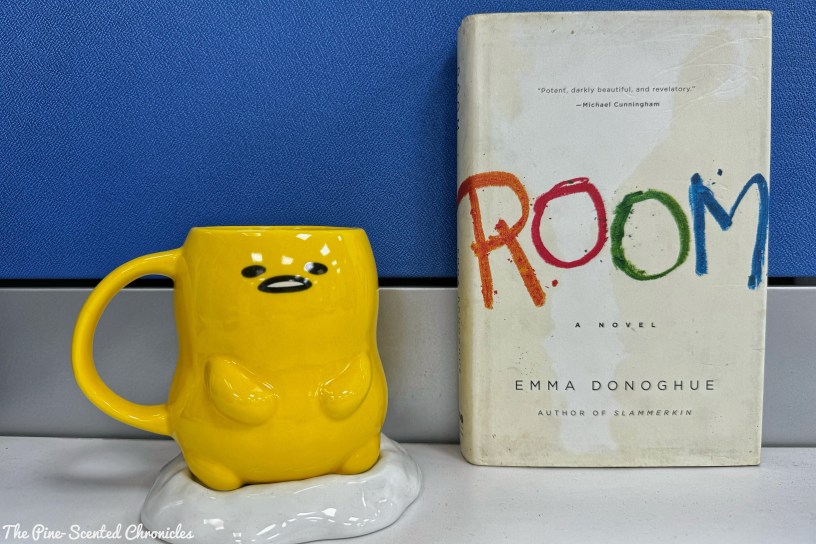
Isolation and A Mother’s Love
Playwright, literary historian, novelist, and screenwriter Emma Donoghue was born to a big Irish family; she was the youngest of eight children. With academic and literary critic Denis Donoghue as a father, Donoghue’s path toward a literary career is already a foregone conclusion. She earned first class honours Bachelor of Arts degree in English and French from University College Dublin. She then moved to England where she earned her PhD in English from Girton College, Cambridge. At the tender age of 23, she started earning a living as a writer. There was no looking back for her. In 1994, she published her debut novel, Stir Fry which was a finalist for the Lambda Literary Award in 1994. Donoghue was on the path to literary success.
Building on the momentum sparked by the success of her debut novel, Donoghue worked on a wide genre which included biographies, short stories, plays, and works of nonfiction. However, it is her works of fiction that would gain her global recognition. Among her novels, one stands out: Room. Published in 2010, Room is Donoghue’s seventh novel and is narrated from the perspective of five-year-old Jack. Jack was living in a secured single-room outbuilding, hence, the book’s title. The room had the necessities: a small kitchen, a basic bathroom, a wardrobe, a bed, and a TV set. Living in this room along with Jack was his twenty-six-year-old mother who he simply refers to as Ma; we never get to learn her actual name.
Mother and son were never able to go outside. With the story commencing in medias res, this restriction immediately begs the question: why can they not go out and who is preventing them from doing so? Details of what happened were slowly unveiled as the story moved forward. When she was a nineteen-year-old college student, Ma was kidnapped and kept in captivity in an 11-by-11-foot square reinforced shed where she stayed for the past seven years. Shortly after she was abducted, Ma was abused and raped by her kidnapper; Ma and Jack simply referred to him as Old Nick. The abuse was regular, with Jack being the product of one of these sexual assaults.
“The sea’s real, I’m just remembering. It’s all real in Outside, everything there is, because I saw the airplane in the blue between the clouds. Ma and me can’t go there because we don’t know the secret code, but it’s real all the same. Before I didn’t even know to be mad that we can’t open Door, my head was too small to have Outside in it. When I was a little kid I thought like a little kid, but now I’m five I know everything.”
~ Emma Donoghue, Room
Like his Ma, Jack was never allowed to leave the “room.” As such, he has no concept of the outside world. He grew up without an inkling about a world beyond the four corners of the room they were occupying. He believes that the things he watches on television are figments of his imagination. His mother reinforced this idea that nothing existed beyond the room. Ma deliberately chose not to explain to her son their situation. From a young age, it was inculcated into Jack that the world revolves around the room. Old Nick would occasionally drop for a visit and check up on his captives, providing them the necessities. During these visits, Jack must hide in the Wardrobe as Old Nick still abuses his mother. Jack was unaware of this, referring to it simply as “squeak(ing)” the bed. Some nights, Jack counts how many times the bed creaked until “he (Old Nick) makes that gaspy sound and stops.”
Despite the suffocating atmosphere – the room was soundproof and had a single skylight – Ma managed to create a routine that ensured that Jack would grow normal and live a normal life, or at least a semblance of it. The restrictions in their movement did not limit the story. Ma and Jack spend their days keeping the room tidy. Mental and physical exercises ensure that their body and mind are both occupied. Children’s books and stories kept Jack company. Strict body and oral hygiene were observed. Watching television was limited. Jack loves Dora the Explorer and despite the limited television time, Ma relishes this distraction as it keeps their brain from being idle. With their routine, Ma was ensuring that her son experienced a normal childhood despite the palpable limitations. All the while, Ma was keeping her sanity intact.
Ma and Jack’s circumstances created a sense of claustrophobia. Nevertheless, their routine made Jack feel secure and not feel trapped. Further, the limited physical space came alive because of Ma and Jack’s routine. Animating the physical space and the objects that occupied it was among the novel’s finer elements, a stark dichotomy to the prohibitive space. Wardrobe, Sink, Bed, Rug, and Meltedy Spoon, among other inanimate objects, became characters. As a result, Jack grew up to be highly imaginative. These playful elements remind the readers that the novel is narrated from the perspective of a five-year-old. Misspellings (deliberate) and erroneous verb tenses were ubiquitous, understandably so. Laying out the landscape of the story was the first layer of the story, providing the context for what would ensue.
It was from Jack’s perspective that we get to understand Ma. While there were some details she obscured from her son, she was very honest with him about her life. Their proximity, forced it may be, allowed Jack to adapt to his mother’s mannerisms and disposition. He understood her every contour and every crease on her face. He was her sounding board. Her understanding of her world beyond the room made her feel incarcerated and claustrophobic. It was all helpless but it did not matter because Jack was beside her. Jack was the primary reason that she kept going, that kept her enduring the horrors that were within reach. Ma was fiercely protective of Jack; Ma asked Old Nick that she keep Jack to herself, hence, the little contact between the two.
“Outside has everything. Whenever I think of a thing now like skis or fireworks or islands or elevators or yo-yos, I have to remember they’re real, they’re actually happening in Outside all together. It makes my head tired. And people too, firefighters teachers burglars babies saints soccer players and all sorts, they’re all really in Outside. I’m not there, though, me and Ma, we’re the only ones not there. Are we still real?”
~ Emma Donoghue, Room
The direness of their situation has not stopped Ma from yearning for freedom. She knew it was vital and the first step for this was to make Jack understand that there is a world outside. Ma knew that she had to act; Jack deserved a better environment. For Jack, however, the room was his sanctuary; after all, it was the only world he knew and the prospect of stepping out of it sounded ominous. The outside world was so foreign to Jack. In the end, mother and son decided to trust each other. Their situation was getting desperate after Ma learned that Old Nick had been unemployed for half a year. His home, including the shed that Ma and Jack occupied, was in danger of being foreclosed. This has dire consequences for the captives. Thus started the scheming and planning.
Will Ma and Jack be able to escape? The subsequent sequence was the book’s most thrilling. However, Room is no typical story as it mirrors an actual one. It was inspired by the real-life case of Elisabeth Fritzl, a woman from Austria. Fritzl was held captive by her own father, Joseph Fritzl, in a cellar under the family home. For twenty-four years, she was assaulted, sexually abused, and raped. This repeated abuse resulted in seven children and several miscarriages. Three of her children were looked after by their mother during her captivity. One child died shortly after birth while the other three were raised by Joseph and his wife Rosemarie. To escape suspicion, Joseph reported the three children as foundlings; for years, Rosemarie was led to believe that her daughter had run away and joined a cult. On April 26, 2008, Elisabeth was finally freed by her father – after the reopening of Elisabeth’s case – and a little under a year later, Joseph pled guilty to various charges.
While it is one of the most sensational, the Fritzl case, unfortunately, is not the only case of child abuse and abduction that involved long-term detention. A quick search would yield several results. Sadly, several cases were perpetrated by relatives, like in the case of Elisabeth. Most of the victims were also women and young children, underlining their vulnerability; this was also depicted in Room. It is also happening all over the world. Some of the victims were not able to live to tell the tale. Some were fortunate enough to keep their mental faculties and scheme and plan their escape, such as the case of Michelle Knight, Amanda Berry, and Gina De Jesus. One thing is for sure, the details of abuses are extensive and horrifying. Evil was a recurring theme in the story and Old Nick was its personification.
“In the world I notice persons are nearly always stressed and have no time…I don’t know how persons with jobs do the jobs and all the living as well…I guess the time gets spread very thin like butter all over the world, the roads and houses and playgrounds and stores, so there’s only a little smear of time on each place, then everyone has to hurry on to the next bit.”
~ Emma Donoghue, Room
It then comes as no surprise that trauma weighed heavily on the story. Trauma, in the story stemming from repeated sexual abuse and captivity, can have a long-lasting impact on those who experienced it. The adverse impact can even be permanent. The neglect that Ma experienced further underlines this major theme. Details of her trauma floated to the surface after Ma and Jack were medically evaluated. Ma’s interactions with the police also provided an extensive landscape of the abuse she was forced to deal with. For Jack, trauma manifested slowly as he learned to navigate the world beyond the room that had been his safe haven for years. Beyond the trauma, the novel vividly captured the sense of isolation and, in stark dichotomy, the sense of freedom.
Freedom, however, came at a price for the young Jack. The outside world was foreign to Jack. It came in waves of shock. He had to dismantle the idea of the outside world that was built by Ma while they were in the room. The new people who entered his life, including his own Grandma, were strangers to him. He also has to embrace the idea that his Ma is not his alone, that he shares her with the rest of the world. It can be disorienting; learning that Ma had other names came as a shock. Thrown into uncharted territories, we witness Jack develop, grow, and change his perspective of the world beyond. Despite the atrocities that Ma and Jack had to face, the novel reverberated with hopeful warmth. Donoghue’s writing was most affectionate when capturing tender moments between mother and son. Despite the changes that were bound to take place, Ma was, first and foremost, Jack’s mother.
Shortlisted for the 2010 Booker Prize and the Orange Prize and the winner of several literary awards – it was even adapted into a film – Room is a complex story about profound subjects such as freedom, motherhood, and unwavering parental love. Maternal love overflowed in the story, an eternal spring that beacons in an otherwise dark story. Trauma, abduction, sexual abuse, isolation, and fear provide a stark dichotomy to the novel’s hopeful elements. Room also underlines an ugly reality: the world outside our comfort zone can be ominous. It is riddled with different forms of danger. Evil lurks in every corner. Overall, Room is a compelling read that keeps the readers at the edge of their seats.
“It’s weird to have something that’s mine-not-Ma’s. Everything else is both of ours. I guess my body is mine and the ideas that happen in my head. But my cells are made out of her cells so I’m kind of hers. Also when I tell her what I’m thinking and she tells me what she’s thinking, our each ideas jump into our other’s head, like coloring blue crayon on top of yellow that makes green.”
~ Emma Donoghue, Room
Book Specs
Author: Emma Donoghue
Publisher: Little, Brown and Company
Publishing Date: 2010
No. of Pages: 321
Genre: Suspense, Literary
Synopsis
To five-year-old Jack, Room is the world. It’s where he was born, it’s where he and his Ma eat and sleep and play and learn. There are endless wonders that let loose Jack’s imagination – the snake under Bed that he constructs out of eggshells, the imaginary world projected through the TV, the coziness of Wardrobe below Ma’s clothes, where she tucks him in safely at night in case Old Nick comes.
Room is home to Jack, but to Ma it’s the prison where she has been held since she was nineteen – for seven years. Through her fierce love for her son, she has created a life for him in that eleven-by-eleven-foot space. But Jack’s curiosity is building alongside her own desperation – and she knows that room cannot contain either much longer.
Told in the poignant and funny voice of Jack, Room is a story of unconquerable love in harrowing circumstances, and of the diamond-hard bond between a mother and her child. It is a shocking, exhilarating, and riveting novel – but always deeply human and always moving. Room is a place you will never forget.
About the Author
Emma Donoghue was born on October 24, 1969, in Dublin, Ireland. Donoghue was the youngest of eight children born to Frances and Denis Donoghue. Denis Donoghue is a renowned academician and literary critic. She attended Catholic convent schools in Dublin. She earned first class honours Bachelor of Arts in English and French from the University College Dublin. She then moved to England where she earned a PhD in English from Girton College, Cambridge. It was while studying at Cambridge that Donoghue met her future wife, Christine Roulston, a Canadian who is now a professor of French and Women’s Studies at the University of Western Ontario.
From the age of 23, Donoghue earned a living as a writer. One of her earliest works, Passions Between Women: British Lesbian Culture 1668-1801 (1993), was a work of nonfiction. Her prolific literary career covers a lot of genres, including short stories, plays, and even screenplays. However, she was more renowned for her works of fiction. Her debut novel, Stir Fry, was published in 1994. It was a finalist for the Lambda Literary Award in 1994. Building on this momentum, she published Hood (1995) which won the 1997 American Library Association’s Gay, Lesbian and Bisexual Book Award for Literature (now known as the Stonewall Book Award for Literature).
Donoghue’s most critically renowned and commercially successful work, however, was her seventh novel, Room, which was published in 2010. It was shortlisted for the Booker Prize and the Orange Prize and won Donoghue a slew of literary awards across the world. The novel was also adapted into a film of the same title. She wrote the screenplay for the film for which she was nominated for the Academy Award for Best Adapted Screenplay. Her latest novel, Learned by Heart, was published in 2023.
Donoghue permanently moved to Canada with her wife in 1998. In 2004, Donoghue was granted Canadian citizenship. She lives in London, Ontario, with Roulston and their two children.
 The Pine-Scented Chronicles