A Nation at Odds
Around the Dublin Bay emerged the city of Dublin, the capital and largest city of Ireland. The city has had a storied past that spans nearly two millennia. The area was already inhabited during the prehistoric times but the first known settlement was built in the fourth century. The settlement was called Áth Cliath (Hurdled Fort). Around the sixth century, a monastery called Duiblinn – Irish for ‘blackpool’ – was founded. The settlement thrived after it was invaded and conquered by the Norse around the ninth century. Following the Anglo-Norman invasion in 1170, Dublin was named the capital of the English Lordship of Ireland. From a settlement, it has evolved into a walled medieval town and eventually, into the thriving city that it is today.
Throughout history, Dublin has also emerged as a thriving cultural center. Its atmosphere is permeated with the sound and beat of Irish music; popular singers Bono, Sinéad O’Connor, and Ronan Keating, among others, are children of Dublin. The heart of the Irish artistic scene, Dublin is riddled with art galleries, museums, libraries, and theaters. The city also has a significant literary heritage that is bannered by a bevy of Nobel Laureates in Literature such as William Butler Yeats, George Bernard Shaw, and Samuel Beckett. Prominent writers Oscar Wilde, Jonathan Swift, Bram Stoker, Maeve Binchy, Anne Enright, and John Banville are also among the many renowned children of Dublin.
Another prominent literary name who traces his provenance in this city of culture is James Augustine Aloysius Joyce, more renowned as James Joyce. And who has not heard of Joyce, whose magnum opus, Ulysses, remains one of the most studied literary classics out there. Because of his extensive contributions to the world of literature, particularly to the modernist avant-garde movement, Joyce is often considered one of the most influential and innovative writers of the twentieth century. His ascent to literary greatness and global recognition started with poetry, with his first full-length collection, Chamber Music, published in 1907. At the same time, he was a prolific writer of short stories.
“He went often to her little cottage outside Dublin; often they spent their evenings alone. Little by little, as their thoughts entangled, they spoke of subjects less remote. Her companionship was like a warm soil about an exotic. Many times she allowed the dark to fall upon them, refraining from lighting the lamp. The dark discreet room, their isolation, the music that still vibrated in their ears united them. This union exalted him, wore away the rough edges of his character, emotionalised his mental life.”
~ James Joyce, Dubliners
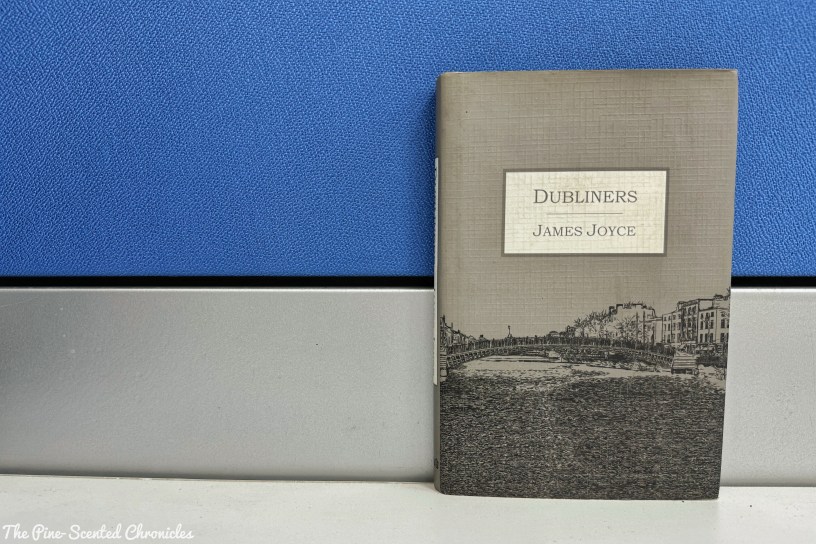
Taking inspiration from the city he grew up in, Joyce published his first short story collection, Dubliners, in 1914. The collection is comprised of fifteen short stories that vividly capture the portrait of life in Dublin in the early twentieth century. The first story, The Sisters was set in 1895 and related to the death of Father James Flynn after a third stroke. Hearing about his death was his young protégé, an unnamed boy. The boy’s uncle and Old Cotter, the bearer of the sad news, were discussing how the boy should have not been involved with Father Flynn and should have been playing “with young lads of his own age.” There were also whispers of scandal and mental instability at the house of mourning, further confounding the young boy who looked up to his mentor.
An Encounter, the second story, builds on the landscape laid out by The Sisters. It features another anonymous young boy. Obsessed with adventure and Western stories, he and his classmate Mahony skipped school to explore Dublin. Everything was going well until the titular encounter with an old man whose stories discomfited the two friends. Araby, meanwhile, captures the wonders and pains of innocent love. A teenage boy had a crush on the sister of his friend, Mangan. Out of the blue, his crush asks him if he plans to go to a bazaar, the titular Araby. He then promised to buy her a gift when he dropped by the bazaar. Eveline deviates from the first three stories as the main character is a young woman who lives alone with an abusive father; her mother died and her brothers moved out. She wanted to run away from her quotidian life, a promise seemingly fulfilled by Frank.
Eveline also marks a seminal pivot in the stories. Jimmy, an affluent well-off young man, was the heart of After the Race. He was part of a circle of equally rich young men. Or perhaps not, as he would soon realize. Achieving that realization, unfortunately, entailed huge losses. Two Gallants introduced two men in their early 30s, Corley and Lenehan, who were living decadently as if they were younger men. Another man in his thirties, Bob Doran, was introduced in The Boarding House. Bob was living in a boarding house run by the domineering Ms. Mooney. A Little Cloud, meanwhile, introduced Little Chandler, a conservative clerk. A reunion with his old friend Gallaher, a journalist who lives an exciting life in London, made him reflect on his life choices.
Two middle-aged characters, Farrington and Maria, were individually the focuses of Counterparts and Clay, respectively. Farrington was a reiteration of an Irish vice featured prevalently in the other stories: alcohol and drunkenness. Several characters are drawn to drinking which, in turn, adversely impacts their lives. In the case of Farrington, drinking keeps him from performing in his job. Mrs. Sinico, an unhappily married woman in A Painful Case, also descended into alcoholism after her close friendship with Mr. Duffy was cut short. A bachelor, Mr. Duffy was reluctant to be in a romantic relationship with her. Tom Kernan, at the heart of Grace, also had an insatiable appetite for alcohol that ended in an accident.
“Evidently she had been unfit to live, without any strength of purpose, an easy prey to habits, one of the wrecks on which civilisation has been reared. But that she could have sunk so low! Was it possible he had deceived himself so utterly about her? He remembered her outburst of that night and interpreted it in a harsher sense than he had ever done. He had no difficulty now in approving of the course he had taken.”
~ James Joyce, Dubliners
The consequences of drunkenness, however, is not limited to the individual as it also impacts those around them. Their children and spouses had to bear the brunt of it. Their inability to function properly in the workplace also impacts their job. For Mrs. Mooney, her husband’s drunkenness foiled her aspirations for financial security. Ambition was another recurring theme in the stories. The Dubliners all have dreams, several of which are unfulfilled. Little Chandler, for instance, yearned for literary success. Mrs. Kearney, the titular mother in A Mother, also dreams of a higher social standing which she believed she could achieve through her daughter Kathleen’s musical talent. Unfortunately, different factors held them down. For Little Chandler, it was his timidity while for Mrs. Kearney, it was her greed.
The ambition imbibed by the Dubliners, in a way, was a microcosm of the grander ambition of early 20th-century Ireland. The turn of the century was critical in Irish contemporary history. They were yearning for independence from the United Kingdom. However, they were in a bind as they were still in need of resources that the United Kingdom could provide. This discourse was highlighted in Ivy Day in the Committee Room, the most politically inclined of the stories. On Ivy Day – a day celebrated to commemorate the anniversary of the death of Charles Stewart Parnell, a prominent Irish nationalist politician – a group of political canvassers converged at the National Party committee room. While waiting for their wage, they discussed politics, particularly the impending visit of the King of England to Ireland.
The King’s visit would boost Ireland’s economy but nationalists objected to any influences of the British monarch. The presence of England loomed large throughout the stories. It was cited as one of two major factors that stymied Ireland’s development. The other factor was the Roman Catholic Church whose influence in Irish lives was far-reaching despite being hounded by several controversies. They kept Ireland from reaching its full potential, shackling it to the ground and precluding it from experiencing any substantial economic and social development. In the early twentieth century, Ireland was one of the poorest and least developed European nations. These two elements were subtly underscored in the first story, with Father Flynn symbolizing the Church. He also lived on Great Britain Street and passed away on the anniversary of England’s victory over Ireland in 1690.
While England and the Church were two major factors in Ireland’s declining state in the early twentieth century, some factors played a seminal role in this decline. The waning Irish spirit, captured by Joyce with his unflinching gaze, runs parallel to the decline of Ireland. The descent to the drunkenness of many characters was symptomatic but this was also accompanied by the other spiritual vices that continue to haunt the Dubliners, and consequently, the Irish. These include gambling, child and spousal abuse, prostitution, suicide, and even blackmail. Moral corruption has also pervaded the Dubliners, contributing to the paralysis of Ireland. Simony, perversity, and truancy were all referenced in the story. Through these stories, Joyce captured a nation yearning for identity.
“There were so many different moods and impressions that he wished to express in verse. He felt them within him. He tried to weigh his soul to see if it was a poet’s soul. Melancholy was the dominant note of his temperament, he thought, but it was a melancholy tempered by recurrences of faith and resignation and simple joy.”
~ James Joyce, Dubliners
These vices have also developed into a cycle of frustrations that several characters yearn to escape from. Escape was a prevalent theme explored by the story. The characters yearn for escape from the predicaments before them. However, the characters cannot act on their yearning for escape, thus, their frustrations. Another major theme explored by James was death. Death, in its physical form, was immediately introduced in the first story. Death would also permeate the succeeding stories. It came in different forms, such as the death of morality and spiritual death. These literary deaths are, in turn, interconnected with the underlying themes. The most extensive probe on death is in the novella The Dead which often accompanies the short stories.
Dubliners provided glimpses into early twentieth-century Ireland and the maladies that plagued a nation and its denizens for centuries. The short story collection was also seminal in honing Joyce’s mettle for storytelling. It provided glimpses into his literary brilliance that would come in full display in his works of full-length prose. It had the earliest sprouts of Joyce’s writing acumen. Having it published, however, was an entirely different discourse. As early as 1905, James sent the manuscripts to publishers. However, publishers refused to publish the collection because they deemed the stories, with their vivid portrayal of the unattractive qualities of Irish life, were not suitable for readers. Further, three of the stories, The Sisters, Eveline, and After the Race appeared under the pseudonym Stephen Dedalus.
Through the fifteen stories that comprised Dubliners, Joyce was able to paint an evocative portrait of a nation and its people during a seminal period. Through the eclectic cast of characters that populated these stories, James was able to vividly capture Ireland at the turn of the century: its denizens descending to moral and spiritual death, their values corrupted and their spirits waning. Ireland was a nation at odds with itself. The Dubliners – rendered wonderfully by James’ brand of realism – were trapped by these circumstances. Their cultural and spiritual vices, coupled with the looming presence of the Roman Catholic Church and England, obstructed them from realizing their aspirations, both as individuals and as a nation.
“ If he was dead, I thought, I would see the reflection of candles on the darkened blind, for I knew that two candles must be set at the head of a corpse. He had often said to me: I am not long for this world and I had thought his words idle. Now I knew they were true. Every night as I gazed up at the window I said softly to myself the word paralysis. It had always sounded strangely in my ears, like the word gnomon in the Euclid and the word simony in the Catechism. But now it sounded to me like the name of some maleficent and sinful being. It filled me with fear, and yet I longed to be nearer to it and to look upon its deadly work.”
~ James Joyce, Dubliners
Book Specs
Author: James Joyce
Publisher: Vivi Books
Publishing Date: 2018 (1914)
No. of Pages: 233
Genre: Literary, Short Stories, Historical
Synopsis
This collection of 15 stories presents a mosaic of Dublin life at the beginning of the twentieth century. Each of the stories reveals moments of epiphany in the lives of a cast of Dubliners.
Linked by place, the collection forms an arc across the various stages of life. In the opening stories, the protagonists are children coming to terms with adult experiences and emotions. The middle stories deal with love, the loss of dreams and the emptiness of lives constrained by social expectations. Dubliners ends with the longest and most well known of the collection – ‘The Dead’, in which, after an evening out with his wife, Gabriel Conroy has an epiphany about the nature of life and death.
More than 100 years since their first publication, these stories reveal enduring insights into human life, passion and emotion, while capturing Dublin and its people at a precise moment in time.
About the Author
James Augustine Aloysius Joyce was born on February 2, 1882, in suburban Dublin, Ireland. He was the eldest of 10 children in a middle-class family to survive infancy. When he was six, he was sent to Clongowes Wood College, a Jesuit boarding school that has been described as “the Eton of Ireland.” His father’s decadence, however, buried the family in debt, prompting Joyce not to return to school. For two years, he stayed at home and tried to educate himself; his mother checked his work. In April 1893 he and his brother Stanislaus were admitted, without fees, to Belvedere College, a Jesuit grammar school. He excelled academically and was even elected twice as the president of the Marian Society.
At the University College Dublin, he studied languages. He read widely, particularly books that were recommended by the Jesuits and was also active in the college’s Literary and Historical Society. He also became active as a writer and, at the age of eighteen, he had a review of the play When We Dead Awaken by Henrik Ibsen published in the London Fortnightly Review. This review was warmly received, confirming Joyce’s resolution to pursue a career in writing. An essay, The Day of the Rabblement, was published in October 1901. Upon graduation in 1902, Joyce moved to Paris and, after 1904, returned to Ireland only sporadically. In 1905, he and his partner, and later wife, Nora Barnacle, settled in Trieste. During World War I the family lived in Zurich, moving to Paris after the war, and then to the South of France before the Nazi invasion. The family was living in Zurich when Joyce died.
While he is renowned for his prose, Joyce’s first published book was a collection of poetry, Chamber Music (1907). His other poetry collections include Giacomo Joyce (written in 1907, and published in 1968) and Pomes Penyeach (927). In 1914, after years of convincing publisher, Joyce published his first collection of stories, Dubliners. In the same year, Joyce started working on A Portrait of the Artist as a Young Man which was published eventually in 1916. Encouraged by the acclaim of Joyce’s first published novel, the American Little Review began to publish episodes from Ulysses in March 1918. However, it was discontinued in December 1920 when it was banned. In 1922, Ulysses would be published as a single work. Despite its initial censorship troubles, Ulysses would ascend to global recognition. His last work, Finnegan’s Wake was published in 1939.
 The Pine-Scented Chronicles