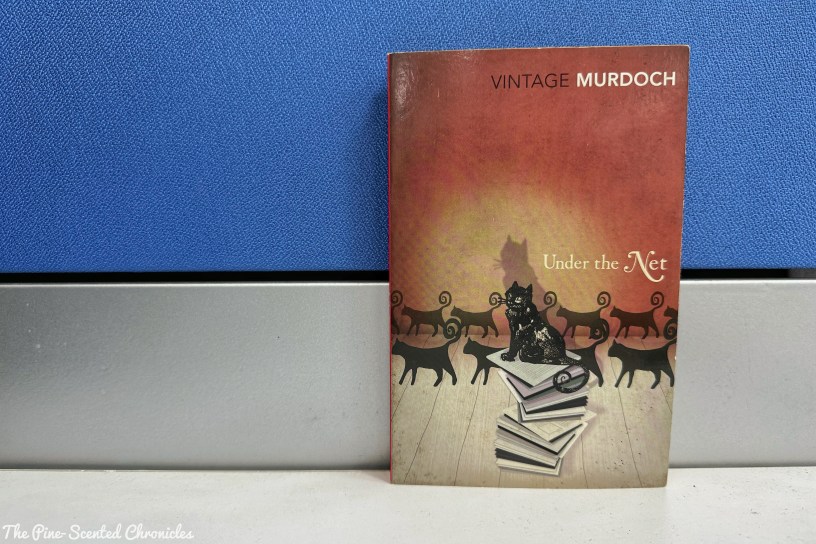
Sweet Serendipity
Born on July 15, 1919, in Phibsborough, Dublin, Ireland, Dame Jean Iris Murdoch is one of the several titans of contemporary literature. The journey to global recognition and the zenith of literary success, however, was not, as the timeless idiom goes, a walk in the park. Before pursuing a full-time career in literature, Murdoch worked in the British Treasury during the Second World War. She then worked for two years as an administrative officer with the United Nations Relief and Rehabilitation Administration. Post-war, she worked in a Displaced Persons Camp in Austria. In 1948, Murdoch was elected a fellow of St. Anne’s College, Oxford where she lectured in Philosophy. Following the end of the war, Murdoch also studied philosophy as a postgraduate at Newnham College, Cambridge.
It was also in philosophy that Murdoch first established her niche. Her earliest writings were philosophy essays. Her first published work was a critical study, Sartre, Romantic Rationalist (1953). It was also the first monograph about Jean-Paul Sartre published in English. She would publish a couple more philosophy books, including The Sovereignty of Good (1970) and Metaphysics as a Guide to Morals (1992). Over the course of her prolific career, she published poetry collections and wrote plays. However, Murdoch was more renowned for her novels which have also earned her several awards. In fact, six of her works were nominated for the Booker Prize, making her among the second most nominated writers for the award, one book behind Salman Rushdie. Her 1978 novel, The Sea, The Sea, deemed by many as her magnum opus, won her the prestigious literary award.
Murdoch’s ascent to literary excellence, at least where her prose is concerned, started with the publication of her debut novel, Under the Net in 1954. Set in London, Murdoch’s debut novel charted the fortunes of Jake Donaghue. Donaghue was an aspiring but struggling writer in his early thirties. The readers first meet him as he returns to London after a brief visit to France. Finn, a distant relative, promptly informed him that they no longer had a house to live in after they had been thrown out of their friend Magadalen’s, or Madge for short, house. Finn and Donaghue were freeloaders who had been staying at Madge’s house rent-free for the past eighteen months. Madge had to evict them to make room for her boyfriend, Sammy Starfield, an affluent bookmaker.
“All work and all love, the search for wealth and fame, the search for truth, life itself, are made up of moments which pass and become nothing. Yet through this shaft of nothings we drive onward with that miraculous vitality that creates our precarious habitations in the past and the future. So we live; a spirit that broods and hovers over the continual death of time, the lost meaning, the unrecaptured moment, the unremembered face, until the final chop chop that ends all our moments and plunges that spirit back into the void from which it came.”
~ Iris Murdoch, Under the Net
Thus commenced Jake and Finn’s search for their new home. Their first salvation came in the form of Dave Gellman; Jake was reminded of him after leafing through all his manuscripts; Jake was earning a living translating mediocre French novels to English. Dave was a teacher and a philosopher. He was also Jake’s old friend although they had not kept in touch for years. Dave, however, was dismissive of them but relented to having Finn stay in his flat. Jake, on the other hand, was only allowed his suitcase to leave behind. Upon Finn’s advice, Jake approached Anna Quentin who seemed to be his final recourse. Anna was a talented folk singer and was once Jake’s lover who, like in the case of Dave, Jake has not had contact with for years.
It was, yet again, a futile exercise. After searching for Anna, Jake learned that Anna was busy with a filming project. Nevertheless, Anna allowed her former lover to stay for one night before pointing him in the direction of her sister Sadie, an actress. As luck would have it, Sadie was looking for a caretaker who would look after her flat while she was away. She was running away from her admirer, Hugo Belfounder. Hugo once worked in his parents’ fireworks factory. It was a profession he loved and excelled in. However, he soon tired of it. Upon inheriting the business, he sold it and set up his own film studio. For Jake, her meeting with Sadie was another serendipitous encounter – the novel was brimming with these serendipitous encounters – because Hugo was another former friend.
From the present, Murdoch then delves into the backstory of how Hugo and Jake’s paths first intersected. Narrating the story from his point-of-view, Jake iterated that “my acquaintance with Hugo is the central theme of this book.” Hugo and Jake first met a couple of years before when they both volunteered for medical research. Jake immediately recognized that he was in the presence of an incredible person. During their stay in the cold-cure experiment, they connected on several levels but it was their philosophical discussions that left an impression on Jake; he even kept notes of these discussions. Their philosophical discussions, particularly on the subject of language, became the backbone material for Jake’s relatively unsuccessful novel, The Silencer. Jake, however, had his misgivings and believed that the book’s publication was an act of betrayal, prompting him to sever his friendship with Hugo.
As agreed, Jake made his way to Sadie’s residence. There was nothing out of the ordinary, on the onset. While checking out the flat, Jake found a copy of his book which he assumed was given by Hugo to Sadie. At this juncture, things started going south. The telephone rang and on the other end was Hugo who was looking for Miss Quentin. Hugo immediately dropped the call once Jake identified himself. Following the call, Jake decided to track down Hugo, going against Sadie’s wishes for him not to leave the flat. However, Jake realized that he was imprisoned; he was deliberately locked in by Sadie. In yet another serendipitous moment, Jake saw Dave and Finn walking down the street. While his friends found it a hilarious situation, they agreed to help Jake, first, to unlock the flat and second, to look for Hugo.
“There are special nightmares for the daytime sleeper: little nervous dreams tossed into some brief restless moments of unconsciousness and breaking through the surface of the mind to become confused at once with the horror of some waking vision. Such are these awakenings, like an awakening in the grave, when one opens one’s eyes, stretched out rigid with clenched hands, waiting for some misery to declare itself; but for a long time it lies to suffocation upon the chest and utters no word.“
~ Iris Murdoch, Under the Net
As the trio tracks down Hugo, what ensued was an eventful picaresque story. Jake found himself involved in several adventures and misadventures. At one point, he gambled the money he received as a bribe from Sammy and won. A translation Jake had gone missing only to learn that it was taken by Sammy. Jake overhears a conversation between Sammy and Sadie who were plotting to rip him off; they were planning to adapt the transcript into a film. The characters, after encountering an activist called Lefty Todd, went on a spontaneous dip on the Thames. Jake dognaps Sammy’s dog, Mr. Mars. Jean-Pierre Breteuil whose works Jake was translating from French, won the Prix Goncourt, to Jake’s surprise. Jake takes on the job of being a hospital orderly through which he would reunite with Hugo.
For all the comedic scenes the novel was brimming with, what manifested was the portrait of a young man who was uncertain of what he wanted in life. Jake was at the crossroads and was struggling to find his place in this world, hence, his preoccupation with spontaneous adventures and misadventures. His situation was exacerbated by his cynicism and detachment. He also spent as little time working and opted to rely on his friends for shelter because of his “shattered nerves.” He acted on his impulses without thinking them through. But it was also through Jake’s story that we read about the struggles of budding artists, particularly writers. He aspires to be a writer and has even started working on some manuscripts. However, his compunction for flightiness precluded him from finishing any of his works.
One captivating aspect of the story was Murdoch’s London. With her descriptive prose, she transformed London into an essential character in the story. The story came alive with the atmosphere of 1950s London, with most of the story’s action taking place in the streets. Murdoch takes the readers through a virtual tour of streets, pubs, and even bus routes with her impressionable details. They also provide a sense of place and time. Meanwhile, Jake was not rooted in a particular place as he has lived in different parts of the city. His meandering across the city demonstrates the unpredictability in the life of artists. As he journeyed across the city, he was also growing as an individual and a writer. The product of his newly found maturity was the novel, Under the Net.
“To anyone who will take the trouble to become attached to her she will immediately give a devoted, generous, imaginative and completely uncapricious attention, which is still a calculated avoidance of self-surrender. This is no doubt another reason why she never went into films; her private life must be an almost full-time activity. This has the sad result too that her existence is one long act of disloyalty; and when I knew her she was constantly involved in secrecy and lying in order to conceal from each of her friends the fact that she was so closely bound to all the others.“
~ Iris Murdoch, Under the Net
Beyond the adventures, the novel imbibed Murdoch’s philosophical leanings; she was a philosopher first before a novelist. Hugo Bellfounder was the representation of the novel’s philosophical aspects. He was a profound thinker and his philosophies were echoed by some of the characters, including Anna and Jake. Hugo, in a way, was the antithesis of Jake. While Jake was spontaneous, Hugo was meditative, calm, and soft-spoken. Dave was also a philosopher who, ironically, dissuaded his students from pursuing philosophy. In a way, the dichotomy between Hugo and Jake underscores the difference between a contemplative nature and a creative one. The former bears ideas while the latter communicates these ideas. Elsewhere, the novel has undertones of unrequited love.
In her debut novel, Murdoch crafted an eclectic cast of characters. Their quirks and idiosyncrasies create a lighthearted atmosphere. For all its lightheartedness, it is a comedic journey toward finding one’s voice, that of Jake’s. Jake has been bogged down by his flightiness, uncertainties, and cynicism but he eventually learns to overcome them to find a new meaning in his literary journey. In the meantime, Under the Net takes the readers across Murdoch’s London through Jake’s series of madcap misadventures and capers. Details of philosophy added a layer to the story. Under the Net was not without its faults but it evocatively showcases glimpses of Murdoch’s writing and storytelling, both of which would evolve with her succeeding works.
“When the sun was set I might perhaps go to sleep. I never let myself sleep during the day. Daytime sleep is a cursed slumber from which one wakes in despair. The sun will not tolerate it. If he can he will pry under your eyelids and prise them apart; and if you hang black curtains at your windows he will lay siege to your room until it is so stifling that at last you stagger with staring eyes to the window and tear back the curtains to see that most terrible of sights, the broad daylight outside a room where you have been sleeping.“
~ Iris Murdoch, Under the Net
Book Specs
Author: Iris Murdoch
Publisher: Vintage Books
Publishing Date: 2002 (1954)
No. of Pages: 286
Genre: Literary
Synopsis
Jake, clever and lazy, makes a living out of writing translations and sponging off his friends. When he is kicked out of his latest lodgings he embarks on a series of fantastic and hilarious adventures around London involving movie stars, majestic philosophers, bookies, singers and a celebrity hound called the Marvellous Mister Mars.
About the Author
To learn more about the highly heralded Irish writer Iris Murdoch, click here.
 The Pine-Scented Chronicles