The Weight of Tradition and Culture
It cannot be denied that Nigerian literature has slowly been gaining recognition across the world. The most populous African country, Nigeria has produced some of the most influential names in contemporary African, and consequently world literature. Writers such as Amos Tutuola, Elechi Amadi, and Chinua Achebe were among the first names who placed Nigerian literature in the subconscious of global readers. Their writings contributed greatly to the growing recognition of Nigerian literature, and in its wake, African literature as a whole. Their bodies of work have also earned them accolades in various parts of the world. In 2007, Achebe won the Man Booker International Prize while in 1986, Wole Soyinka became the first Black African to be awarded the Nobel Prize in Literature, widely considered the most prestigious literary award in the world.
The contribution of female Nigerian writers cannot also be underestimated. One of the most prominent Nigerian woman writers is Florence Nwapa who has been lauded by many literary pundits as the mother of modern African Literature. She was the first African woman to internationally publish a novel in English and Nwapa is also widely regarded as the forerunner to a new generation of African female writers. Her legacy is carried on by a new herd of established and rising literary stars such as Ayọ̀bámi Adébáyọ̀, Sefi Atta, Oyinkan Braithwaite, and Chimamanda Ngozi Adichie. Their works have also received accolades from various award-winning bodies such as the Booker Prize and the Women’s Prize for Fiction.
Another influential name in the ambit of Nigerian women writers is Buchi Emecheta. Born on July 21, 1944, in Lagos, Nigeria to Igbo parents, she started writing a regular column in the New Statesman, a British political and cultural magazine published in London; Emecheta and her children moved to London to follow her husband who moved to the United Kingdom to study. In her column, Emecheta shared her Black British life experiences. Emecheta would weave together some of these pieces into a singular volume, making it her first published novel, In The Ditch, which was published in 1972. This marked the start of a prolific literary career that produced fifteen novels. Her oeuvre also boasts children’s and young adult novels and even a score of plays.
“The sounds that rose from them were moving, purposely prolonged but full of words sung so rapidly that, to the untutored ear, they would be compared to the noise made when a bricklayer pours little pebbles on a zinc roof. Yet despite this effect, one could not help being carried away by the smoothness that linked the words together in a tranquil, undisturbed stream.”
~ Buchi Emecheta, The Bride Price
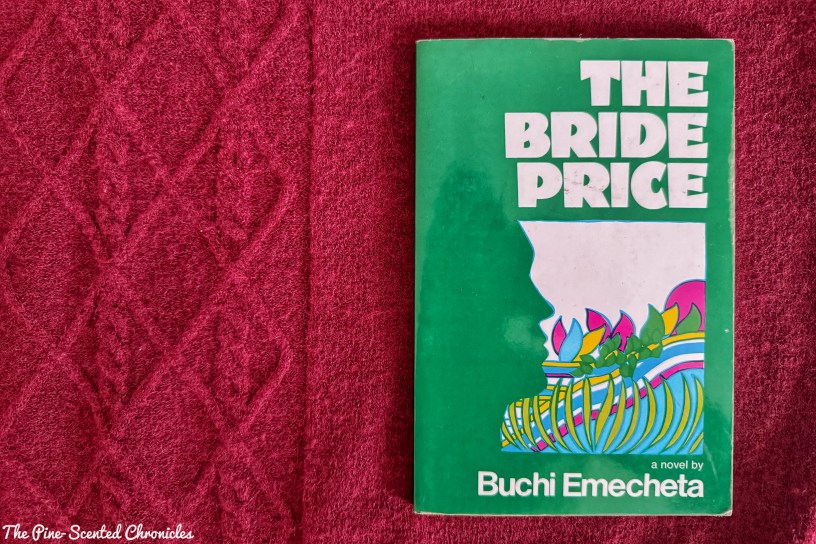
Among her fifteen novels is The Bride Price. Originally published in 1976, The Bride Price was Emecheta’s third published novel. The novel is set in Nigeria and starts in the country’s former capital, Lagos, where Emecheta introduces the Odia family, a member of the Ibo tribe. The patriarch was Ezekiel while the matriarch was referred to as Ma Blackie. The Nigerian couple had two children: Nna-nndo, a son, and Aku-nna, a daughter. When the story started, Ezekiel bade farewell to his children; Ma Blackie went home to Ibuza to perform fertility rites. Ezekiel told his children that he would just go for a routine check-up at the hospital and that soon he would be back. Unbeknownst to his family, Ezekiel was sicker than everyone thought. Three weeks after leaving his children, Ezekiel perishes.
Ezekiel’s death has left a gaping hole in the family he has left behind. In the Nigerian culture of that time, a fatherless family is considered a nonexistent family. Ezekiel’s absence means that his family has no means to support themselves. With no other recourse – Ma Blackie was cognizant that she can’t survive the city as a widow – Ma Blackie moved her children to the Nigerian countryside, particularly to Ezekiel’s family domain in Ibuza. With Ezekiel’s death, Ma Blackie has become the newest wife of Okonkwo, Ezekiel’s brother. Nna-nndo and Aku-nna have also become Okonkwo’s children. Ma Blackie and her children now also reside in one of the huts in Okonkwo’s family compound.
The merging of the two families also had far more complications for Ezekiel’s children, particularly Aku-nna who was the heart of the story. As the story moves forward, Aku-nna starts slowly blossoming. She was thin and passive but her beauty made boys and young men in their neighborhood gravitate toward her. The attention she was getting did not escape her stepfather’s attention. Okonkwo had ambitions of becoming an Obi, or a village chief and with Aku-nna’s bride price – essentially a fee traditionally paid by the prospective husband’s family for the prospective wife – Okonkwo was assured of fulfilling his dream. Because of the number of boys and young men competing for Aku-nna’s hand in marriage, it was a reasonable expectation that her bride price would be high. But despite the attention she was attracting, Aku-nna remained largely oblivious to the attention. She had her attention on someone else.
As the story progresses, several layers of the multilayered novel are unpeeled. What rose to the fore was a probe into various facets of Nigerian society and culture, the most palpable of which was the highly patriarchal structure of Nigerian society. This was a subject prevalent in Emecheta’s other works. As depicted in The Bride Price, women have no constitution over their lives. They are subservient to the expectations and diktats of the men in their lives. They are muted in the process of selecting a spouse. Even Ma Blackie’s realization that she won’t survive in Lagos without a husband and instead seek Ezekiel’s brother is symptomatic of how women were raised to always submit and conform to the patriarchy. As can be gleaned from the Odia family’s fate, power resides in the men of the family.
“It is so even today in Nigeria: when you have lost your father, you have lost your parents. Your mother is only a woman, and women are supposed to be boneless. A fatherless familyis a family without a head, a family without shelter, a family without parents, in fact, a non-existing family. Such traditions do not mchange much.”
~ Buchi Emecheta, The Bride Price
At a young age, it was inculcated in girls’ minds that they must learn to be submissive. Any form of resistance to the patriarchy is meted with ostracism. Education for girls and young women is also frowned upon. The only reason Aku-nna was sent to school was that her mother had savings to pay for her education. Okonkwo also allowed it because he believed it would increase her bride price further. After the wedding, the bride price entails child-bearing which is viewed as the role of women. Bearing a child is a further manifestation of the patriarchy. While birthing a daughter is generally not frowned upon, having a son is more desirable. Daughters, on the other hand, are valued for their bride prices. Interestingly, Aku-nna’s name translates to “father’s wealth”; her brother’s name translates to “father is the shelter.” Consequently, the Ibo young men also had to work hard to earn themselves money to pay for the bride price. The bride price was hovered above everyone’s life.
Other facets of Ibo, and consequently, Nigerian culture were subtly highlighted in the story. During the wake of Ezekiel, we read how Aku-nna deferred to her aunts and uncles for decisions regarding her father’s funeral rites. Aku-nna also had to quell her inquisitive thoughts because children were expected not to probe on matters that involved adults. Someone who disrupts the silence is considered a bad kid. It was also during the funeral that we read how life in the countryside is contrasted against or compared to urban living. For her composure, her relatives remarked that “for a girl not born in Ibuza” Akunna “did not do too badly.” It was also during the funeral that Aku-nna learned more about society’s expectations of her as a girl: “girls were supposed to exhibit more emotions.”
The funeral was a microcosm upon which Emecheta studied various elements of Ibo culture. It was also a means for her to capture some of the heritage of colonialism; it was also a recurring theme. A melting pot of various tribal cultures, Nigeria was also influenced by British colonialism. In the novel, Emecheta vividly portrays the cultural shift and the also how British and Western culture has influenced traditional culture. Like most Nigerians, Aku-nna’s relatives praised the “European Living God” on Sundays. However, when the occasions arise, they call traditional healers. Christian ideas of heaven and hell were also integrated into the traditional religion. The Ibo people praised both the Christian God and their traditional beliefs because they were afraid of offending any deities.
“The soil was redder, the leaves were that type of deep green which suggests a tinge of black. The forests became really dense like mysterious groves. Here you saw a narrow footpath like a red ribbon winding itself into the mysterious depths. There you saw a human figure emerge as it were from a secret green retreat, carrying on her head a bunch of ripe, blood-coloured palm frits. Or a girl with her little sister, scrambling into the deep forest at the sound of the approaching lorry.”
~ Buchi Emecheta, The Bride Price
One element of Nigerian society that was also captured in the story was the dynamics of the caste system. In Ibo society, there are two main classes: –the Nwadiala and the Osu. The former literally translates to “the son of the soil”, hence, the masters while the latter are the slaves. Osus are essentially outcasts. During colonization, the Ibo tribe sent slaves to missionary schools to appease missionaries sans disrupting tribal life. Those who descended from slavery are always frowned upon regardless of the status they have achieved in the contemporary. The passage of time also does not erase one’s family legacy. As such, marriage or even romance between the two classes is disapproved because such would taint not only the individual but also their family and clan. This was another demonstration of how tradition and culture loomed as an obstacle for the characters.
All throughout, the weight of tradition and culture weighed heavily on the characters. As Emecheta has captured in her novel, this burden falls mainly on women. The subservience to traditions, however, does not prevent Nigerian women from going against the flow. They seize their own destinies and build their own paths. Emecheta is a prime example. She was married at a young age and walked out of her abusive marriage. In fact, The Bride Price was the first novel Emecheta wrote but her original manuscripts were burned by her husband. She managed to rewrite it and produce a testament to female resilience. Like Emecheta, Aku-nna was no ordinary girl or young woman. Despite traditions looming, she took control of her own life, even outwitting the men of her life.
Overall, The Bride Price is a multilayered story where various elements of culture, tradition, and even history converge to complete a compelling story that chronicles the struggles of Nigerian women in a highly patriarchal society. This reverberates on a global scale as women have historically been muted by patriarchal societies across the globe. Nevertheless, what distinguishes Aku-nna’s story are the cultural touchstones woven into the lush tapestry. These details gave the story a distinct texture. The novel masqueraded as a sly social commentary with overtones of romance. The Bride Price captures the landscape of early 20th-century Nigerian culture but it was also Aku-nna’s coming-of-age story, an evocative tale about seizing one’s destiny and taking the first steps to dismantle a rigid patriarchal structure.
“You mean you want to continue until your bride price is paid. Why didn’t you say that? How many hours do you spend thinking about your famil, your mother, your uncle? You think about them so much that sometimes I think I don’t exist for you. Do you wonder what it would be like for me if you became ill, maybe too ill even to care for our child? I shall see that that bride price is paid, if it’s the last thing my father ever does for me. And you are not gong to die and leave me. Do you understand?”
~ Buchi Emecheta, The Bride Price
Book Specs
Author: Buchi Emecheta
Publisher: Penguin Books
Publishing Date: 2009 (1976)
No. of Pages: 168
Genre: Literary, Historical
Synopsis
The Bride Price is the poignant love story of Aku-nna, a young Ibo girl, and Chike, the son of a prosperous former slave. They are drawn together despite the obstacles standing between them and their happiness, defying even the traditions of tribal life. Aku-nna flees an unwanted marriage to join Chike, only to have her uncle refuse the required bride price from Chike’s family. This leads to Aku-nna’s haunting fear that she will die in childbirth – the fate (according to tribal lore) awaiting every young girl whose bride price is not paid.
About the Author
To learn more about the prolific Nigerian writer Buchi Emecheta, click here.
 The Pine-Scented Chronicles