A Quarter-Life Crisis
It is said that our twenties is one of the, if not the most challenging phase in our lives. It is a period of several changes, with some that are even radical. It is a period when our view of the world starts changing. We transition from students to fully functioning adults, sometimes without much of a preamble. It is when we are slowly transitioning to real life. It is a rite of passage and like most rites of passage, it can be very challenging, even painful. We go out and explore the world. We market ourselves to earn a decent-paying job. This is a period marked by several growth pains as we try to learn how to navigate the different worlds beyond our comfort zones. The ideas we have of the world and of the people around us are constantly challenged. This prompts us to dismantle old ideas in exchange for new ones.
Our twenties are indeed the most tumultuous but also the most pivotal part of our development as part of society. It is a period of examining our relationships with the people around us. We meet new friends and weed out those who don’t align with our values. Meanwhile, some of our old friends are starting to settle down while some of us remain romantically untethered as our careers become the focus of our lives. We also realize that our parents are starting to age. Wrinkles have started to show on different parts of their body. Gray hairs, bald spots, and creases remind us that they are no longer getting younger. Our age, in the current generation’s parlance, is starting to get more serious. These changes can be disorienting. With all of these, we find ourselves caught in a whirlpool. We have officially entered our first quarter-life crisis.
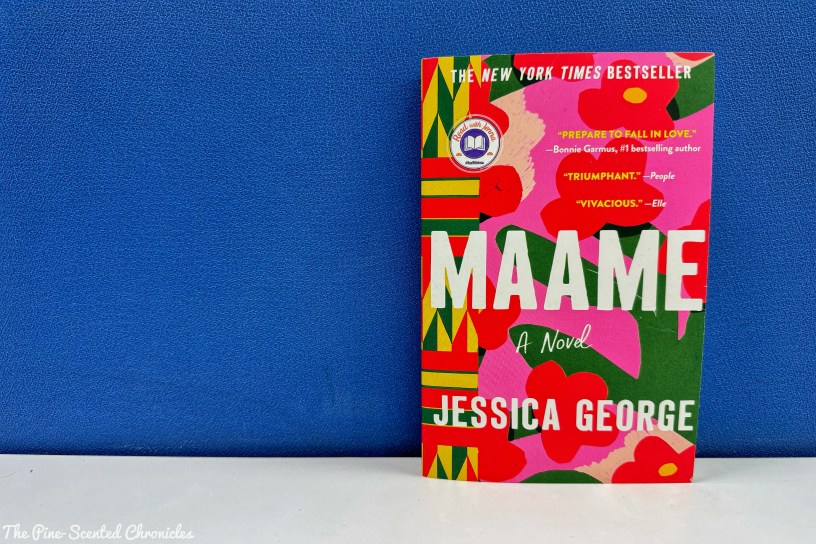
It was at this juncture that Madeleine Wright found herself in. Maddie, as she was fondly and familiarly referred to by her friends and family, was the heroine of Jessica George’s novel Maame. Maddie was born to Ghanaian parents who immigrated to London. Her life, however, was far from the ideal. In the present, she was living alone with her father. Her mother had to divide her time between Ghana and London because, following the death of her father (Maddie’s maternal grandfather), she was the one managing their family business, a hostel; Maddie’s uncle was not adept at running the family business. Because of the cost of airfare, she visits her husband and children every other year. Maddie also has a brother, James, who has long moved out of their London home to pursue his own dreams, if only to avoid family drama.
“Many assume love is straightforward, when really it is the most complicated of things. There is a right way, a preferred way, for each individual, to love and be loved by someone—but there isn’t only one way. I believe the difficulty of life has much to do with understanding and then navigating how the people you love both express and receive love themselves. It cannot be your responsibility, your burden, to reshape people into someone you’d like them to be. Ultimately, you must either accept a person for who they are, how they behave, how they express themselves emotionally, and find a healthy way to live with them, or let them go entirely.”
~ Jessica George, Maame
With her mother gone most of the time and her brother nearly uncontactable, Maddie was the primary caretaker of her 57-year-old father. Her father had been suffering from advanced-stage Parkinson’s disease for over a decade already and in that period, it was Maddie who was his chief carer. It did not help that neither her brother nor her mother wanted to be bothered by the patriarch’s declining state. To support them, Maddie was working an unfulfilling administrative job at a theater company. But before she leaves for work, Maddie prepares her father’s snacks and meals. She was also the one coordinating with her father’s caregiver. She kept her mother and brother abreast of her father’s condition.
What she earned was meager but she also had to split it between herself, her father’s needs, her mother, and even her brother. Despite her relatively young age – Maddie was just twenty-five – she had quite such a burden on her shoulders. A brief respite came when her mother decided to make an unscheduled return to London to look after her husband; in a way, she was finally embracing her responsibility and, in the process, taking off some load from her daughter’s shoulders. For Maddie, this was an unexpected opening to finally live her life to the fullest. Without further ado, she grabbed the opportunity even it if entailed stepping out of her comfort zone. But for someone who has lived most of her life tethered and whose routines are set in stone, the change was disorienting.
Maddie finally had an opportunity to live life as a twenty-five-year-old. However, because she had to dedicate her time to her father, Maddie had a nonexistent social and romantic life. She had a very tight circle of friends – there were three of them in the circle – and was in only one serious romantic relationship. Meanwhile, the people around her, from her few friends to her colleagues, were all busy getting ahead in their lives while Maddie was stuck in an impasse she was trying to move on from. Guiding her was a list she crafted containing milestones she wanted to achieve. One of these was sharing a flat with new individuals, her workmates to be exact. She also got to experience after-work drinking for the first time.
These experiences, to some extent, were liberating and eye-opening for Maddie even if, to the casual spectator, these seemed normal. But just when Maddie was finally able to spread her wings, life had other ideas. A final tragedy created a wedge between her and her newfound friends. On the other hand, it was also this same tragedy that allowed her to reexamine her relationship with her brother and her mother, both of which were beyond ideal. This was exacerbated by heartbreak; a part of experiencing life included opening herself up to romantic relationships. Emotions started running high and Maddie must learn to muster her wits lest she be swallowed whole by these pitfalls. Will Maddie get swept into this whirlwind of emotional highs and lows? Or will she crumble?
“My parents are not special people, they’re ordinary, and one of my problems is that I’m expecting perfection from ordinary people. They’re not saints or masters of knowledge just people, people who have children, which, last time I checked, required no proficiency test. People who continue to make mistakes, attempt to learn from them and repeat, until death.”
~ Jessica George, Maame
Navigating uncharted territories can be daunting, as Maddie would soon realize. But props to her as she nevertheless mustered the courage to step out of her comfort zone. In doing so, she was learning more about herself and the people around her. A self-confessed late-bloomer – at least in terms of sex, love, and relationships – Maddie was gaining new perspectives. With the help of lists, articles, drafts of emails, text messages, Google searches, and even Reddit threads, Maddie was able to gain a little bit of wisdom. These bits and pieces provided a lighter atmosphere to the story as some of these text messages and Google searches were hilarious. Maddie’s reliance on Reddit threads and Google threads, seen from a different vantage point, underscores the growing importance of the World Wide Web in our lives. We have come to depend on them, treating them as if they are a vast data bank.
But life has taught has that there is no better teacher than actual experience. However, actual life can also slap hard, as Maddie would learn. Many can relate to her moments of confusion contrasted by her desire to explore every facet of adult life. As Maddie was finally learning to steer her own life, she must also learn how to navigate the complexities of her heritage. She was born to Ghanaian immigrants and her cultural heritage hovered above her. Like most individuals born with mixed heritage, she struggled with cultural acceptance. At work, she was the only person of color in the room the majority of the time; she also experienced thinly-veiled racism and microaggressions. Meanwhile, in Ghana, she was ridiculed by her cousins for not being able to do what a typical Ghanaian girl would do.
Maddie must also navigate the contrasting social and sexual mores of the two cultures. Culture and tradition also hovered above Maddie. Her moniker, the titular Maame, was given to her by her mother. In Twi language, it can mean both mother and woman. It was a name that Maddie liked when she was younger: “I’ve been called Maame ever since I can remember and I loved being referred to as a woman when I was still a girl.” However, as an adult, the nickname became a burden; Maame, Maddie explains, has other definitions in Twi beyond woman and mother. In Maddie’s case, being a Maame meant taking responsibilities beyond what she could manage; Maame can also mean “the responsible one.” The novel highlights how names are important in Ghanaian culture.
“If I’d realised how much that pressure would build inside me, the slow descent into a dull existence, days blemished with concern for my dad and whether I’m looking after him properly — well, I would have stayed out late some nights, lost my virginity at sixteen instead of still having it, developed a fondness for alcohol, sat at bars, smoked weed, danced at clubs, and turned strangers into friends.”
~ Jessica George, Maame
Familial duty weighed heavily on Maddie as well. In a way, she wanted to fulfill her role as a good daughter, and by extension, a good sister, even if her duties were detrimental to her personal well-being. But what one could perceive as duty could be the manifestation of love for another. Maddie would have deposited her father to a nursing home and stopped financially supporting her mother and brother had she been raised in a different culture. Unfortunately, no one else beyond her immediate circles knew of these added burdens. At a young age, Maddie was taught to keep family affairs within the family. She religiously adhered to it even though there were times she wanted to lighten her burden by opening up with the people she met. These are further illustrations of the burdens of social and cultural expectations.
The contrasting mix of light and sad moments gave Maame an interesting landscape. They commingle like they do in real life. While there were moments of frustration, disappointments, and worries, there were also lighthearted moments as friends reunited. Mental health was woven into the novel’s lush tapestry. Ironically, despite the manifestations of depression, we refuse to acknowledge them, worse, we ignore them. Sometimes, we dismiss it as our high emotional sensitivity. There was also a cathartic moment toward the end as the characters confront their differences and learn how to move forward. In the end, all’s well that ends well. Maddie’s life started turning around toward the end. There was a budding romance and the professional recognition she was seeking finally materialized. She also learned who her real friends are.
In a way, Maame is a bildungsroman. Many can relate to Maddie’s struggles and her journey toward emancipation. What made her story even more riveting was that she had to hurdle cultural differences. Maddie’s biggest dilemma, however, was her search for her own identity and genuine connection. She had to navigate different worlds while confronting the factors, including social and cultural expectations and complicated family dynamics, that have shackled her to the ground. In this searing debut novel, dark moments were contrasted by light moments, very much akin to life. Written following the untimely death of George’s father, Maame is a story of a young woman who was finally blossoming; her journey made it all worthwhile, including the funny, the growth pains, and even the awkward moments.
“It’s easy to conflate being well-liked with being well-loved. There’s often a misconception that to be well-loved, the love has to come from multiple sources, when truthfully, one or two people can love you with the strength of ten.”
~ Jessica George, Maame
Book Specs
Author: Jessica George
Publisher: St. Martin’s Griffin
Publishing Date: 2023
No. of Pages: 307
Genre: Literary, Coming-of-age
Synopsis
It’s fair to say that Maddie’s life in London is far from rewarding. With a mother who spends most of her time in Ghana (yet still manages to be overbearing), Maddie is the primary caretaker for her father, who suffers from advanced-stage Parkinson’s. At work, her boss is a nightmare, and Maddie is tired of always being the only Black person in every meeting.
It’s fair to say that Maddie’s life in London is far from rewarding. With a mother who spends most of her time in Ghana (yet still manages to be overbearing), Maddie is the primary caretaker for her father, who suffers from advanced-stage Parkinson’s. At work, her boss is a nightmare, and Maddie is tired of always being the only Black person in every meeting.
Smart, funny, and affecting, Maame deals with the themes of our time with humor and poignancy: from familial duty and racism to the complexity of love and the lifesaving power of friendship. Most important, it explores what it feels to be torn between two homes and cultures – and celebrates finally being able to find where you belong.
About the Author
Jessica George was born and raised in London. Her parents were Ghanaian immigrants. George studied English Literature at the University of Sheffield. After working at a literary agency and a theater, she landed a job in the editorial department of Bloomsbury UK. In 2023, she made her literary debut with Maame.
 The Pine-Scented Chronicles