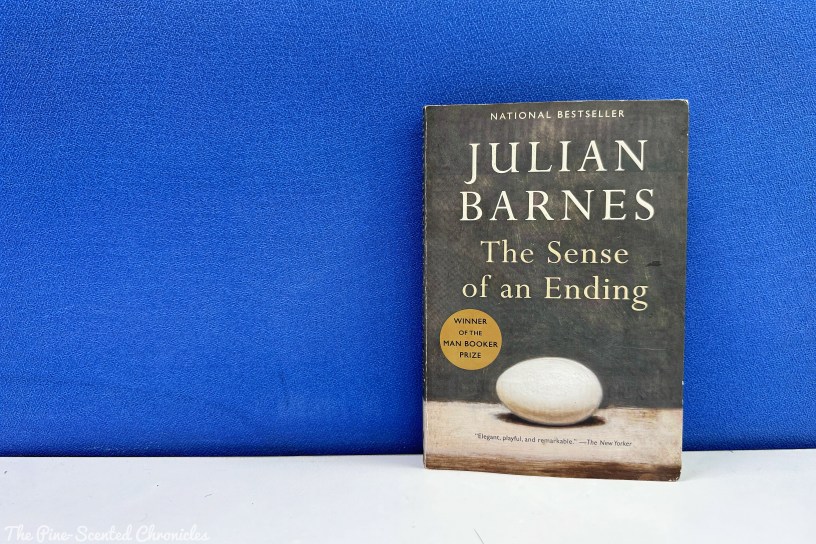
Grappling with Memory
Born on January 19, 1946, in Leicester, England, Julian Barnes is part of a long tradition of British writers who have furthered the reach of one of the most influential and extensive literature in the world. An alumna of Magdalen College Oxford, he started his career as a literary critic, contributing reviews to the Times Literary Supplement in the 1970s. It was also around this time that he started publishing literary thrillers under the pseudonym Dan Kavanagh; he would eventually publish works under another pseudonym, Edward Pygge, alongside other writers. In 1980, he published his first novel under his own name, Metroland. It was warmly received by readers and critics alike. He kept the momentum going by publishing, more novels, short story collections, and even works of nonfiction.
With a career that spanned over four decades, Barnes’ writing has earned him several accolades from different parts of the world. Metroland earned him the Somerset Maugham Award in 1981. He was also the recipient of the 1985 Geoffrey Faber Memorial Prize, the 2004 Austrian State Prize for European Literature, and the 2004 Commandeur de L’Ordre des Arts et des Lettres. His works also have not escaped the attention of the British literary circles. His third novel, Flaubert’s Parrot (1984) not only earned him the French Prix Médicis Essai in 1986 but it also earned him his first shortlisting for the prestigious Booker Prize. This initial shortlisting would be succeeded by two more: England, England (1998) and Arthur & George (2005).
In 2011, Barnes finally made his Booker Prize breakthrough. His novel. The Sense of an Ending was announced as the winner of the highly-regarded literary prize. At the heart of his eleventh novel is Tony Webster who was first introduced in the contemporary. He was a sixty-year-old retired arts administrator living alone in London. The catalyst for the novel’s action was a letter Tony received from a lawyer. The letter concerned a mysterious bequest that led him to reflect on his past and its connection to the inheritance he just received. As he grapples with his memories, he is slowly realizing that there were some gaps in how he remembered things which made him question the accuracy of his memories. It was dawning on him that the past was not how he remembered it to be.
“I certainly believe we all suffer damage, one way or another. How could we not, except in a world of perfect parents, siblings, neighbours, companions? And then there is the question on which so much depends, of how we react to the damage: whether we admit it or repress it, and how this affects our dealings with others. Some admit the damage, and try to mitigate it; some spend their lives trying to help others who are damaged; and there are those whose main concern is to avoid further damage to themselves, at whatever cost. And those are the ones who are ruthless, and the ones to be careful of.”
~ Julian Barnes, The Sense of an Ending
As more questions than answers emerged, Tony found himself introspecting about the past and how it has impacted him as an individual. To understand him in the present, he takes the readers to when he was young. Tony flashes back to when he was attending an all-boys high school in London in the 1960s. At this school, Tony was the third member of a well-bonded clique; the other two were Colin and Alex. The preoccupation of the first of the book’s two parts was the intersection of Tony’s path with two other individuals. These two individuals would be integral in shaping his younger self. The first of these two individuals was Adrian who Tony first met in high school. When he first arrived, Tony was initially dismissive of Adrian’s presence. It didn’t take time for Tony to warm up to Adrian. Adrian soon became a part of Tony’s circle.
Despite being accepted in Tony’s circle, Adrian kept himself at a distance. He also tends to keep things to himself; unlike his friends, his parents were divorced, a rarity in his environment. In a way, Adrian was the antithesis of Tony. Adrian has a more serious approach to life and studies. Adrian actively participates in school activities. He contemplates his teacher’s questions. While Tony would respond to these questions with witty quips or ripostes, Adrian would respond with philosophical arguments. This, however, does not mean that Adrian lacks humor and wit. His intellect was among the things that left a deep impression on Tony. Tony recalls a clever quip made by Adrian during the last history class of the term. When Tony complimented Adrian, Adrian took it seriously rather than deflecting it.
Following their graduation, the friends’ paths diverged. Adrian’s intellect earned him a scholarship to Cambridge. Tony, on the other hand, started studying history at Bristol. It was there that he met the second character who influenced his life, his first girlfriend, Veronica Mary Elizabeth Ford. While Tony found her nice, he was soon intimidated by her, particularly her social and economic status; she belonged to a social station above Tony’s. A pivotal point in their relationship came when Veronica invited Tony to meet her family in Kent, at Chislehurst. Veronica’s father and brother’s treatment of him discomfited Tony; he felt like he was looked down upon because of his social status although he was unsure if this feeling emanated from a place of paranoia.
Sarah Ford, Veronica’s mother, however, left a deep impression on him, particularly Sarah’s caveat vis-à-vis her daughter. She advised Tony to not let Veronica get away with too much. As fate would have it, Veronica and Tony broke up. A couple of years later, Veronica ended up dating Adrian. Tony’s initial response was that he did not mind their relationship but after dwelling on the issue, he denounced the couple. This was followed up by a tragic but seminal juncture in the friend’s story. Meanwhile, Tony went on with his life and married Margaret with whom he had a daughter named Susie. This jolts the readers back into the present where Tony is again caught in the swirl of introspection about time and memories. As more gaps in his memory manifested, Tony was forced to confront the ghosts of the past that were haunting him in the present.
“We live in time – it holds us and molds us – but I never felt I understood it very well. And I’m not referring to theories about how it bends and doubles back, or may exist elsewhere in parallel versions. No, I mean ordinary, everyday time, which clocks and watches assure us passes regularly: tick-tock, click-clock. Is there anything more plausible than a second hand? And yet it takes only the smallest pleasure or pain to teach us time’s malleability. Some emotions speed it up, others slow it down; occasionally, it seems to go missing – until the eventual point when it really does go missing, never to return.”
~ Julian Barnes, The Sense of an Ending
The Sense of an Ending, ironically, is a very slim volume. However, it is an ambitious literary piece that examines a plethora of subjects. Memory was, of course, the backbone of the story. However, memory can be imperfect. Memory is mutable making it unreliable. How one recalls an event can greatly differ from how another recalls it. This allows us to create our own narratives which can lead to manipulation and even self-deception. It is laced with misinterpretations and uncertainties. In a sense, memory is a matter of perspective. In the case of Tony, his memories were challenged and even undone by a new piece of information he acquires as he confronts his past. He recognized the limitations of his own memory and to understand them, he needed the assistance of others from his past.
While Tony was wading through fragments of his memory, he also set into motion a conquest for the truth, although at the onset it was more of a search for corroborating evidence to validate his own memories. It is a journey fraught with obstacles. This is exacerbated by the unwillingness of others to deal with or explore the past. The past is a sunk cost that others would rather move on from rather than be sunk by. Not everyone is willing to have their memories questioned. To do so would dismantle some core memories and even erode their images. Take Tony’s experience meeting Veronica’s family for the first time. To admit paranoia entails changing his understanding of her family. In light of Tony’s experiences in the present, will we really be able to find out what truly happened?
In connection with the novel’s exploration of the unreliability of memory, it also tackled time. Barnes captured how time can impact one’s identity. Time can alter our perspective and even influence our understanding of our own selves and those around us. The most direct illustration of this is Tony’s introspection which also allowed him to see the changes, both the radical and the subtle, that took place. He used to be a misogynist, rebellious, and lacking in ambition. He ended up living a dull life. With the passage of time comes maturity and wisdom. In his sixties, Tony started to understand how he and his actions have impacted the people he once held dear. With new information coming to light, Tony was allowed an opportunity to confront his perspectives. In a way, Tony’s journey can be a form of healing.
Beyond memory, history, and the search for the truth, the novel also explores the complexities of love and loss. The former was explored through Tony and Veronica’s love story. It was not always sunshine and flowers. There were also betrayals and feelings of disappointment. Betrayals create feelings of resentment. Their romance also underlined, albeit to a lesser extent, subjects such as social classes, sexual liberation, and even the dynamics of power. On the other side of the spectrum, is the exploration of loss and grief. Suicide was featured in the story with deaths creating rifts and major tensions in the story. With this came the exploration of remorse. Human nature was extensively explored in the story.
“Does character develop over time? In novels, of course it does: otherwise there wouldn’t be much of a story. But in life? I sometimes wonder. Our attitudes and opinions change, we develop new habits and eccentricities; but that’s something different, more like decoration. Perhaps character resembles intelligence, except that character peaks a little later: between twenty and thirty, say. And after that, we’re just stuck with what we’ve got. We’re on our own. If so, that would explain a lot of lives, wouldn’t it? And also – if this isn’t too grand a word – our tragedy.”
~ Julian Barnes, The Sense of an Ending
Another integral element of the story was philosophy and also literary ideas. These were intricately woven into the novel’s lush landscape. The characters often find themselves poring over how philosophy resonates in our daily lives. The characters were embroiled in philosophical discourses that even covered subjects of life and death. The novel’s wonderful elements were woven together by Barnes’ adept hands. He was able to weave a lush tapestry. It is a readable book with a rather fast pace. However, moments of introspection require the reader’s careful attention. It is deceptively slim but it sure packs a lot of punch. It was melancholic but was also brimming with nostalgia. Both of these qualities were carefully and masterfully handled by Barnes’ prose.
The winner of the 2011 Booker Prize, The Sense of an Ending is a work of wonderful deceptions. At the onset, Barnes makes the readers believe that Tony’s story is a meditation on lost memories. The novel extensively examines memory and how it is often subjected to alteration. We have this compunction to paint ourselves in the best image possible. At times, we create scenarios and even lie to ourselves. Our memories are infallible and can change with time. Such is the folly of time. These are among the difficult questions that the novel asks, prompting the readers to reflect. But time is the ultimate teller of truth. Tony’s story further scrutinizes a myriad of subjects such as the search for truth, the follies of aging, and the intricacies of love, and loss. Deceptively slim, The Sense of an Ending is a compelling and thought-provoking read with delicate undertones.
“When you’re young – when I was young – you want your emotions to be like the ones you read about in books. You want them to overturn your life, create and define a new reality. Later, I think, you want them to do something milder, something more practical: you want them to support your life as it is and has become. You want them to tell you that things are OK. And is there anything wrong with that?”
~ Julian Barnes, The Sense of an Ending
Book Specs
Author: Julian Barnes
Publisher: Vintage International
Publishing Date: May 2012
No. of Pages: 163
Genre: Literary
Synopsis
A novel so compelling that it begs to be read in a single sitting, The Sense of an Ending has the psychological and emotional depth and sophistication of Henry James at his best, and is a stunning new chapter in Julian Barnes’ oeuvre.
This intense novel follows Tony Webster, a middle-aged man, as he contends with a past he never thought much about – until his closest childhood friends return with a vengeance: one of them from the grave, another maddeningly present. Tony thought he left this all behind as he built a life for himself, and his career has provided him with a secure retirement and an amicable relationship with his ex-wife and daughter, who now has a family of her own. But when he is presented with a mysterious legacy, he is forced to revise his estimation of his own nature and place in the world.
About the Author
Julian Patrick Barnes was born on January 19, 1946, in Leicester, England, to French teachers. Shortly after his birth, his family moved to suburban London. From 1957 to 1964, he attended the City School of London. At Magdalen College Oxford, he studied modern languages.
Prior to pursuing a literary career, Barnes worked as a lexicographer for the Oxford English Dictionary supplement before he started contributing literary reviews to the Times Literary Supplement in the 1970s. He also worked as a television critic, first for the New Statesman and then for The Observer. While writing reviews, he started publishing thrillers under the pseudonym Dan Kavanagh; the Kavanagh was derived from his wife Pat Kavanagh, a literary agent, who he wed in 1979. In 1980, Barnes published his first novel under his name, Metroland. Two years later. he published Before She Met Me. His third novel, Flaubert’s Parrot (1984) earned him his first shortlist at the prestigious Booker Prize. It also won him the 1986 Prix Médicis Essai.
England, England (1998) and Arthur & George (2005) were also shortlisted for the Booker Prize. In 2011, The Sense of an Ending finally earned Barnes the elusive Booker Prize. The novel was also shortlisted for the Costa Book Awards. Barnes’ latest novel, Elizabeth Finch, was published in 2022. He also published collections of short stories and works of nonfiction, including a collection of essays, Something to Declare (2002). His works also earned him accolades across the world including the 1985 Geoffrey Faber Memorial Prize, 2004 Austrian State Prize for European Literature, and 2011 David Cohen Prize for Literature. He was also conferred with the Commandeur de L’Ordre des Arts et des Lettres in 2004 and the Officier in the Ordre National de la Légion d’Honneur in 2017.
Barnes is currently residing in Tufnell Park, north London, where he lived since 1983.
 The Pine-Scented Chronicles