In Pursuit of One’s Identity
Gates. Checkpoints. Demilitarized Zones. History is riddled with these physical manifestations of limits and divisions. They are the reminders of the severance of human connections. They symbolize the rifts and schisms that continue to divide us. The Korean Peninsula has the Demilitarized Zone effectively dividing the Peninsula between North and South. When Germany was divided between East and West, the Berlin Wall was one of its most enduring symbols. Jerusalem has its own version. Between the Israeli and Jordanian sectors of the holy city once stood the Mandelbaum Gate. Located just north of the western edge of the Old City along the Green Line, the Gate once served as a checkpoint and the only entry point between the two sovereign nations.
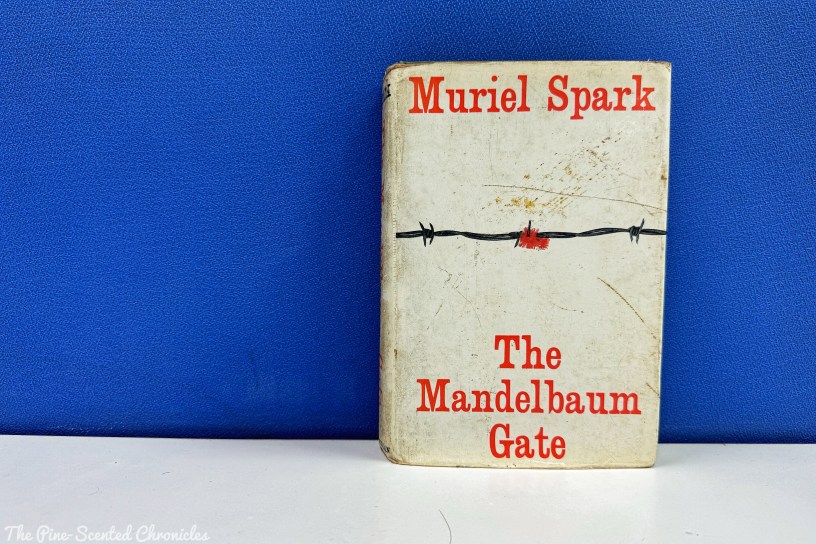
The Gate, which derived its name from the Mandelbaum House that once stood on its site, is also a contentious point in the modern history of the Holy Land. It was symbolic of the tensions that have long plagued the Holy Land. It was the convergence of religious pilgrimage and modern political tensions. It was this historic landmark that was the subject of Muriel Spark’s novel, The Mandelbaum Gate. Spark’s earlier works were characterized by humor and, in a way, The Mandelbaum Gate was a critical juncture in Spark’s career as it was one of her first attempts toward examining heavier subjects and themes. This ambitious undertaking takes the readers to 1961 Jerusalem where an Englishwoman named Barbara Vaughan found herself on a pilgrimage; Barbara was the book’s main character.
Barbara was a spinster schoolmistress born to an upper-middle-class English father and a British-Jewish mother. She also converted to the Catholic faith and is in a relationship with Harry Clegg. Harry was also one of the reasons why Barbara found herself in Jerusalem. He was an archeologist engaged in the Dead Sea Scrolls site at Qumran in Jordan. Harry was also married but his first marriage is awaiting annulment by the Catholic Church. The annulment of Harry’s first marriage will cement their plan of getting married. On top of this, Barbara’s journey to Jerusalem made her confront the complexities of her heritage, particularly her Jewish origins. As such, Barbara’s pilgrimage to the Holy Land is no typical journey. It was driven by several factors, including spiritual, racial, and romantic.
“He was demanding an explanation. By the long habit of her life, and by temperament, she held as a vital principle that the human mind was bound in duty to continuous acts of definition. Mystery was acceptable to her, but only under the aspect of a crown of thorns. She found no rest in mysterious truths like, ‘I am who I am’; they were all right for deathbed definitions, when one’s mental obligations were at an end.”
~ Muriel Spark, The Mandelbaum Gate
Barbara wanted to cross the border to the Jordanian-controlled East Jerusalem to “throw light on the ritualistic lines which the man in the glass box was repeating, or give meaning to her mesmerized presence on the scene.” To do so, she must first cross the titular Mandelbaum Gate. It is at this juncture that complications arose. Despite her British nationality, her Jewish origins made Jordanian authorities suspect Barbara to be an Israeli spy. This caveat was issued to Barbara but she was adamant to cross the border and meet her fiancé. To reduce the likelihood of being apprehended upon crossing the Gate, Barbara enlisted the assistance of Freddy Hamilton, a British consular official, and a group of other Arab officials. These officials’ intentions, however, were obscure. It remains to be seen if they sympathize with Barbara’s mission.
For Barbara to safely cross the border, she must disguise herself as an Arab servant; this entails covering her face in a hijab. It was fraught with danger but her newfound “allies”, Arab siblings Adbul and Suzi Ramdez born to an unlikeable father, assured her that they would guide her through the pilgrimage across the border. Just when things were about to look up for Barbara, Barbara contracted scarlet fever upon crossing over the border. There was no recourse for her but to be quarantined in an obscured hideout in Jericho. It was at this hideout that Barbara encountered an eclectic cast of characters, including prostitutes and an anti-Semitic spy. Because of her absence, Barbara was considered as “missing” by her family and friends. This unwelcome news ushered in more seemingly concerned characters trying to locate Barbara.
Among these characters was her friend Miss Rickward, or Ricky who turns up in Jerusalem to Barbara’s surprise. Ricky was the domineering headmistress of the private school Barbara was teaching at. She traveled to Jerusalem in search of her friend but her intentions were anything but good. Barbara’s cousin Michael also arrives in Jerusalem to cover the Adolf Eichmann trial. Eichmann is a major Holocaust perpetrator who was captured in Argentina by Israeli agents and brought to Israel to stand trial. The Eichmann trial is one of the prevailing themes of the novel as it is extensively discussed by the characters. As Barbara goes missing and more characters converge in the Holy Land, Freddy suffers from amnesia; he wakes up having completely lost two days of his life. Harry, meanwhile, was in Rome working on the annulment of his marriage.
The Mandelbaum Gate was dense and filled with several incidents. However, it was propelled by its eclectic cast of characters with diverse backgrounds, nationalities, and even ideologies. Barbara looms large in the story. As Barbara ventures across the border, the story flashes back to her childhood; the novel weaves in and out of different periods. Barbara was also the quintessence of one of the novel’s main themes: division. The largest allegory for division, of course, was the gate. But this division also manifested in various aspects of Barbara’s makeup. She was born with a mixed heritage, one that played a critical role in her presence in the Holy Land. Religiously, she was also divided. She has Jewish blood but converts to Catholicism. The Eichmann trial is also a reminder of the racial and religious divides that were among the catalysts for the current situation in the Holy Land.
“Like practically everyone else – and she was one of those afflicted by her gifts. For she was gifted with an honest, analytical intelligence., a sense of fidelity in the observing of observable things, and at the same time, with the beautiful and dangerous gift of faith which, by definition of the Scriptures, is the sum of things hoped for and the evidence of things unseen.”
~ Muriel Spark, The Mandelbaum Gate”
~ Muriel Spark, The Mandelbaum Gate
However, the most palpable division was that of Israel and its neighbors. Political and religious tensions and divides keep the Holy Land in perpetual turmoil. As highlighted in the novel, Jordan and Israel have a very precarious relationship; they barely recognize each other’s existence, hence, the imposition of strict border patrols. Interestingly, several biblical sites are located in Jordan and to visit them, one must go through stringent checks. But this is just a microcosm of the social and political pandemonium that persists in the Holy Land. The creation of the State of Israel following the end of the Second World War disrupted the lives of the occupants of the Holy Land, pushing some of the denizens to outer territories. The legacy of this historical event reverberates into the contemporary. Palestine is under constant threat from the Israeli government.
The legacy of colonialism was also subtly woven into the novel’s lush tapestry. Freddy was an allegory for the colonialist ideals. The British once had control of the region and were instrumental in the creation of the State of Israel. In a way, this was a catalyst in the identity crisis that ensued in post-colonial Britain. The religious and political differences came to a head. This identity crisis was further examined through Barbara; her story was also about belongingness. In Jerusalem, she found herself at an impasse due to her mixed heritage. Her conversion to Catholicism also figures into the equation. Her pilgrimage to the Holy Land was, in part, also a quest to understand her roots, both racial and religious. In this eventful novel, there were several instances when Barbara had to confront her identity.
Crossing the border, she assumed multiple and even contradicting identities. The quest for identity, however, was not limited to Barbara. Siblings Abdul and Suzi wanted to step out of the shadow of their domineering father; their father, Joe Ramdez runs and manages a tourist company that also serves as a cover for his nefarious activities. The siblings wanted to carve their own destinies. With his interactions with Freddyf and Western ideals, Abdul’s political ideologies shifted toward the West. The thorny relationship between parents and their children was a recurring subject. The case of the Ramdez siblings was one exemplification of this. Despite the fact that Freddy was working in Jerusalem, his mother who was in Harrogate kept on interfering with his life. Elsewhere, the novel explores espionage, stalking, and even homosexuality. These are on top of the religious references that were interspersed in the story.
Despite the presence of several characters, most of them remain ciphers at the end of the story. Their motivations and even their intentions were rarely clear to the readers. Further, the fifty-year-old Freddy was a passive character albeit him being the central male character. He had an unexciting career and was rarely in control of his own life. Unlike Barbara, Abdul, and Suzi, he lacked ambition. In times of trouble, he goes incognito. He hides behind the mask of mental stress to escape responsibility for his actions. It was all too convenient for him. He prefers the passive and decadent life he lived that allowed him to cross borders without much complications. Barbara was his biggest complication. She was his antithesis. She was single-minded and clearly knew what she wanted. As her adventure across the borders demonstrated, she was not easily dissuaded.
“She knew he was in business for political purposes, that he was in political things to enable him to score personal vendettas; she knew he was also in business for political purposes, was a political informer for the Jordanian secret service, that he passed intelligence to the United Arab Republic concerning the Jordanian government, and that these activities were balanced to a fine point which so depended on instinct that he could no more have put them down on paper than he could actually see his own face. They all revolved round blackmail of sorts, the arranging of forged visas and other papers, and, when dealing with foreigners, a plausible technique of feigned misunderstandings. Suzi did not think of her father as a crook or a traitor, but she knew that he was. He thought of himself as a patriot, an Arab, and overwhelmingly, as a man who, in all his actions, did justice to himself”
~ Muriel Spark, The Mandelbaum Gate
Spark wove all of the novel’s wonderful elements together with her insightful writing riddled with layers of humor and adventurousness. This produced a lush tapestry with a dense. The bevy of events that transpired provided the tapestry various interesting complexions. With her writing, Spark also managed to evoke a sense of time. As part of her research for the book, Spark spent two months in Israel. Interestingly, she even attended the trial of Adolf Eichmann as a reporter. One can surmise that Barbara was Spark’s alter ego. Spark created various elements of the novel with precision and care. However, the story tended to meander. This was exacerbated by the novel’s tendency to weave in and out of periods. Rather than adding a level of complexity, the time element made the story convoluted. It can be a slow read at times.
The winner of the James Tait Black Memorial Prize in 1965, The Mandelbaum Gate is a compelling addition to Spark’s oeuvre. It marked a shift from her usually lighthearted stories. The humor was still there but the novel examined more serious subjects. Through Barbara’s pilgrimage to the Holy Land, the novel exposes the divisions and rifts that have long plagued the region. The legacy of colonialism plays a pivotal role as political, religious, and social concerns intertwine and the pandemonium that ensued undermines the stability of the region. Political overtones and historical context enriched the story. Beyond the complex subjects it tackled, the novel was also personal. It is about finding one’s identity in a complex world, which can be an eventful odyssey on its own, as Barbara would experience.
“He always felt he had perhaps been boring during his stay, and it was one’s duty in life to be agreeable. Not so much at the time as afterwards, he felt it keenly on his coscience that he had said no word between the soup and the fish when the bright talk began; he felt at fault in retrospect of the cocktail hours when he had contributed nothing but the smile for which he had been renowned in his pram and, in the following fifty years, elsewhere.”
~ Muriel Spark, The Mandelbaum Gate
Book Specs
Author: Muriel Spark
Publisher: Macmillan and Company Limited
Publishing Date: 1965
No. of Pages: 330
Genre: Literary, Family Saga, Historical
Synopsis
In the British Consulate in Israel’s Jerusalem is Freddy Hamilton, given to the composition of formal verses, and long evasive letters to his aged mother ‘Dearest Ma…’. Kindly, celibate, hater of emotional scenes, but ultimately no sort of fool, he comes across a young Englishwoman on a visit and appoints himself her friend and protector. His fears for her safety are well founded.
Barbara Vaughan has come to the divided city of Jerusalem, resounding in her own ambivalence. Half English ‘county’, half London Jewish, a Catholic convert, she is in pursuit of her fiancé, a Dead Sea scrolls archaeologist, and in flight from her oldest friend, a fellow-schoolmistress. She insists, in spite of Freddy’s warnings that her Jewish blood will endanger her life, on combining her holiday of hide-and seek with a pilgrimage to the Holy Places in Jordan’s Jerusalem.
The pilgrimage becomes one of flight, rout, disguise, pursuit, abduction, murder, espionage. A marvelous supporting cast brings out the best and worst in heroine and hero, as they are plunged from high comedy to low tragedy and back, on a switchback of suspense and drama.
The Mandelbaum Gate is consistently, compulsively readable, deadly serious and extremely funny. It is a book in praise and condemnation of the wicked and the blessed, the sacred and the profane, and all the contradictions and dichotomies in Jerusalem and under the sun.
About the Author
Sarah Muriel Spark (née Camberg) was born on February 1, 1918, in Edinburgh, Scotland to a Jewish father and an English mother. She attended James Gillespie’s School for Girls from 1923 to 1935 where she received some education in the Presbyterian faith. At Heriot-Watt College, she took a course in commercial correspondence and précis writing from 1934 to 1935. In 1937, she traveled to Southern Rhodesia (present-day Zimbabwe) and married Sidney Oswald Spark; they would separate in 1940.
In 1944, Spark returned to Britain and worked in military intelligence for the remainder of the Second World War. Following the end of the war, Spark pursued wiring as a full-time career. She started with poetry and literary criticism. From 1947 to 1949, Spark worked as an editor for the Poetry Review, the literary journal of the Poetry Society. She then published a series of critical biographies of literary figures and editions of 19th-century letters, including Child of Light: A Reassessment of Mary Wollstonecraft Shelley (1951), John Masefield (1953), and The Brontë Letters (1954). The Fanfarlo and Other Verse, her first poetry collection, was published in 1952.
She then expanded her oeuvre by venturing into prose. Her first novel, The Comforters, was published to great critical acclaim in 1957. She immediately followed it up with Robinson (1958) and Memento Mori (1959). More critical acclaim arrived with the publication of The Prime of Miss Jean Brodie in 1961. Over the course of her career, Spark published 22 novels, with The Finishing School (2004) her last. Other works include The Go-Away Bird and Other Stories (1958), Collected Poems I (1967) and Collected Stories (1967). Her autobiography, Curriculum Vitae, was published in 1992. The Informed Air (2014) is a posthumous collection of some of her nonfiction.
For her works, Spark has earned several accolades including the Ingersoll Foundation T. S. Eliot Award for Creative Writing in 1992 and the David Cohen Prize in 1997. The Mandelbaum Gate (1965) won the James Tait Black Memorial Prize in 1965. Her works The Public Image (1968) and Loitering with Intent (1981) were shortlisted for the Booker Prize. In 1998, she was awarded the Golden PEN Award by English PEN for a “Lifetime’s Distinguished Service to Literature.” She became an Officer of the Order of the British Empire in 1967 and Dame Commander of the Order of the British Empire in 1993 for services to literature.
Dame Muriel Sarah Spark DBE FRSE FRSL passed away on April 13, 2006.
 The Pine-Scented Chronicles