A Response to Radicalism
Born on November 11, 1821, in Moscow, Russia, Fyodor Mikhailovich Dostoyevsky is, without a doubt, one of the most renowned Russian writers; he along with a select few is synonymous with Russian literature. He is widely regarded by readers and literary critics alike as one of the best novelists of all time. A foray into the vast ambit of world literature as a whole would not be complete without a step into the world of Dostoyevsky. Unlike his contemporaries, Leo Tolstoy and Ivan Turgenev, Dostoyevsky was not born into the land gentry. Despite this, his interest in literature – primarily through legends and fairy tales – was cultivated at a young age. As a student, Dostoyevsky was drawn to works of Romantic and Gothic fiction. The works of Sir Walter Scott, Ann Radcliffe, Nikolay Karamzin, Friedrich Schiller, and Aleksandr Pushkin were staples for Dostoyevsky.
In 1846, Dostoyevsky published his first major work, Bednyye lyudi (Poor Folk) which is considered by many as a pioneer of existentialist literature. Shortly after the book’s publication, he was named by the most influential critic of his day, Vissarion Belinsky, as the great new talent of Russian literature. However, his increasing involvement in political activism resulted in his exile to Siberia, alongside members of Petrashevsky Circle, a group of intellectuals who discussed utopian socialism. The years following his release on February 14, 1854, were marked by constant travels. He was first stationed at Semipalatinsk in Kazakhstan for military duties but was released due to deteriorating health. While traveling, he continued to write short stories. He then traveled to Western Europe before finally settling down in Russia in the 1860s.
Dostoyevsky’s return to Russia marked undoubtedly the greatest years of his literary career. It started with the publication of his first major novel, Prestupleniye i nakazaniye in 1866. The novel would be known by the Anglophone-speaking section of the world as Crime and Punishment. It set the tone for what would be the hallmarks of Dostoyevsky’s oeuvre: psychological insights and the innate understanding of human nature. Crime and Punishment would also be the first of what many would collectively refer to as his four masterworks which elevated Dostoyevsky to global recognition. Like most of his works, most of which are highly influential masterpieces, they have transcended time and remain integral in literary discourses; they are familiar presences in must-read lists.
“That is base, that is the whole deceit! Life is pain, life is fear, and man is unhappy. Now all is pain and fear. Now man loves life because he loves pain and fear. That’s how they’ve made it. Life now is given in exchange for pain and fear, and that is the whole deceit. Man now is not yet the right man. There will be a new man, happy and proud. He for whom it will make no difference whether he lives or does not live, he will be the new man. He who overcomes pain and fear will himself be God. And this God will not be.”
~ Fyodor Dostoevsky, Devils
An Unusual Meeting
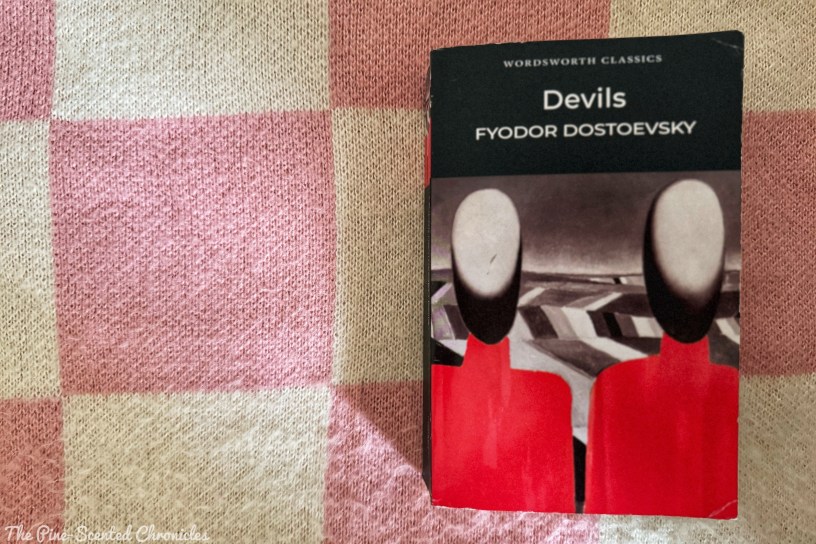
Originally published in serial form from 1871 to 1872 in the journal The Russian Messenger, Bésy (Бѣсы) is the third of Dostoyevsky’s four masterworks. It was translated into English as Devils; it would later be published under the English titles The Demons and The Possessed. Devils is divided into three parts. The first part lays out the landscape of the novel and introduces the main characters. Stepan Trofimovitch Verhovensky is an intellectual with an illustrious academic career but his career was cut short. In the throes of this devastating turn of events, he was hired by affluent landowner widow Varvara Petrovna Stavrogina to be the tutor of her son Nikolay Vsyevolodovitch Stavrogin, the novel’s main character. Stepan would spend two decades living with Varvara. As fate would have it, Stepan was in an intimate but platonic relationship with his patroness.
Following rumors about her son’s romantic involvement with different women, Varvara was relentless. One rumor linked him to Liza (Lizaveta Nikolaevna Tushina), the daughter of her friend Praskovya Ivanovna. However, according to Praskovya, Nikolay was also involved with Darya Pavlovna (Dasha), Varvara’s young protégée. Gossipmongers have also mentioned Marya Timofyevna Lebyadkina, a crippled woman. To stymie the spread of the rumors, Varvara arranged a marriage between Stepan and Dasha. The proliferation of these rumors also prompted Varvara to convene a meeting with all the parties involved in her estate, Skvoreshniki, in the Russian countryside. This gathering at her home was abruptly broken by the entry of yet another mysterious character purporting to be Nikolay; who turned out to be Pyotr Stepanovitch Verhovensky, Stepan Trofimovitch’s strange son.
The meeting cleared up some of the misunderstandings. However, it concluded on a rather sour note. Ivan Pavlovitch Shatov, the brother of Dasha, struck Stavrogin in the face; Stavrogin, however, did not retaliate. Stepan, meanwhile, was banished from her estate by Varvara. As the first part concluded, little has been resolved, thus, the tension that percolated was used by Dostoyevsky to build upon the Second Part of the novel. The novel’s middle part – also its heftiest – saw the spread of the rumors among the town’s social circles. While most characters opted to insulate themselves, Pyotr saw it as an opportunity to ingratiate himself into the town’s social life. Pyotr was gifted in the art of dialogues and conversations. This made him close with Yulia Mihailovna von Lembke, the governor’s wife. Her husband, Andrey Antonovitch von Lembke, was a troubled man anxious about his duties as the provincial governor. The tension between the governor and Pyotr was palpable.
A Town in Pandemonium
While Pyotr was ingratiating himself with Yulia, he was plotting a political revolution in the town. To this end, he exploited Yulia’s liberal idealism by claiming to work for Internationale, an organized conspiracy that plans to overthrow the government. The goal was to establish socialism. He was also able to convince a small group of co-conspirators, among them Captain Lebyadkin, Fedka (an escaped convict), Erkel, Lyamshin, and Liputin. He indoctrinated them, turning them into nihilists and making them believe that they would play a seminal role in a scheme that would set off a nationwide revolt. However, there was one individual that Pyotr was desperate to recruit for their cause: Nikolay. Pyotr tried everything, including ensnarement and persuasion, to convince Nikolay. Nikolay, however, was reluctant to join the group. Nikolay also saw through Pyotr’s facade and schemes.
“Every people has its own conception of good and evil, and its own good and evil. When the same conceptions of good and evil become prevalent in several nations, then these nations are dying, and then the very distinction between good and evil is beginning to disappear. Reason has never had the power to define good and evil, or even to distinguish between good and evil, even approximately; on the contrary, it has always mixed them up in a disgraceful and pitiful way; science has even given the solution by the fist. This is particularly characteristic of the half-truths of science, the most terrible scourge of humanity, unknown till this century, and worse than plague, famine, or war.”
~ Fyodor Dostoevsky, Devils
It was unfortunate as Pyotr planned to install Nikolay as the group’s leader. Pyotr, however, was not one to be easily discouraged. He was relentless in his pursuit to instigate chaos. To this end, he convinced Yulia to host a literary fete; Pyotr’s intention was not to celebrate but rather to mock the cultural elite. Meanwhile, the nihilists sowed discord among the Spigulin factory workers, making them demand improved working and pay conditions. The day of the fete was pandemonium, the events of which were captured in the last part of the novel. The tension that was brewing on the surface escalated exponentially. The nihilists set fire to the poorer side of town which created irreversible damage. This set into motion death, rage, and even murder. It was a tumult, just like Pyotr had envisioned.
Clashing Political Ideologies
Toward the latter part of the 1860s, Russia was marked by the proliferation of liberal, socialist, and revolutionary ideologies. These ideologies made their way into universities, resulting in growing student group movements that instigated political unrest. Radical ideas have proliferated the universities. In response to this, Dostoyevsky birthed the idea of Devils. It was planned to be a scathing commentary against radical thought and actions. Pyotr was the quintessence of a radical who was the main driver for the chaos that swept the Russian countryside. He was imbued with socialist ideals and aimed to dismantle social orders. He was the antithesis of his father who cultivated liberal ideas. The dichotomy in their political ideologies further created a rift between father and son. There were undertones of angst and revenge vis-a-vis their thorny relationship.
In writing the novel, Dostoyevsky drew inspiration from an actual event: the murder of a group of agitators of their former comrade at Moscow’s Petrovskaya Agricultural Academy. The group was led by the young Sergey Gennadiyevich Nechayev, an anarcho-communist who was part of the Russian nihilist movement. The murdered student was Ivan Ivanov; Ivanov started questioning the existence of his underground organization and detached himself from the group. Pyotr and his group were the titular devils. His group of conspirators was reeled into a world of destruction not only because of their idealism. This is convoluted by their vanity, naïveté, idealism, and by the susceptibility of youth.
In a way, the town – particularly the mayhem that happened during the fete – was a microcosm. The novel vividly depicts the adverse impact and the potential consequences of radicalism and extremism on the rest of the country. Indeed, the events of the novel drew eerie parallels to events that would happen a couple of decades later. In the early 20th century, discontent was ubiquitous. Revolutionists and radicals thrummed the call for radical changes. Their call would be heeded, prompting the rise of the Russian Revolution which would bring Russia to its heels. Czar Nicholas II and the last lineage of the Romanovs were overthrown This paved the way for the assent of Vladimir Lenin and the Bolsheviks. The rest, they say, was history. These events adversely altered the Russian political and social landscape. Devils earned Dostoyevsky a reputation for being a political prophet.
“As always, I do not blame anyone. I’ve tried great debauchery and exhausted my strength in it; but I don’t like debauchery and I did not want it. You’ve been observing me lately. Do you know that I even looked at these negators of ours with spite, envying them their hopes? But your fears were empty: I could not be their comrade, because I shared nothing. Nor could I do it out of ridicule, for spite, and not because I was afraid of the ridiculous–I cannot be afraid of the ridiculous–but because, after all, I have the habits of a decent man and felt disgusted.”
~ Fyodor Dostoevsky, Devils
The Man in the Middle
The novel’s lush political discourses characterized it. However, it does not reduce itself to a mere political novel. Rather, it was also a novel about a man caught in the crossfire. When he was younger, Stavrogin embraced and eventually cast off, different ideologies. These ideologies were then adopted by other intellectuals who were drawn to Stavrogin. Stavrogin was a man of paradoxes. Because of his social standing, he was self-assured. However, his demeanor showed distractedness. Stavrogin lived a life of decadence and was even involved in crime, may it be in Moscow or abroad. Even in his spirituality, Stavrogin exhibited polar opposites. One side careened to rationality, intellect, and even egoism. The other side was pegged on spiritual longing inculcated into him Stepan.
Despite his flaws, those around him were enamored by him. Among Stavrogin’s admirers was Shatov. Before the events at the family estate, Shatov looked up to Stavrogin. He was also once a socialist at university but he eventually became a passionate Slavophile; Dostoyevsky was also sympathetic to Slavophile ideals. Pyotr, on the other hand, saw his natural charisma. He saw Stavrogin as a figurehead for his cell of revolutionaries. However, Stavrogin can be whimsical and indulgent. He was not the type of individual to settle down in one place. He was an enigma and a man of contradictions. He can be clear-thinking but can also act insane. In a way, he was more of a nihilist than the young men that Pyotr was able to round up.
The novel was extensive and explored a plethora of subjects. Atheism and belief were major themes in the novel. The rejection of religious and moral foundations creates a space for radical and destructive ideologies; Dostoyevsky views atheism as one of the root causes of Russia’s social maladies. Spiritual conflicts also permeate the story. Stavrogin was a prominent example. Relative to religion, suicide was prevalent in the novel, with Alexei Nilytch Kirillov as its major representation; the major characters represented different facets of Russian society. Kirillov was set on taking his life. Like Shatov, he was also influenced by Stavrogin. He saw taking his own life as a form of sacrifice for the greater good. For Dostoyevsky, suicide was symptomatic of the declining religious faith in Russia. It also underscores the disintegration of key social institutions like the family.
Social classes and social chances were also underlined in the story. Characters were expected to behave based on their social standing. As such, the denizens of the town were intrigued by the marriage of Stavrogin and Marya. The socialist revolution sparked by Pyotr was aimed at dismantling social classes. He exploited the discontent of the lower classes to spark this revolution. Dostoyevsky was also resplendent in capturing the portrait of Russian provincial life He satirized the feeble civic authorities and the pettiness of the elite. The novel highlights generational change. This can be gleaned from the dichotomy in the political schools of thought of Stepan and his son. They were polar opposites. The revolutionary ideals sparked in the 1860s resonated for decades, culminating in the overthrow of the Czar and the rise of the Soviet Union.
“Is this what is called remorse of conscience or repentance? I do not know, and I cannot tell to this day. Perhaps this remembrance even now contains something pleasurable for my passions. No–what is unbearable to me is only this image alone, and precisely on the threshold, with its raised and threatening little fist, only that look alone, only that minute alone, only that shaking head. This is what I cannot bear, because since then it appears to me almost every day. It does not appear on its own, but I myself evoke it, and cannot help evoking it, even though I cannot live with it.”
~ Fyodor Dostoevsky, Devils
A Literary Masterpiece
Devils is an extraordinary achievement of literature. It is a scathing response to the rising revolutionary movement; the novel was not met with fanfare by the revolutionists and the radicals. The novel was an extensive examination of the consequences of radicalism, one that was not foreseen at the time. Further, the novel probes into these different and clashing political ideologies. The reality that would materialize after the book’s publication would establish Dostoyevsky’s reputation as a political prophet. Devils was a political satire and a critical and reflective study of the dangers of unchecked radicalism. In this aspect, the novel is a cautionary tale with a message that goes beyond the context of Russian politics and society. The dangers of radicalism reverberate in the contemporary.
Beyond its political overtones, Devils was also an examination of the waning Russian spirit; this is another quality of Dostoyevsky’s works. In his searing and evocative novel, Dostoyevsky attributed the declining Russian spirit to the rise of the aforementioned political ideologies exacerbated by the rejection of religion. Both were drivers in the disintegration of social structures. The various subjects and themes were explored through an eclectic cast of characters, with each representing different political ideologies and schools of thought. Dostoyevsky yet again fascinates with how he painted and delved into the psychological motivations of his characters; apart from being a prophet, Dostoyevsky is renowned for being the quintessential literary psychologist. Their contrasting beliefs, desires, and conflicts rendered the story interesting textures.
Without a doubt, Devils is a literary masterpiece. Albeit complex and dense, it is a literary work that transcends time and borders. In its timelessness, it remains an integral part of contemporary political and literary discourses. It is a multifaceted and multilayered cautionary tale, a social and political commentary, and an in-depth psychological study. In a nutshell, Devils is a complex work that highlights everything great about Dostoyevsky’s prose. It encapsulates Dostoyevsky’s literary legacy, consolidating his place among the literary greats. For sure, Devils belongs to the vaunted halls of literary classics.
“My immortality is necessary if only because God would not want to commit an injustice and utterly quench the flame of love for him once it has been kindled in my heart. And what is more precious than love? Love is higher than existence, love is the crown of being, and how is it possible that existence is not subordinate to it? If I have come to love him and have taken joy in my love, is it possible that he should extinguish both me and my joy and turn us into nothing? If God exists, then I am immortal too!”
~ Fyodor Dostoevsky, Devils
Book Specs
Author: Fyodor Dostoevsky
Translator (from Russian): Constance Garnett
Publisher: Wordsworth Classic
Publishing Date: 2009 (1871-1872)
No. of Pages: 694
Genre: Historical, Literary, Political, Psychological
Synopsis
In 1869 a young Russian was strangled, shot through the head and thrown into a pond. His crime? A wish to leave a small group of revolutionaries, from which he had become alienated. Dostoevsky takes this real-life catastrophe as the subject and culmination of Devils, a title that refers to the young radicals themselves and also to the materialistic ideas that possessed the minds of many thinking people in Russian society at the time.
The satirical portraits of the revolutionaries, with their naivety, ludicrous single-mindedness and readiness for murder and destruction, might seem exaggerated – until we consider their all-too-recognisable descendants in the real world ever since. The key figure in the novel, however, is beyond politics. Nicolay Stavrogin, another product of rationalism run wild exercises his charisma with ruthless authority and total amorality. His unhappiness is accounted for when he confesses to a ghastly sexual crime – in a chapter long suppressed by the censor.
This prophetic account of modern morals and politics, with its fifty-odd characters, amazing events and challenging ideas, is seen by some critics as Dostoevsky’s masterpiece.
About the Author
To learn more about Fyodor Dostoevsky/Dostoyevsky, one of the greatest Russian writers of all time, click here.
 The Pine-Scented Chronicles