
First Impression Friday will be a meme where you talk about a book that you JUST STARTED! Maybe you’re only a chapter or two in, maybe a little farther. Based on this sampling of your current read, give a few impressions and predict what you’ll think by the end.
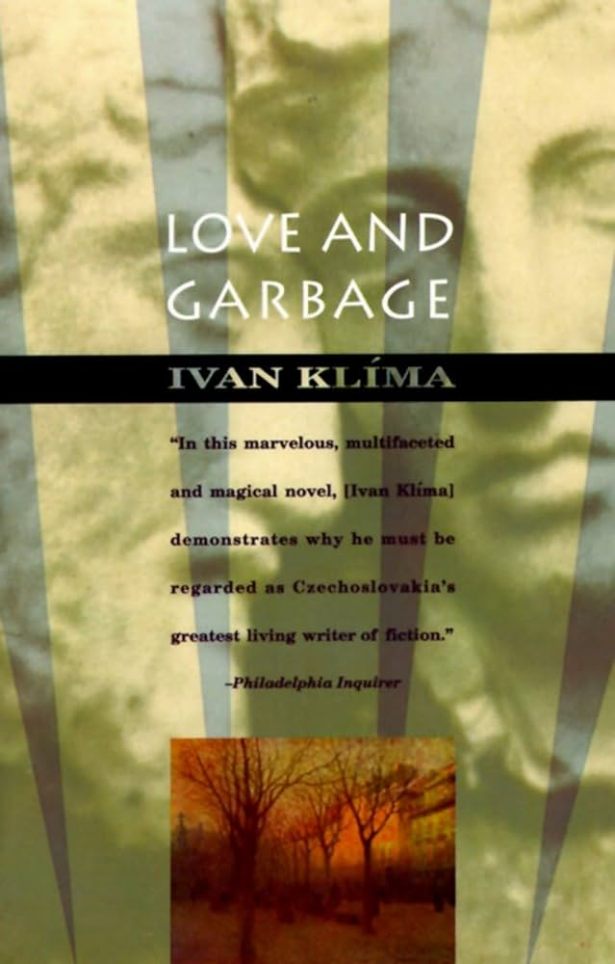
Synopsis:
Like Milan Kundera and Josef Skvorecky, Ivan Klima is a Czech writer whose work was banned in his own country and thus was more or less compelled to become truly international in scope and impact. For although Love and Garbage is set in Prague in the years before the Velvet Revolution, it explores themes of conscience and betrayal that cut to the bone of life in both totalitarian and democratic societies.
The writer-hero of this shrewd, humane, and poignant novel by the author of Judge on Trial has responded to state suppression by becoming a street-sweeper. From his vantage point in Prague’s gutters comes a piercing vision of a world in which everything – from uncomfortable ideas to a former mistress – may be reduced to garbage and only love has the power to grand permanence.
It is the weekend again! That is another work week in the books. I hope it was not as hectic, at least mine was not as hectic as the first week of the month especially because it was the week immediately preceding the end of the second quarter and the first half of the year; it was a double whammy for me. This is also the reason why I rarely enjoy my birthday week. Nevertheless, I had fun last week despite the tediousness of it all. It also spilled over into this week as I met old friends. Anyway, I hope everyone ended the work week on a high note. I hope the week went the way you wanted it to. I hope that, after a long week at the office, you can recharge and regain some of the manna you’ve lost during the weekend. I hope you will be able to rest, relax, and reflect. More importantly, I hope that everyone is doing well, in body, mind, and spirit.
But before I can fully dive into the weekend, let me cap another blogging week with a fresh but late (again) First Impression Friday update. With six months chalked up already, my 2024 literary journey is in full swing. I have already read over 60 books and the signs indicate another 100-book year. If so, 2024 would be the third consecutive year I achieved this feat. But I don’t want to look too far into the future. I want to focus on the present. In the present, I have extended my foray into the works of European literature – this is the third consecutive month I have read works of European literature – because I realized I still have a lot of books from this part of the literary world that I wanted to read. These books shuttled me across the continent, making me experience an enthralling journey that allowed me to explore writers whose oeuvres I have not explored before while, at the same time, reintroducing familiar ones.
Among the new names that this journey introduced to me is the Czech writer Ivan Klíma. Earlier this year, I was able to obtain a copy of his novel, Love and Garbage. Curious about what the novel has in store, I made it part of my ongoing venture into European literature. Besides, my foray into Czech literature has been limited at best. Apart from Milan Kundera, the only other Czech writer who I can name at the top of my brain – and the only other Czech writer whose work I have read, at least as far as I can remember – is Bohumil Hrabal. This is one of the reasons why I decided to read Love and Garbage even though I have other books sitting longer on my bookshelf. (I am sorry, HAHA). I just might read a book by Kundera later this month; I planned to read one of his works since I learned of his demise last year.
In a way, Klíma shares a similarity with Kundera. Their works were both banned in their home country. Their individual oeuvres have also earned them accolades across the world. Anyway, back to Love and Garbage which was originally published in 1986 – three years before the fall of the Czech regime – in Czech as Láska a smetí. It is also widely considered as Klíma’s most successful work and one of his most important. Set in the Czech capital of Prague, The heart of the novel is an anonymous street sweeper who relates the story from his perspective. We learn that before he became a street sweeper, he was a writer. However, his works were not allowed by the regime to be published.
His new occupation takes him across the city. As he is shuttled across the city to pick up its daily refuse, he finds himself getting transported to the past. It also allowed him time to contemplate his journey as a writer. We learn that he is writing a thesis about Franz Kafka, one of the greatest writers to live who was also a son of Prague. The narrator, however, was cognizant that what he was writing wouldn’t see the light of day. The narrator’s former occupation and his preoccupation with Kafka immediately underline one of the novel’s prevailing themes. It is a rumination about literature in general. The narrator, a survivor of the ghetto, found reprieve in literature during the darkest phase of his life: I realised the amazing power of literature and the human imagination generally: to make the dead live and stop the living from dying.
Kafka was the narrator’s main driver. Kafka has become a fixture in his life. He found parallels between him and the writer he admired the most. For one, they are both outcasts. They were both misunderstood and were generally unhappy in love. When the story commenced, the narrator was heartbroken. Despite being married and having children, he has a lover, Daria, a sculptor. However, he had to end his affair because of his guilt and his inability to lie. Still, this left him unhappy. Memories kept hounding him. As the past and the present alternate, he also introduces the readers to his fellow street sweepers, all victims of the system. As the story moves forward, it becomes increasingly palpable that garbage is a metaphor.
The book is rather slim but the beauty of the writing kept me immersed. Well, I also had to slow down my reading pace because this is a new territory for me. Nevertheless, I have a little over a hundred pages more to finish and I can’t wait to be swept further by the Czech writer’s prose and writing. How about you fellow reader? What book or books are you going to take with you this weekend? I hope you get to enjoy whatever you are reading right now. Happy weekend!
 The Pine-Scented Chronicles