
Happy Wednesday everyone! Wednesdays mean WWW Wednesday updates. WWW Wednesday is a bookish meme hosted originally by SAM@TAKING ON A WORLD OF WORDS. The mechanics for WWW Wednesday are quite simple, you just have to answer three questions:
- What are you currently reading?
- What have you finished reading?
- What will you read next?

What are you currently reading?

We are midway through July already. How time flies! Nevertheless, my foray into the works of European literature is still in full swing albeit I am in the process of slowly wrapping it up as I will pivot toward a different region – Asian literature to be more specific – come August. Besides, I have outstayed my original plan; I have been scouring nooks and crannies of European literature in the past three months. In my previous WWW Wednesday update, I mentioned the fact that my foray into European literature is lacking female touch. I managed to salvage it by reading the works of Jane Austen and Jenny Erpenbeck. Building on this momentum, I set to read George Eliot’s Adam Bede.
After Middlemarch, Adam Bede is my second novel by Eliot; George Eliot is the pseudonym of Mary Ann Evans. However, it has been nearly six years since I read Middlemarch which meant that time is ripe to read another work by Eliot. Set in the late 18th century English countryside, the titular Adam Bede is the son of the Thias and Lisbeth Bede. He also has a brother, Seth, who was a carpenter. The story commences with the unexpected death of Thias; he drowned in the river near their house following a night of drinking. The novel then charts the events following his demise. I haven’t truly felt Adam despite reading about 100 pages of the book. I guess this is because Eliot is still laying the story’s landscape. I hope to get to know him more as the story progresses. I will be sharing more of my impressions of the book in this week’s First Impression Friday update.
What have you finished reading?
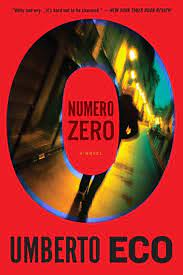
My literary adventure across Europe introduced me to names I am not familiar with. It also made me revisit writers whose oeuvres I have become a fan of. Among them is Umberto Eco who I first encountered through must-read lists. His debut novel The Name of the Rose is a familiar presence in these lists. While it was not the first Eco novel I read, reading The Name of the Rose made me appreciate Eco’s body of work. I loved it and made me look forward to reading more of his works. A couple of years later, I read my fourth novel by Eco, Numero Zero, a book I was not originally planning to read.
Numero Zero is Eco’s seventh novel and the last novel published during Eco’s lifetime. Of the four Eco novels I have read so far, Numero Zero is also the slimmest. The novel is narrated by Colonna, a hack journalist, a sometime translator, and a ghostwriter of detective stories. When we first met him, he was already in his fifties. Out of the blue, he found himself being hired by Simei to work on a newspaper called Domani (Tomorrow). The newspaper is financed by Commendator Vimercate, an influential businessman. However, not everything is as it seems. What ensued was a tale of how historical truths are being challenged, so much so that fiction was slowly turning into reality. One such historical truth birthed a conspiracy theory regarding Italian strongman Benito Mussolini. The conspiracy theories are interesting and keep the story very engaging. However, they seemed ludicrous at best. It did not help that the story never left the confines of editorial meetings where Colonna and the editorial staff, particularly Braggadocio engaged in these endless discussions about conspiracies. Overall, the novel was rather anticlimactic, undeserving of being called Eco’s swan song.
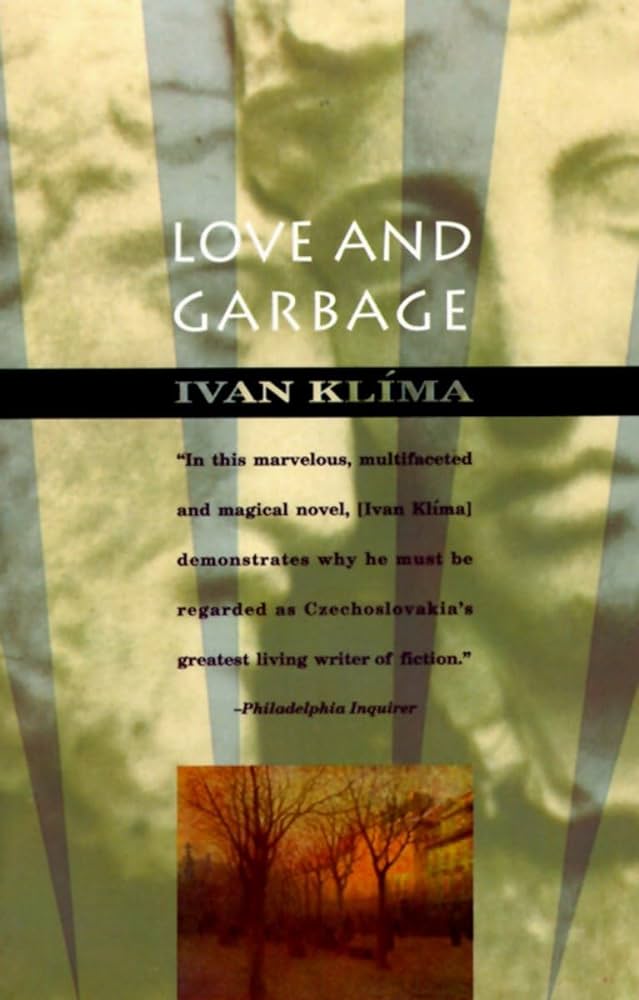
From Italy, my literary journey next took me to Czechia, a part of Europe I admit I have rarely explored. The first name that comes to mind when Czechia is mentioned is Milan Kundera. A more recent discovery is Bohumil Hrabal. Earlier this year, I encountered Ivan Klíma and his novel Love and Garbage. Curious, I obtained a copy of the book. I think I have heard of him somewhere, maybe in some must-read lists. Nevertheless, my interest was piqued and I obtained a copy of the book which I decided to include in my ongoing foray into the works of European literature, ahead of the other books gathering dust on my bookshelf.
Originally published in 1986 – three years before the fall of the Czech regime – in Czech as Láska a smetí, Love and Garbage is widely considered Klíma’s most successful and most important work. Set in the Czech capital of Prague, the heart of the novel is an anonymous street sweeper who relates the story from his perspective. Before becoming a street sweeper, he was a writer. However, his works were not allowed by the regime to be published; in a way, it reflects Klíma’s case during the regime as his works were also banned. The former writer’s new occupation took him across the city. As he is shuttled across the city to pick up its daily refuse, he finds himself getting transported to the past. It also allowed him time to contemplate his journey as a writer. We learn that he is writing a thesis about Franz Kafka, one of the greatest writers to live who was also a son of Prague, although he was cognizant that this thesis wouldn’t see the light of day. The slender novel was a rumination about literature in general. The narrator, a survivor of the ghetto, found reprieve in literature during the darkest phase of his life. While rather slender, Love and Garbage is an engaging read packed with a lot of punch.

My three-book journey in the past week concluded with a familiar writer. Spanish writer Carlos Ruiz Zafón’s The Shadow of the Wind was ubiquitous, prompting me to obtain a copy of the book although I was barely interested in it, at the onset. Reading the book during the height of the pandemic, however, made me rue how I kept pushing back the book when it was ultimately one of the most atmospheric and engaging reads I ever had. That was how I became a fan of Ruiz Zafón. I was saddened by the news of his demise during the pandemic. After The Shadow of the Wind, I resolved to read the rest of the books in The Cemetery of Forgotten Books series.
The second book in the series is The Angel’s Game, originally published in 2008. Like its predecessor, the novel is in early 20th-century Barcelona and charts the story of David Martin. When he was 14, his father was murdered in front of the Barcelona newspaper office where he works. Pedro Vidal, one of the newspaper’s owners, gave David a job as an assistant. A couple of years later, David became successful in writing sensationalist crime stories under the pseudonym Ignatius B. Samson. He also moved into a once-abandoned Gothic tower house where he works on his novels. His life started to unravel when he was 28. He learned that he had an inoperable brain tumor and that he had under a year to live. Amidst this personal and professional turmoil – he was also in love with Cristina, Vidal’s wife – he sought counsel from Sempere, an old bookseller and surrogate father figure to him. Sempere took him to the labyrinthine library known as the Cemetery of Forgotten Books; readers of the first book would be familiar with this. Around this time, a mysterious French publisher named Andreas Corelli offered him 100,000 francs for a book. A young writer wanna-be named Isabella also popped into his life. As the story moved forward, several layers were being unpeeled. While it was engaging, I was not as impressed as I was with The Shadow of the Wind.
What will you read next?


 The Pine-Scented Chronicles