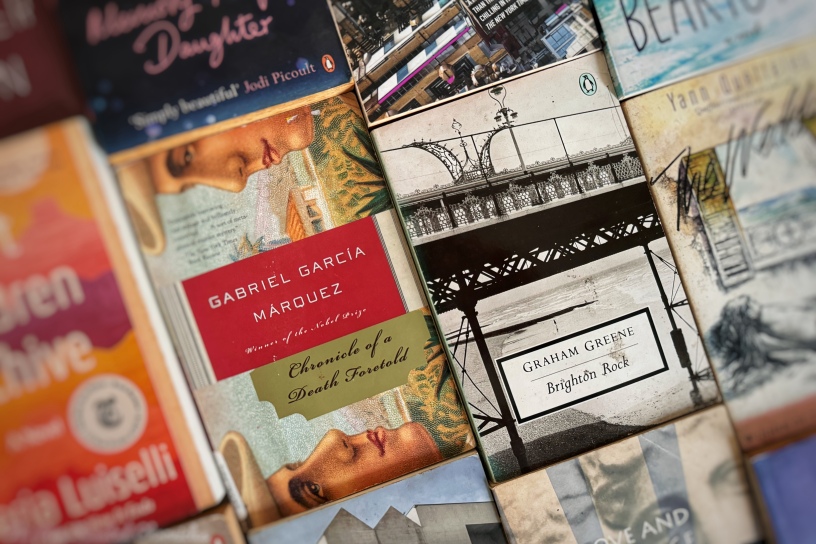
The passage of time is one of the realities of life. Before we realize it, one month has already passed us by. It still seems like yesterday when we greeted July – my birth month – and now we are already in the eighth month of the year. How time flies. This also means that the year is drawing closer to its inevitable conclusion. Here in the Philippines, Christmas-related memes are already being thawed as the -ber months are drawing closer. I hope that the first seven months of the year have been great for everyone. I hope that everyone is doing well. in mind, body, and spirit. I hope that the remainder of the year will shower everyone with positive energy, good news, and blessings. I hope that everyone gets to accomplish their goals in the coming months. I hope that everyone will get to savor the fruits of their labor.
Reading-wise, I have several goals I want to tick this year. I hope that I get to achieve them before the year ends. Vis-à-vis my reading challenges, it seems that I am on track in most of them. I guess starting early on my 2024 Top 24 Reading List contributed a lot; I usually cram toward the end of the year. Currently, I have read 17 of the 24 books on the said list. I still have other ongoing reading challenges but my focus is my Top 24 Reading List. Speaking of, I was able to tick off two books on the said list in July; July was the third consecutive month I ventured into the works of European literature. While I had to hit pause – at least for now – I beyond stoked to have read amazing works by writers who are both new and familiar to me. Here is a look back at how my July reading journey shaped up. Happy reading!

Mansfield Park by Jane Austen
If there was something lamentable about my foray into European literature it would be the glaring lack of female writers; to be fair, I did have a Women’s Literature month before venturing into European literature. This prompted me to include Jane Austen’s Mansfield Park, one of two books by Austen I have yet to read. Besides, it has almost been two years since I read Northanger Abbey, the last Austen novel I read. The titular Mansfield Park is a vast estate owned by the affluent Sir Thomas and Lady Maria Bertram. The couple had four children: Tom, Edmund, Maria, and Julia. However, it was Lady Bertram’s niece, Fanny Price, who was the heart of the novel. Born to an impoverished family, Fanny’s two aunts agreed to foster her, hence, her move to Mansfield Park when she was ten. Unaccustomed to ostentatious displays of opulence, Mansfield Park daunted her. Her cousins, all older than her, also gave her a lukewarm reception. Tom was a spendthrift and also a drunk. Meanwhile, Her female cousins were shallow and only desired to enter a gainful marriage. She did, however, find camaraderie in Edmund. As she grows up, Fanny gets used to the atmosphere and even becomes Lady Bertram’s companion. Morality is a seminal element of the story; Austen paints the psychological portrait of the people surrounding Fanny. The values of rural communities surface as the story moves forward. Fanny, like most Austen characters, is a spectator and observer as these rural values, including family values, interplay. This is always a fascinating facet of Austen’s works.
Goodreads Rating:

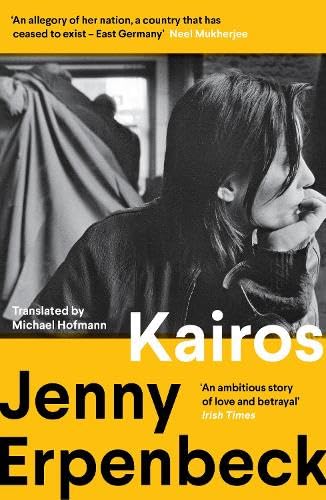
Kairos by Jenny Erpenbeck
My literary journey brought me back to continental Europe and for the first time since April, I have read back-to-back works of female writers. It was recently that I encountered German writer Jenny Erpenbeck whose novel Kairos was longlisted for the International Booker Prize. I was initially dismissive of it but my interest and curiosity were soon piqued when the book was announced the winner of the prestigious literary prize. Without ado, I immediately delved into the book once I was able to obtain a copy of it. I was actually curious about the book’s unusual title. In ancient Greek, Kairos (καιρός) meant “the right or critical moment” while in modern Greek, it means time or weather. Sure enough, Kairos transports the readers in time although it commences in the present when Katharina, the novel’s heroine, learns about the demise of Hans, her former lover. A box of his papers sent to her apartment served as a time capsule that took her back to when they first met in East Berlin in 1986. Hans was in his fifties and was married to Ingrid, Katharina, on the other hand, was just nineteen. Despite their age gap, they got swept into a whirlwind romance, with the novel capturing the landscape of relationships, including its intellectual facets. But the novel was more than just a love story as it was juxtaposed with the decline of East Germany. Like their nation, their dreams and hopes were slowly crumbling. Kairos is an atmospheric story fraught with nostalgia and yearning and captures the intricacies and complexities of history and relationships
Goodreads Rating:
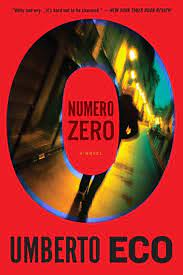
Numero Zero by Umberto Eco
My literary adventure across Europe made me revisit familiar literary territories, such as the oeuvre of Umberto Eco which I first encountered through must-read lists. His debut novel The Name of the Rose made me appreciate Eco’s body of work and is one of my all-time favorite reads. It also made me look forward to reading more of his works, leading me to my fourth novel by Eco, Numero Zero. Numero Zero is Eco’s seventh novel and the last novel published during his lifetime. Of the four Eco novels I have read so far, Numero Zero is also the slimmest. The novel is narrated by Colonna, a proverbial jack-of-all-trades: a hack journalist, a sometime translator, and a ghostwriter of detective stories. Already in his fifties, he found himself being hired by Simei to work on a newspaper called Domani (Tomorrow); this offer came out of the blue. Financing the newspaper is influential businessman Commendator Vimercate. However, not everything is as it seems. What ensued was a tale of how historical truths are being challenged, so much so that fiction was slowly turning into reality. One such historical truth birthed a conspiracy theory regarding Italian strongman Benito Mussolini. The conspiracy theories are interesting and keep the story very engaging. It was promising but then, in hindsight, the discourses seemed ludicrous at best. It did not help that the story never left the confines of editorial meetings where Colonna and the editorial staff, particularly Braggadocio engaged in these endless discussions about conspiracies. Overall, the novel crumbled underneath the weight of its vision, if there ever was.
Goodreads Rating:

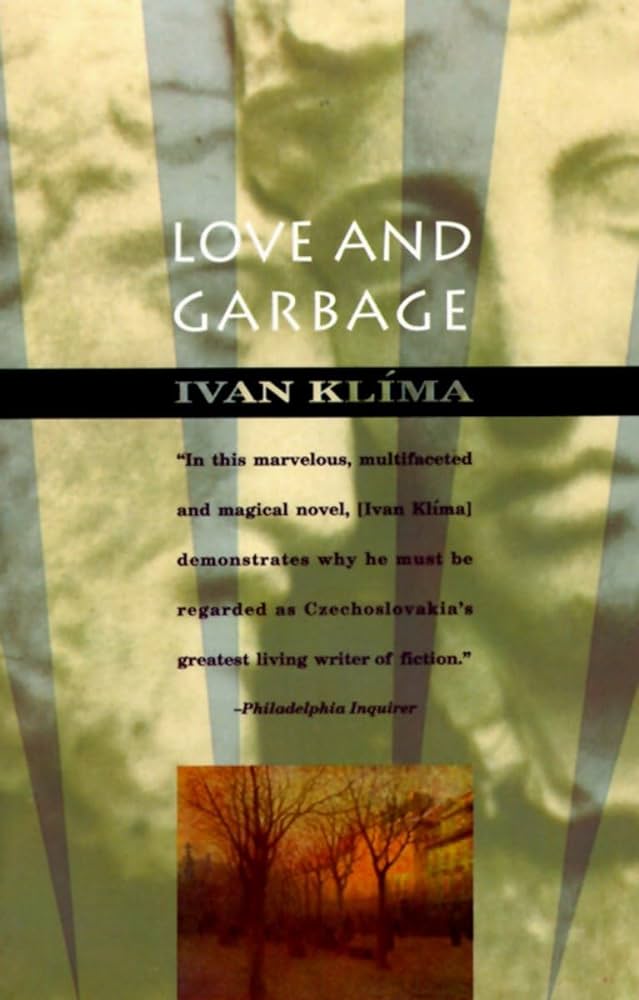
Love and Garbage by Ivan Klíma
From Italy, my literary journey next took me to Czechia, a part of Europe I have rarely explored although I did read the works of Milan Kundera. A more recent discovery is Bohumil Hrabal and earlier this year, I came across Ivan Klíma and his novel Love and Garbage. Apparently, some of his work was listed as among the 1,001 Books You Must Before You Die. I decided to include it in my ongoing foray into the works of European literature. Originally published in 1986 – three years before the fall of the Czech regime – in Czech as Láska a smetí, Love and Garbage is widely considered Klíma’s most successful and most important work. Set in Prague, the novel charts the fortunes of an anonymous street sweeper who relates the story from his perspective. He used to be a writer but his works were not allowed by the regime to be published; this reflects Klíma’s case during the regime as his works were also banned. The former writer’s new occupation took him across the city. As he crisscrossed the various intersections of the city to pick up its daily refuse, the unnamed narrator finds himself transported to the past. It allowed him time to contemplate his journey as a writer; he was currently writing a thesis about Franz Kafka, one of the greatest writers to live who was also a son of Prague. He was, however. cognizant that his thesis might not get published. In a way, the novel is a rumination about literature in general. The narrator, a survivor of the ghetto, found reprieve in literature during the darkest phase of his life. Deceptively slender, Love and Garbage is an engaging read packed with a lot of punch.
Goodreads Rating:

The Angel’s Game by Carlos Ruiz Zafón
Admittedly, I have been ambivalent about reading Spanish writer Carlos Ruiz Zafón’s The Shadow of the Wind. This was even though the book was ubiquitous in the mid-2010s. However, reading the book made me rue how I kept pushing back the book when it would wind up being one of my most atmospheric and engaging reads. After The Shadow of the Wind, I resolved to read the rest of the books in The Cemetery of Forgotten Books series. The second book in the series is The Angel’s Game, originally published in 2008. The novel again transports the readers to early 20th-century Barcelona. The heart of the story is David Martin. When he was 14, his father was murdered in front of the Barcelona newspaper office where he now works. Under the pseudonym Ignatius B. Samson, he becomes a successful writer of sensationalist crime stories. His life started to unravel when he learned that he had an inoperable brain tumor; he had under a year to live. Amidst this personal and professional turmoil – he was also in love with Cristina, his boss Vidal’s wife – he sought counsel from Sempere, an old bookseller and surrogate father figure to him. Sempere took him to the labyrinthine library known as the Cemetery of Forgotten Books. Around this time, a mysterious French publisher named Andreas Corelli offered him 100,000 francs to write a book. Further complications were provided by the entry of a young writer wanna-be named Isabella into his life. As the story moved forward, several layers were being unpeeled. While it was engaging, I was not as impressed as I was with The Shadow of the Wind.
Goodreads Rating:

Adam Bede by George Eliot
Among the familiar writers I encountered during my journey across European Literature is George Eliot who I first encountered through must-read lists. Her works were ubiquitous. In 2018, I read her – George Eliot is a pseudonym by Mary Ann Evans – novel Middlemarch. It was a complex book that gave glimpses into the intricacies of life in rural England. While it was a challenging read it made me look forward to reading her other works, such as Adam Bede. I acquired the book pre-pandemic, prompting me to include it in my 2024 Beat the Backlist Challenge and 2024 Top 24 Reading List. Set in the fictional countryside town of Hayslope, the novel charts the fortunes of four characters. The eponymous Adam Bede is a young local carpenter who is renowned for being principled and hard-working. When the story commenced, his father Thias unexpectedly passed away after drowning in the river in front of their house. His mother, Lisbeth, was devastated. Lisbeth found comfort in Dinah Morris, a Methodist preacher who recently arrived in town, prompting Lisbeth to wish her to be her daughter-in-law. This foreshadows the rest of the story. Meanwhile, Adam was besotted with Hetty Sorrel, Dinah’s cousin. Adam pursued Hetty but Hetty found herself seduced by a fourth character. Captain Arthur Donnithorne was the grandson of the local landlord. Eliot’s debut novel, Adam Bede craftily constructs the psychological profiles of the eclectic cast. She takes the readers into their minds to understand their motivations. Overall, Adam Bede is a compelling read that set the standard for Eliot’s oeuvre.
Goodreads Rating:

I’m Not Stiller by Max Frisch
Like Adam Bede, Max Frisch’s I’m Not Stiller is one of the books I included in my 2024 Top 24 Reading List; this makes it the 17th book from the said list that I read. When I first encountered Frisch – I initially thought was German – I barely had any iota about who he was nor have I encountered any of his works before. It was sheer curiosity that prompted me to obtain a copy of the Swiss writer’s novel I’m Not Stiller, a book I encountered through an online bookseller. Further, the book is listed as one of the 1,001 Books You Must Read Before You Die. Originally published in 1954 in German, the novel opens with a man named James Larkin White – the novel’s narrator – being arrested upon his arrival in Switzerland. Carrying an American passport, the Swiss authorities alleged that he was the missing Swiss sculptor Anatol Ludwig Stiller. White vehemently refuted the allegations but everyone was apprehensive about his claims, including his lawyer. His cynicism was not helping his case. This begs the question of White’s real identity. White remained levelheaded and was nonplussed, reiterating his backstory although it was ludicrous; it included confessing to killing his own wife. The police, however, already built a dossier. People who claimed to know Stiller arrived in Switzerland and White’s story was slowly shredded into pieces. People from Stiller’s life were able to confirm that White and Stiller were one and the same. As the story unfolds, one begins to understand the motivations underneath. Can we truly run from our past and rewrite our lives? I’m Not Stiller is a riveting read.
Goodreads Rating:

Cities of the Plain by Marcel Proust
Among the books I long wanted to complete is French writer Marcel Proust’s In Search of Lost Time/Remembrance of Things Past. It is widely considered one of the most defining works of fiction. It has been years since I acquired a copy of Swann’s Way – the first book in the seven-book novel – but I had to put on hold reading the book when I learned it was just one of seven books comprising the novel. I finally commenced reading the book after I obtained four more books in 2020. Last year, I read the second and third books and this year, I read the fourth book. Cities of the Plain was originally published in 1921/1922 as Sodome et Gomorrhe, hence, the alternative English title of Sodom and Gomorrah. The title is a giveaway of what the book was about. At the heart of the story again is the unnamed narrator; many consider it the author himself. Picking up from where the third book left off, Marcel was waiting for the confirmation of his invitation to a soiree at the Princesse de Guermantes’s residence. The first part of the book is concerned with the social gathering where Marcel caught up with his old friends including Baron de Charlus who Marcel previously had a disagreement. The crux of the story, however, was a sexual encounter between the Baron de Charlus and a tailor named Jupien that Marcel witnessed following the soiree. It was one of Marcel’s early encounters with same-sex relationships. Cities of the Plain captures the glaring dichotomies between our private and public lives. Like the first three books, the book requires the reader’s full attention. It is also as riveting as the three earlier books.
Goodreads Rating:

My Brilliant Friend by Elena Ferrante
From France, my literary journey next took me across the border, to Italy. Among the many writers who recently intrigued me was Italian writer Elena Ferrante. Recently, her works have been ubiquitous; My Brilliant Friend was a familiar presence in bookstores but like most hyped books, I was ambivalent about reading her novel. I would eventually learn that My Brilliant Friend is part of a series collectively called Neapolitan novels. With my interest piqued, I commenced my foray into the enigmatic writer’s works. My Brilliant Friend’s prologue introduces sixty-year-old Elena Greco who received a call from the son of her friend Rafaella “Lila” Cerullo back in Naples; Elena and Lila were childhood friends. Elena was informed that Lila had gone missing. Elena knew that her friend did not want to be found, hence, she discouraged Lila’s son from looking for his mother. The story then flashes back to the past. Elena and Lila first met during their elementary school in an impoverished section of 1950s Naples. They were the best students in Maestra Oliviero’s class. However, their paths soon diverged. Elena considered Lila the more clever of the two but, unfortunately, Lila failed to impress during their final test. With the Maestra’s motivation, Elena pursued further education. Lila, on the other hand, had to settle for being a helper at her father’s shoe repair shop. Her parents refused to pay for further schooling. Lila also grew into a local beauty which naturally attracted the neighborhood’s young men. The concluding pages of the story are setting up the story for a sequel.
Goodreads Rating:

Us Against You by Fredrik Backman
I was originally not planning on reading Fredrik Backman’s Us Against You, the sequel to Beartown, a novel that further underscored why I have become a fan of the Swedish writer’s works. Toward the end of the month, I resolved to read the succeeding books in the trilogy. I am curious about what happens next to the characters introduced in Beartown. Us Against You transports the readers back to the Swedish countryside, to the quaint town of Beartown which once prided itself on its ice hockey team. However, things haven’t been easy lately. With the growing lack of employment prospects, the younger generation is moving out of town. Salvation came when the junior ice hockey team, helmed by prodigy Kevin Erdahl, reached the semifinals of the national competition. A scandal undid this progress and uncovered the fault lines hiding beneath the surface, leading us to the second book in the trilogy. While other members of the junior team moved to the neighboring town of Hed, Bobo, Benji, and Amat opted to stay for various reasons. Can the town’s waning spirit be rejuvenated or will it ultimately fall into grace? Just when everything seemed bleak, a ray of hope came. Elizabeth Zackell entered the town driven by a mission: to win. But in a town where the best have fled, it is a tall order. Meanwhile, the lives of the characters are unraveling. With the Olympics ongoing, Us Against You is a timely read. However, it is more than a sports novel as it probes deep into small-town life. Us Against You encroaches into other subjects not tackled or were ephemerally captured in the first book. It is a scintillating read that further underlines Backman’s deep understanding of human nature.
Goodreads Rating:


The Beautiful Mrs. Seidenman by Andrzej Szczypiorski
My foray into Polish literature, unfortunately, is limited to the works of Nobel Laureate in Literature Olga Tokarczuk. However, I wanted to expand this venture so when I came across Andrzej Szczypiorski’s The Beautiful Mrs. Seidenman during the recent Big Bad Wolf Sale, very little barred me from obtaining a copy of the book. I would later on learn that the book is listed as one of the 1,001 Books You Must Read Before You Die. This further piqued my interest, hence, its inclusion in my ongoing foray into European literature. Originally published in 1988 in Polish as Początek, the novel is set in German-occupied Poland during the Second World War. Before the occupation of Poland by the Germans in September 1939, the eponymous Irma Seidenman lost her husband Ignacy, a radiologist. Just in her thirties, Irma was the quintessence of the model Aryan envisioned by Adolf Hitler: fair hair, blue eyes, and regular features. However, Mrs. Seidenman is a Jew, placing her in immediate danger. She managed to evade persecution by passing as the widow of a Polish officer; she was able to fly under the radar by adopting the alias, Maria Magdalena Gostomska. However, like most war novels, this story is just not about Mrs. Seidenman as it also charts the fortunes of the people orbiting around her. Among them is the young man Pawelek who, as a young boy, fervently desired Mrs. Seidenman. Through his eclectic cast of characters, Szczypiorski vividly captured the horrors of the Second World War and the atrocities that have become reality for those who were at the heart of it. Heartbreaking but brimming with hope, The Beautiful Mrs. Seidenman finds power in providing voices to those who have been muted by history.
Goodreads Rating:
Reading Challenge Recaps
- My 2024 Top 24 Reading List: 17/24
- 2024 Beat The Backlist: 11/20; 61/60
- 2024 Books I Look Forward To List: 2/10
- Goodreads 2024 Reading Challenge: 74/100*
- 1,001 Books You Must Read Before You Die: 10/20
- New Books Challenge: 2/15
- Translated Literature: 38/40
*Updated my Goodreads goal from 80 to 100.
Book Reviews Published in July
- Book Review # 525: The Architect’s Apprentice
- Book Review # 526: Lonely Castle in the Mirror
- Book Review # 527: No Longer Human
- Book Review # 528: The Woman in the Purple Skirt
As has always been the case, this quarter end has been quite tedious. This was exacerbated by the fact that it was also half year end which means I have more reports to prepare than usual. Nevertheless, I was able to make it through the busy period. However, this meant that I had to put on hold some of my book blogging endeavors. Further, the one-week vacation I spent in Japan pushed me further backk. Nevertheless, I was able to tick off some of the many pending book reviews I have. Well, I was able to complete and publish four reviews which is well below my outputs in the previous months; only January was worse, with two book reviews. Anyway, I will try to make up for lost time this August as I am cognizant that I have about a hundred book reviews pending. I hope I get to regain some kind of momentum again although the goal will still be to take it one book review at a time.
August in perspective. In most Asian cultures, August is feared. They consider it as the ghost month wherein individuals are warned from making major decisions. However, reading-wise, I don’t plan on slowing down because I have a lot of books I want to read. The early part of the month will be an extension of my foray into European literature because there are still some books I want to read; I am currently reading Backman’s The Winners, the third book in his Beartown Trilogy. I also might read a book by Milan Kundera and another writer whose oeuvre I have not explored before. After completing these books, there is no clear plan. I was originally planning on having an Asian literature month but with the recent announcement of the Booker Prize longlist, I just might read books published in the previous year that I have been looking forward to or books that have recently been nominated for literary prizes.
August might also be dedicated to books I listed on my 2024 Top 10 Books I Look Forward To list. There are quite a lot of recently published books I am looking forward to. Among them is Percival Everett’s James which was longlisted for the Booker Prize; Everett has long piqued my interest, hence, James‘ inclusion to my 2024 Top 10 Books I Look Forward To list. Other books on this list are Rachel Khong’s Real Americans and Yangsze Choo’s The Fox Wife. Other books I am looking forward to are James McBride’s The Heaven & Earth Grocery Store, Colm Tóibín’s Brooklyn, and Abraham Verghese’s The Covenant of Water. The Covenant of Water is actually part of my 2023 Top 10 Books I Look Forward To list and is a book I can’t wait to dip my fingers into.
I can’t also wait to immerse myself in this eclectic mix of contemporary literature. How about you fellow reader? How is your own reading journey going? I hope you enjoyed the books you have read. For now, have a great day. As always, do keep safe, and happy reading everyone!
 The Pine-Scented Chronicles