
Born Shūji Tsushima, Osamu Dazai is considered one of the titans of Japanese literature. A pioneer of the I-novel, it was only recently that his works gained international recognition. Among these works is No Longer Human, a poignant portrait of a man at odds with himself and those around him. It was also the last novel he published before taking his own life. No Longer Human is a deceptively slender volume that probes into seminal subjects. It is also semi-autobiographical. Because of its probe into the human psyche, the book is brimming with memorable quotes, some of which I am featuring in this quotable quote update. Without ado, here are some of the memorable lines from No Longer Human
Do check out my complete review of Osamu Dazai’s beloved classic by clicking here.

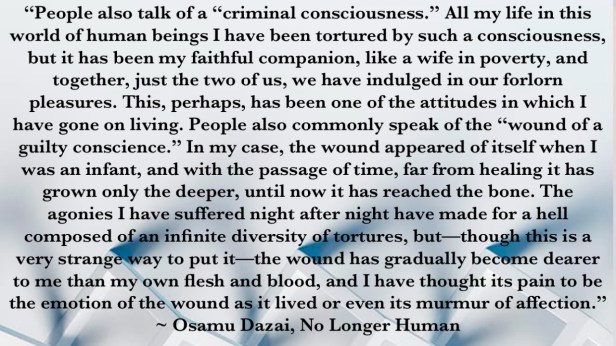
“People also talk of a “criminal consciousness.” All my life in this world of human beings I have been tortured by such a consciousness, but it has been my faithful companion, like a wife in poverty, and together, just the two of us, we have indulged in our forlorn pleasures. This, perhaps, has been one of the attitudes in which I have gone on living. People also commonly speak of the “wound of a guilty conscience.” In my case, the wound appeared of itself when I was an infant, and with the passage of time, far from healing it has grown only the deeper, until now it has reached the bone. The agonies I have suffered night after night have made for a hell composed of an infinite diversity of tortures but – though this is a very strange way to put it – the wound has gradually become dearer to me than my own flesh and blood, and I have thought its pain to be the emotion of the wound as it lived or even its murmur of affection.”
~ Osamu Dazai, No Longer Human

“One of my tragic flaws is the compulsion to add some sor of embellishment to every situation – a quality which has made people call me at times a liar – but I have almost never emebellished in order to bring myself any advantage; it was rather that I had a strangulating fear of that cataclysmic change in the atmosphere the instant the flow ofa conversation flagged, and even when I knew that it would later turn to my disadvantage, I frequently felt obliged to add, almost inadvertently, my word of embellishment, out of a desire to please born of my usual desperate mania for service. This may have been a twisted form of my weakness, an idiocy, but the habit it engendered was taken full advantage by the so-called honest citizens of the world.”