When The Community Comes Together
American literature is certainly a rich minefield of amazing writers and wonderful works of literature. It is one of the contemporary’s most distinguished national literatures. With literary classics such as Herman Melville’s Moby Dick, Mark Twain’s The Adventures of Huckleberry Finn, John Steinbeck’s The Grapes of Wrath, J.D. Salinger’s The Catcher in the Rye, David Foster Wallace’s Infinite Jest, Louisa May Alcott’s Little Women, and Harper S. Lee’s To Kill A Mockingbird, among others, American literature has established itself as a pillar of classic and modern literature. The influences of these writers and their oeuvre have transcended time and physical boundaries. Underlining American literature’s penchant for excellence, it has produced twelve Nobel Laureates in Literature, including Toni Morrison, Steinbeck, Ernest Hemingway, William Faulkner, and more recently, Louise Glück.
The diversity within the ambit of American literature is also astounding. However, it is palpable how, like most national literatures, American literature was shaped by its history. Several of the most influential works of American literature, both in the contemporary and in the past, integrate elements of American history. Among the prevalent subjects vis-à-vis American history are the American Civil War and the country’s involvement in the Second World War and the Vietnam War. Another common subject in American literature is the antebellum South. These works explored the origins and legacies of slavery and how racism continues to pervade different strata of modern American society. These are encapsulated in works such as Harriet Beecher Stowe’s Uncle Tom’s Cabin, Margaret Mitchell’s Gone With the Wind, and Colson Whitehead’s The Underground Railroad.
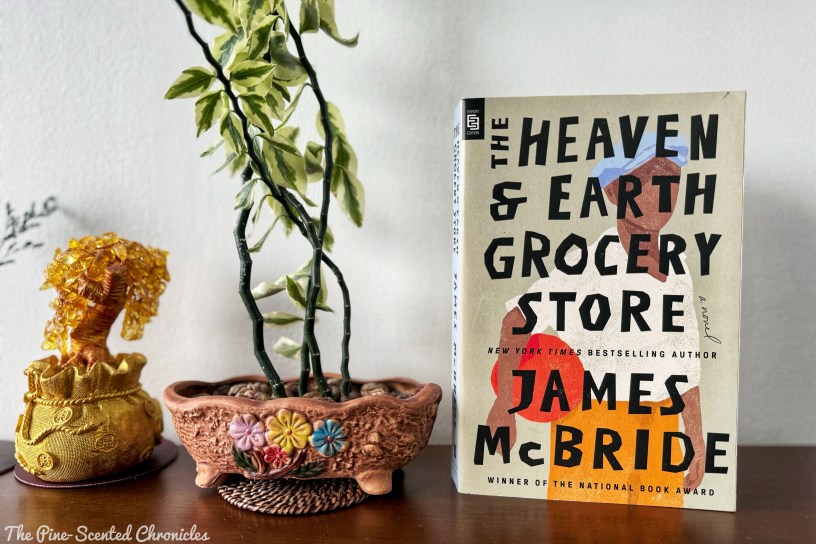
A recent addition to this list of remarkable works of American historical fiction is James McBride’s latest novel, The Heaven & Earth Grocery Store. Published in 2023, the novel commences in June 1792 when construction workers cleared a lot for a new townhouse development in Chicken Hill, a predominantly Black neighborhood of Pottstown, Pennsylvania unearthed a human skeleton at the bottom of a well. Along with the skeleton was a mezuzah, a small case that often hangs on the doorframes of Jewish homes. Policemen were brought in and linked the mezuzah to Malachi, an elderly Jewish man still living at the site of the old synagogue on Chicken Hill. However, before the investigators could get to the bottom of the case, Hurricane Agnes hit the Northeast immediately the day following the discovery. As the crime scene was washed away, all seminal pieces of evidence to what most perceived as murder.
“It was a future they couldn’t quite see, where the richness of all they had brought to the great land of promise would one day be zapped into nothing, the glorious tapestry of their history boiled down to a series of ten-second TV commercials, empty holidays, and sports games filled with the patriotic fluff of red, white, and blue, the celebrants cheering the accompanying dazzle without any idea of the horrible struggles and proud pasts of their forebears who had made their lives so easy.”
~ James McBride, The Heaven & Earth Grocery Store
With Malachi fleeing the scene, the mystery deepens. One can’t help but beg the question, whose skeleton was discovered? The story then flashes back to the 1920s. Forty-seven years before the skeleton’s discovery, Moshe Ludlow, a Romanian Jew who owns the small local dance hall and theater, marries Chona, the youngest daughter of Rabbi Flohr. The Rabbi is the owner of the titular Heaven & Earth Grocery Store, the only Jewish grocery in the area. Before Moshe met Chona, he was on the cusp of financial ruin. Chona, on the other hand, was an avid reader and a beautiful young woman. She was outspoken against any form of injustice. Unfortunately, Chona was crippled by polio and occasionally suffers from tremors and seizures because of it. The young couple then lived above the grocery store that Chona now runs.
As the grocery store prospered, so did Moshe’s business. He branched out from klezmer music and booked Black performers. Moshe’s earnings have allowed them certain levels of luxury. It can support them without having to rely on the grocery store. Their financial success also prompted Moshe to suggest to his wife to sell the grocery store and move somewhere nicer. Chicken Hill is a poor section of the town which the other Jewish families decided to leave. As Moshe exclaimed: “Down the hill is America!” Chona, however, was adamant. She wanted to stay in the area and keep running the store. The Heaven & Earth Grocery Store is no ordinary store. Chona provided credit to the impoverished families It was also a melting pot where Polish, Bulgarian, and Lithuanian Jews from all walks of life, from shoemakers to gangsters, converged. They were joined by Italian laborers and “colored maids, housekeepers, saloon cleaners, factory workers, and bellhops of Chicken Hill.”
The crux of the story, however, involved Dodo, a deaf 12-year-old boy. Dodo is the nephew of Nate and Addie Timblin, close friends and employees of Moshe and Chona who were also prominent members of the black community in Pottstown. Dodo’s mother was Addie’s sister. Dodo found himself orphaned after an explosion caused by a kitchen stove claimed his mother’s life; it was also this accident that took his sense of hearing. At this juncture, the state decided to step in and take custody of Dodo. The state wanted to institutionalize him, sending him to Pennhurst School, a “special school”. However, Pennhurst caters to the mentally unwell; despite the accident, Dodo remained capable and sharp. Nate then enlisted the help of Moshe and Chona to hide his nephew. Considering Dodo as her own child, Chona did not hesitate in hiding Dodo in their apartment. When interrogated by government officials, they told them that Dodo left the state.
Just when they thought they were able to navigate a dire strait, fate handed them a different set of cards. Nate asks Moshe for help in hiding Dodo, and Moshe and Chona take him in. They lie to the government officials saying that Dodo has left the state. In the novel’s second part, Dodo finds himself waking up at the Pennhurst State Hospital ward after being transferred from the Pottstown Hospital. Chona, on the other hand, is in the Reading Hospital in a comatose. The community was abounded with rumors regarding what transpired leading to a series of unfortunate events. In light of these events, however, community spirit prevailed. They transcended lines of color and class, including the steely hands of the law, to redress what they believed was an unconscionable act of injustice.
“I know I’m a hard woman. I’ve made a few mistakes in my life. But I’m no worse than these other mothers out here who pray “Lord, let me child be wise and good” when they really mean “Let this child have more power and money than I have.” I don’t do that with my children. That’s what our father did to us. He built things. The Jewish church, a lot of houses and buildings and things. He tried to build us, too. But he never finished. Maybe he wasn’t building us the right way before he left this life. Maybe that’s why we’re like we are now.”
~ James McBride, The Heaven & Earth Grocery Store
The Heaven & Earth Grocery Store is a multilayered novel that grapples with a plethora of subjects and themes. It starts with a shock factor that blanketed the story with a veil of mystery. But as the story moves forward – the timeline moves backward – are several carefully curated elements skillfully woven together by McBride’s dexterous hands into a lush tapestry. The mantle of the story was a community centered around the titular grocery store. At the grocery converged an eclectic cast of characters from various races and all walks of life, underlining the rich and diverse ethnic heritage of the denizens of the United States. The American diaspora is an integral part of American history. It is also prevalent in the works of American literature. The story, however, casts the literary microscope on two predominant groups: the Jews and the Blacks.
Interestingly, the two predominant groups represent McBride’s own mixed ethnic heritage; he was born to an African-American father and a Polish Jew mother. Inclusivity, however, was not observed in these groups, including the other prominent labor groups that comprised the community. These groups tend to stick together. There were also tensions between, among, and within these groups. The Blacks living on Hemlock Row, just above Chicken Hill, frown upon the Blacks living down them. They referred to them as “on-the-move,” “moving-on-up,” “climb-the-tree,” “NAACP-type” Negroes, wanting to be American. Meanwhile, Italian women argue about the best way to prepare traditional recipes. German-speaking Jews looked down on Yiddish-speaking Jews who they considered as provincial. The novel vividly exposes the fault lines that lie underneath the surface.
The novel vividly paints the interactions of these ethnic and racial groups with the traditionally white Americans. The diversity of the cast of characters provided an opportunity to explore another germane subject that pervades contemporary American society: systemic racism. Doc Earl Roberts is the highest representation of white supremacy. He is the local physician and, like Chona, he has a limp. Doc Roberts was the embodiment of the classic antagonist. He was self-righteous and prejudiced. On top of his anti-Semitic beliefs, he has deep-seated racism and was even a member of the Ku Klux Klan (KKK). Lamenting how Chicken Hill was slowly being overrun with Blacks and immigrants, he joins the annual KKK parade but his limp gives him away. He hides his racism and bigotry behind the cloak of religion and patriotism.
Ironically, Doc Roberts was also predatory, committing perhaps the novel’s most heinous act. He was vile through and through. He also uses his position and influence to exploit vulnerable women even if he frowns upon them. Indeed, power dynamics and corruption were astutely underlined in the story. Another depiction of grave abuse of power was Gustowskis “Gus” Plitzka, a white member of the city council. Plitzka was siphoning town water away from the shul to water his dairy farm. While this plotline seems to be a digression, it plays a seminal role in the events that ensue. Meanwhile, at the asylum, Dodo encountered an attendant on Ward C-1 named Son of Man. His position allowed him to exercise influence over the patients. He was a sadist who abused young boys at the asylum.
“And how she regretted, watching his face locked in grief even as he slept, his lip trembling, that she’d frittered hours away reading about socialists and unions and progressives and politics and corporations, fighting about a meaningless flag that said “I’m proud to be an American,” when it should have said “I’m happy to be alive,” and what the difference was, and how one’s tribe cannot be better than another tribe because they were all one tribe.”
~ James McBride, The Heaven & Earth Grocery Store
Despite the darkness that hovered above the story, what shines through are the positive qualities of the characters. Chona’s kindness shines through the story. She was loved by the community while reviled by characters such as Doc Roberts. Outspoken, Chona was the voice of social justice, lending her voice through letters addressing social concerns she sent to local newspapers. She was the personification of generosity. She had no scruples about lending a hand to someone in need. Despite the Grocery Store incurring losses, she still extended assistance to the less fortunate members of the community. Another beacon of hope that shines through the story is Nate. An equally compelling character, his steady presence and reliability make him a compelling character. His backstory was a subtle elucidation of redemption.
Both Nate and Chona strived to establish authentic connections within the community. Chona and Nate’s finer qualities reverberated throughout the community and when push came to shove, the community came together. They waded through a minefield of oppression and stark dichotomies to help their members in need. They transcended physical divisions, races, skin colors, and even the law to redress a grave error. Chicken Hill was, without a doubt, a patchwork of different ethnicities, races, accents, and skin colors but despite these dichotomies, the spirit of the community soared. Love, resilience, and acceptance blossomed. The characters’ individual stories were also endowed with warmth and even wit. There was a brilliant mix of humor that underlines how humanity can soar amidst the darkness.
With its vast cast of characters, Chicken Hill was a kaleidoscope with the titular Heaven & Earth Grocery Store as its center of life being. The Heaven & Earth Grocery Store exposes the fault lines that lie underneath, including internalized and systemic racism, discrimination, sexual abuse, predatory behaviors, and even corruption. Nevertheless, hope springs eternal. The novel paints a community that comes together amidst this darkness. Shining through are stories of love, kindness, social justice, and resilience. McBride’s dexterous writing vividly painted a tightly-knit community that, on the surface, was divided by a sea of dichotomies. In effect, Chicken Hill is a microcosm that reflects a nation undergoing a sea of changes. With its brilliant master strokes that integrate social injustices, history, and elements of mystery with the resilience of the human spirit, the novel captures the qualities that make the human spirit soar. The Heaven & Earth Grocery Store is an excellent and heartwarming story that restores our faith in humanity.
“And here her eyes sparkled and she stood up straight, her beautiful face shining in the sunlight that glowed into the store window, the light bouncing off the fruit and vegetables and cascading into the corners of the Heaven & Earth Grocery Store, illuminating the peppers and carrots, the Saltines and apple peelers, making life seem as full and new and fresh as the promise of Pennsylvania had once been for so many of those standing about who had come up from the South to the North, a land of supposed good, clean freedom, where a man could be a man and a woman could be a woman, instead of the reality where they now stood, a tight cluster of homes enclosed by the filth of factories that belched bitter smoke into a gray sky and tight yards filled with goats and chickens in a part of town no one wanted, in homes with no running water or bathrooms.”
~ James McBride, The Heaven & Earth Grocery Store
Book Specs
Author: James McBride
Publisher: Riverhead Books
Publishing Date: 2023
No. of Pages: 381
Genre: Historical
Synopsis
In 1972, when workers in Pottstown, Pennsylvania, were digging the foundations for a new housing development, the last thing they expected to uncover was a human skeleton. Who the skeleton was and how it got buried there were just two of the long-held secrets that had been kept for decades by the residents of Chicken Hill, the dilapidated neighborhood where immigrant Jews and African Americans lived side by side, sharing ambitions and sorrows.
Chicken Hill was where Moshe and Chona Ludlow lived when Chona ran the Heaven & Earth Grocery Store, which served the neighborhood’s quirky collection of blacks and European immigrants, helped by her husband, Moshe, a Romanian-born theater owner who integrated the town’s first dance hall. When the state came looking for a deaf black child, claiming that the by needed to be institutionalized, Chicken Hill’s residents – roused by Chona’s kindness and the courage of a local black worker named Nate Timblin – banded together to keep the boy safe.
As the novel unfolds, it becomes clear how much the people of Chicken Hill have to struggle to survive at the margins of white Christian America and how damaging bigotry, hypocrisy, and deceit can be to a community. When the truth is revealed about the skeleton, the boy, and the part the town’s establishment played in both, McBride shows that it is love and community – heaven and hearth – that ultimately sustain us.
Bringing his masterful storytelling skills and his deep faith in humanity to The Heaven & Earth Grocery Store, James McBride has written a novel as compassionate as Deacon King Kong and as inventive as The Good Lord Bird.
About the Author
James McBride was born on September 11, 1957, in Brooklyn, New York. He was the eighth child born to an African American father and a Polish Jew mother. McBride and his siblings were raised in Brooklyn’s Red Hook housing projects until he was seven years old. McBride often skipped his high school class, until he was compelled to change his ways during his sophomore year. During McBride’s high school years, his stepfather died, and his family moved from New York City to Wilmington, Delaware.
McBride graduated from P.S. du Pont High School and then attended Oberlin College in Ohio, where he majored in communications and also studied jazz and composition at the Oberlin Conservatory of Music. It was there that he was introduced to writing. McBride received a master’s degree in journalism from Columbia University, New York, in 1980. Post-graduate school, McBride worked as a journalist, starting with the News Journal in Wilmington. He also served as a reporter or staff writer with The Boston Globe, People, Rolling Stone, and The Washington Post. In 1996, McBride finally published his first book, The Color of Water: A Black Man’s Tribute to His White Mother. He published his first novel, Miracle at St. Anna in 2002. He followed it up with Song Yet Sung (2008) and The Good Lord Bird (2013). The latter won the National Book Award for Fiction in 2013.
His novel Deacon King Kong (2020) won the Andrew Carnegie Medal for Excellence in Fiction and the 2021 Anisfield-Wolf Book Award for fiction. His most recent work was The Heaven & Earth Grocery Store (2023). It was awarded the Kirkus Prize for Fiction and the 2024 Jewish Fiction Award. In 2015 U.S. Pres. Barack Obama awarded McBride the National Humanities Medal for his literary contributions toward “humanizing the complexities of discussing race in America.” Apart from being a writer, McBride is also a renowned musician. He wrote music for soul and rhythm-and-blues singer Anita Baker, jazz-funk saxophonist Grover Washington, Jr., and the popular children’s television show Barney & Friends (1992–2010). McBride was awarded the American Music Theater Festival’s Stephen Sondheim Award in 1993, the American Arts and Letters Richard Rodgers Award in 1996, and the inaugural ASCAP Richard Rodgers Horizons Award in 1996.
In addition, McBride has written original scripts for films, notably co-writing with Spike Lee the screenplay for Red Hook Summer (2012). McBride is a Distinguished Writer-in-Residence at New York University. He is currently residing in New York City and Lambertville, New Jersey
 The Pine-Scented Chronicles
This I must read!
LikeLiked by 1 person
I hope you get to enjoy and like the book.
LikeLiked by 1 person
Fantastic review! You have me even more eager to pick this one up!
LikeLiked by 1 person
Thank you. I hope you get to enjoy it as much as I did.
LikeLiked by 1 person