War, Redemption, and Coming-of-Age
Human history is widely chronicled and several volumes of historical records and books have enshrined several seminal historical events. It is, to say the least, very eventful. Further, the history of mankind is riddled with several historical events that have altered the course of mankind’s destiny. Several of these historical events have influences and implications that reverberate in the contemporary. Among the widely written and studied historical events include the exploits of Alexander the Great and Genghis Khan, the rise of the colonizers, the slave trade, the Industrial Revolution, and the Inquisition, among others. On top of these seminal historical events are battles and wars that brought out the best and the worst of humanity. The two World Wars, the Vietnam War, and even the Cold War have also shown the limits of mankind. These are all well-documented and are still part of contemporary discourses.
Historical events have also been part and parcel of literature. Literature is integral in understanding these historical events. Several works of fiction gave voices to the victims of the Second World War while several novels have captured the atrocities of war in general. Literature is a vessel that preserves memories of these events. Elif Shafak’s The Bastard of Istanbul, for instance, shines the spotlight on the Armenian genocide, a very sensitive subject that Turkey skirts around despite the acknowledgment of several sovereignties. Meanwhile, in Nigeria, the Biafran War, or the Nigerian Civil War was a germane event with impacts that are still felt in the contemporary. However, the war was mostly muted in literary discourses until recently. Chimamanda Ngozi Adichie’s Half of a Yellow Sun (2006) takes the readers to the heat of the action. This has sparked a slew of literary works that also paint the landscape of the war and how its presence can be felt in the contemporary.
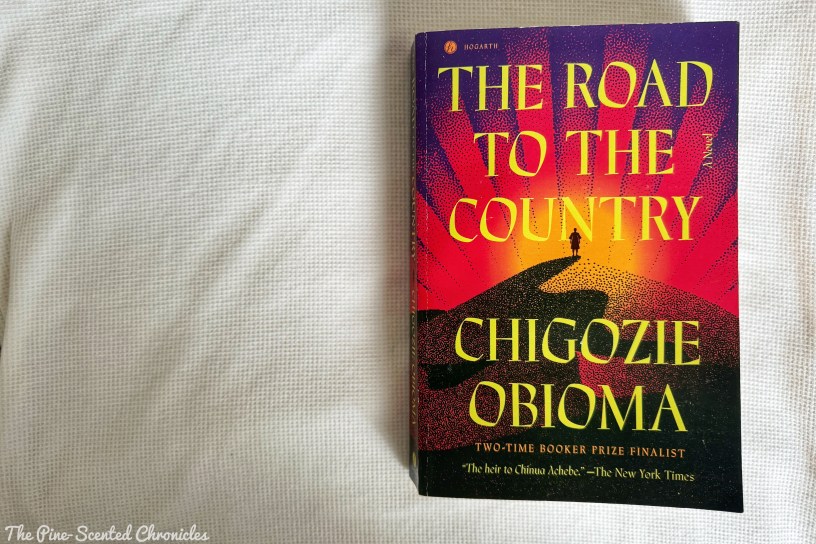
The latest addition to this growing list of books about the Biafran War is Chigozie Obioma’s The Road to the Country. Published in 2024, The Road to the Country is the third novel by the two-time Booker Prize finalist; his first two works, The Fishermen (2015) and An Orchestra of Minorities (2019) were both shortlisted for the prestigious literary prize. The Road to the Country takes the readers across the landscape of the war. The story starts with Adekunle “Kunle” Aromire, a young student at the University of Lagos, who is haunted by the past, particularly by the unfortunate accident that left his brother Tunde disabled. Their parents were quick to reassure him but the incident has left an indelible mark on Kunle, a guilt that he would carry until his young adulthood. When Tunde fled their hometown of Akure in the west to go to the east with a young Igbo woman, Kunle suited up to look for his younger brother. It was his way of atoning for his misstep.
“The man lies there, shrapnel lodged in his neck, the left side of his uniform soaked with dark arterial blood. He is blinking, thick blood coursing through his neck like the mealy saliva of a stricken beast. The wounded man struggles to speak as he is carried onto the bed of a lorry loaded with the bodies of a dozen dead or wounded men. As the lorry drives away, rocking as it encounters the ruts in the road, the bodies of the dead or wounded men, propped in seated positions against the sides of the lorry, bounce against the metal railing, and the seated men seems to sway as if engaged in a quiet dance. Kunle, turning, finds that he has begun to weep.”
~ Chigozie Obioma, The Road to the Country
An Igbo-Yoruba man, Kunle travels to the east, the stranglehold of the Igbo tribe. Unbeknownst to him, tensions have been escalating between the Nigerian and the Biafran armies. This tension would percolate in what would be known as the Biafran War which began in July 1967. This came two months after a charismatic, college-educated military officer named Chukwuemeka Odumegwu Ojukwu announced the creation of the independent Republic of Biafra in Nigeria’s Eastern Region. The year before, over one million members of the Igbo tribe fled to eastern Nigeria to seek refuge. The Igbo people were chased off the northern region after they were used as a scapegoat for a coup; the years immediately following Nigeria’s independence were turbulent and riddled with insurgencies and coup d’états. As a response to Ojukwu’s declaration, the Nigerian government responded with merciless force.
Due to his overall detachment from reality, Kunle was not aware of the war brewing in the eastern region of the country. His quest to redeem himself inadvertently took him to the heart of the war. He was unceremoniously captured by the Biafran army. He was, however, not executed. Rather, he was offered to fight; this underlines the poorly armed and underprepared Biafran militia. Without other recourse, Kunle became a reluctant participant in a war he originally had no intention of fighting. He was hastily trained for combat and was provided a new name; he shares the same name with a Nigerian general known as the Black Scorpion. In this uncharted territory, Kunle was renamed Peter Nwaigbo. Garbed in his fatigues, Kunle would serve as a guide through the landscape of war. Before his gaze, the Nigerian Civil War started to unfold.
It was a grisly scene. The sheer horror and brutality were beyond Kunle’s imagination. Bodies were piling up and the casualties were increasing exponentially as the Nigerian offensive intensified; they were relentless. It was a bloodbath. Incessant bombings inundated the region. The horrors he witnessed gripped Kunle with terror. There was an eerie sense of “being trapped in a burning house.” Kunle was not sanitized by the horrors surrounding him. He sheds tears and grits his teeth as carnage surrounds him. Finding himself at the heart of the war, however, has not hampered him in his quest to find his brother. Meanwhile, witnessing the horrors and injustices of the war also changed Kunle’s perspective. As he befriends the Biafrans he fought along with at the frontlines, he finds himself championing the Biafran cause: “Perhaps instead of attaining the redemption he sought for so long in righting the wrong he once did, he could achieve it on a larger scale if he helped fight to save this people.”
The Biafran War, palpably, sits at the center of the narrative. It is a germane historical event that shaped the modern landscape of Nigeria. It was the percolation of the oppression against the Igbos, including pogroms which claimed the lives of an estimated 30,000 people. A catalyst for the war was the ethnic division that persisted following Nigeria’s independence. Contemporary Nigerian literature has captured the prejudices each ethnic group had against each other. For over two years, the Nigerian army combated the Biafran army. The estimates of the casualties range from 500,000 to about 3,000,000 and most of them were Igbos. Most were also children who died beyond the realms of the battlefield, such as starvation and widespread disease. This was exacerbated by the Nigerian army’s blockade of all food and medical supplies pouring into Biafra; this was depicted in Adichie’s Half of a Yellow Sun.
“He stops at a point where the vegetation turns into a tangled network of wild banana trees, the smell of something decaying and dead seeping out from among the leaves. At his approach, unseen birds lift from the trees. To his left, the forest floor yields to a pit hewn by erosion where a dead pool has formed, covered with moss and leaves, with more detritus gathered at its edges.”
~ Chigozie Obioma, The Road to the Country
Like all novels dealing with the Biafran War, The Road to the Country captured the atrocities of war. What makes the novel soar, however, is its vivid portrait of trench warfare. Obioma’s writing takes the readers to the heart of the war, reeling the readers in with his descriptive and graphic descriptions. This also captured the atmosphere that surrounded Kunle and the people of eastern Nigeria. Several battle scenes and acts of shocking violence permeate the story; the story is not for the faint of heart. Obioma, with his unflinching gaze, was relentless in painting a vivid portrait of the battlefield. It was dire and hope evaded the men and women at the frontline. Ambushes and explosions were ubiquitous. The intricacies of warfare were captured by Obioma. Details of artillery, logistics, and even army command structures were ubiquitous. The geopolitical nature of the war was underlined by Obioma. The Nigerian government heavily relied on the backing of the British government for its supply of artillery.
The minutiae of warfare creates an immersive experience. Obioma provides an intimate peek into the heart of the battle. The details of the war – from the sound of the rain and the explosion of bombs to the overwhelming stench of death and blood that permeates the battlefield – create a distinct experience that activates the senses. The experience was so intimate and evocative it almost felt intrusive: “The man lies there, shrapnel lodged in his neck, the left side of his uniform soaked with dark arterial blood. He is blinking, thick blood coursing through his neck like the mealy saliva of a stricken beast. The wounded man struggles to speak as he is carried onto the bed of a lorry loaded with the bodies of a dozen dead or wounded men.”
Kunle got wounded several times and was even on the brink of death. At times, he considered deserting but he was cognizant of the severe penalties should he do so. These were realities he and his fellow soldiers had to grapple with. However, Obioma gets so fixated with the battlefield that the story gets repetitive and even stressful. But such is the folly of war. Despite the horrible conditions at the front line, the beauty of humanity soars. Camaraderie shone with Kunle slowly earning the mutual respect of his comrades. Friendship and brotherhood blossom and so did courage and generosity. Kunle, in turn, starts feeling affection for the men and women who he fought along with. Emotions that he had suppressed floated to the surface. Kunle, a brooding, troubled young man, started as a cipher but he opened up as the story progressed. What he had witnessed softened him, peeling away the layers once wrapped around him.
Kunle’s character development is one of the novel’s many layers. On the battlefield, he fell in love with a comrade, the vengeful Agnes Azuka. Agnes’ husband and sons were killed by Nigerians. They were surrounded by an eclectic cast of characters who were imbued by Obioma with their own distinct personalities and voices. The air permeated with a plethora of languages, such as English, pidgin English, and Igbo and Yoruban languages. The convergence of various sounds and ethnicities further underlines the weight and demands of war. Obioma also had no scruples capturing even the most mundane of human activities such as taking a piss and taking a shit. They vomit. They cry. They fall in love. They have sex. They experience the full spectrum of human experience and emotions. These are reminders that those on the battlefield are also normal human beings.
“He opens his mouth, something like a discrete mass filling his lungs as he struggles to breathe. He feels something cooling a region of his body, as if it is being slowly sunk into a pool of water. A quick, moving darkness rivers through him, attended by the sounds of explosions, the cries of anguished men, and the staccato snarl of machine gun fire He remains there, quiet, half-concealed by the rubble like a thing hidden from the world, forgotten.”
~ Chigozie Obioma, The Road to the Country
However, Kunle was not the only guide across the battlefield. Alternating with his narrative was the voice of a seer, an Ifa diviner, Igbala, living in the 1940s. The seer was conveying Kunle’s story as a set of visions. The Seer, at the time of Kunle’s birth, had a prophecy of Nigeria descending into chaos. This gave the story a distinct complexion. A voice from a different realm is a hallmark of Obioma’s prose. In The Fishermen, the mythic voice was Abulu while An Orchestra of Minorities was narrated by a chi. While the Seer’s presence added a dimension of African spiritual tradition, he also provided a different perspective. Elements of magical realism were integrated into the story, providing the reader a balance of mythic and reality.
“It occurs to him that the only true thing about mankind can be found in the stories it tells and some of the truest of these stories cannot be told by the living. Only the dead can tell them.”
Obioma’s writing wove all of the novel’s wonderful elements together into a lush tapestry. War was the heart of The Road to the Country and its messages reverberate on a global scale. The novel captures the destructive nature of humanity and its capacity to push its fellows to the brink. Its profound ruminations warn us of the atrocities of war. These are portraits we are familiar with and yet need reiteration. The Road to the Country, however, was not all black and hopeless. Amidst the bleakness and cruelty, love, friendship, and camaraderie usher hope. They provide a lifeline. Kunle, a cipher at the start, metamorphosed into a well-rounded character. The war sharpened him and imbued him with a new personality. With its balance of myth, tradition, history, and coming-of-age, The Road to the Country is a multilayered and multifaceted novel that underscores Obioma’s literary skill.
“She laughs at the urgency of his desire andhow he is able to arouse her. With her hands against the wall, he slides into her with rushed gentleness. The sound of his frequent thrusts – wet and plodding – come to him like footsteps in sludge. Once they are spent, his mood is quickly replaced with the realization that he has arranged for her to leave and will now be the cause of their eventual separation in this dreary and battered country.”
~ Chigozie Obioma, The Road to the Country
Book Specs
Author: Chigozie Obioma
Publisher: Hogarth
Publishing Date: 2024
No. of Pages: 355
Genre: Historical, War Fiction
Synopsis
Set in Nigeria in the late 1960s, The Road to the Country is the epic story of a shy, bookish student haunted by long-held guilt who must go to war to free himself. When his younger brother disappears as the country explodes in civil war, Kunle must set out on an impossible rescue mission. Kunle’s search for his brother becomes a journey of atonement that will see him conscripted into the breakaway Biafran army and forced to fight a war he hardly understands, all while navigating the prophecies of a local Seer, who marks Kunle as an abami eda – one who will die and return to life.
The story of a young man seeking redemption in a country on fire, Chigozie Obioma’s novel is an odyssey of love and unimaginable courage set during one of the most devastating conflicts in the history of the African continent. Intertwining myth and realism into a thrilling, inspired, and emotionally powerful novel, The Road to the Country is Chigozie Obioma’s masterpiece.
About the Author
To learn more about Chigozie Obioma, click here.
 The Pine-Scented Chronicles