
Hello, readers! It is Monday again! As it is Monday, welcome to another #5OnMyTBR update. The rule is relatively simple. I must pick five books from my to-be-read piles that fit the week’s theme.
This week’s theme: Need a BUDDY for this READ

5OnMyTBR is a bookish meme hosted by E. @ Local Bee Hunter’s Nook where you chose five books from your to-be-read pile that fit that week’s theme. If you’d like more info, head over to the announcement post!
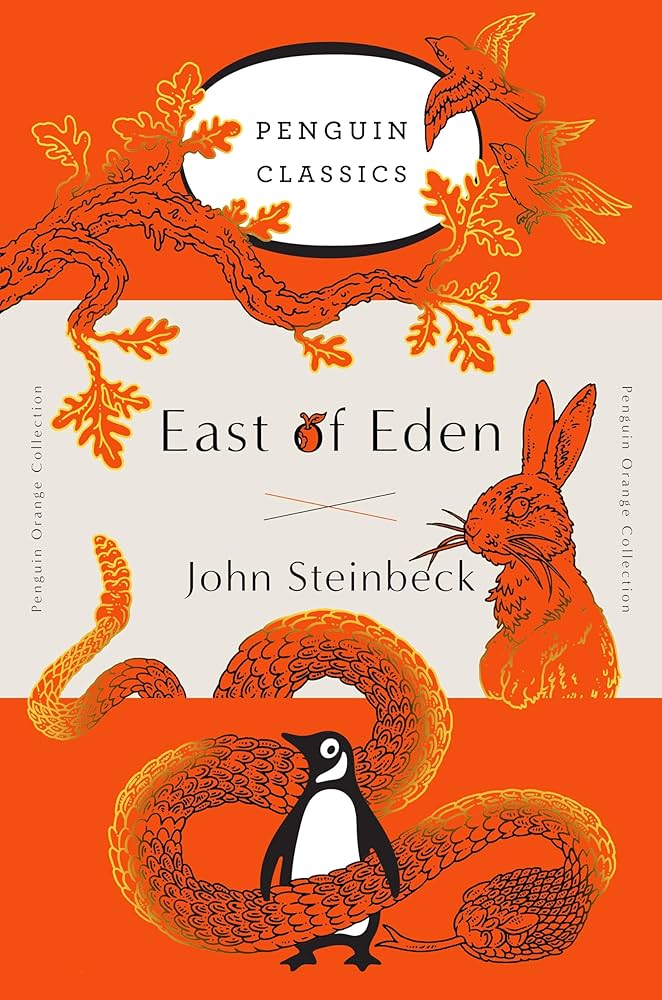
Title: East of Eden
Author: John Steinbeck
Publisher: Penguin Classics
Publishing Date: 2016 (1952)
No. of Pages: 601
Synopsis:
East of Eden is the masterpiece of Nobel Prize winner John Steinbeck’s later years – a vastly ambitious novel that is at once a family saga and a modern retelling of the Book of Genesis. In his journal, Steinbeck called East of Eden “the first book,” and indeed it has the primordial power and simplicity of myth. Set in the rich farmland of California’s Salinas Valley, this sprawling and often brutal novel follows the intertwined destinies of two families – the Trasks and the Hamiltons – whose generations helplessly reenact the fall of Adam and Eve and the poisonous rivalry of Cain and Abel. East of Eden is a work in which Steinbeck created his most mesmerizing characters and explored his most enduring themes: the mystery of identity, the inexplicability of love, and the murderous consequences of love’s absence.

Title: Foucault’s Pendulum
Author: Umberto Eco
Translator (from Italian): William Weaver
Publisher: Guild Publishing
Publishing Date: 1989 (1988)
No. of Pages: 641
Synopsis:
Foucault’s Pendulum is a superb entertainment by the author of The Name of the Rose. An enthralling mystery, a sophisticated thriller, a breathtaking journey through the world of ideas and aberrations, the treasures and traps of knowledge, Umberto Eco’s new novel will delight, tease, provoke, and stimulate.
One Colonel Ardenti, who has unnaturally black brilliantined hair, an Adolphe Menjou mustache, wears maroon socks and fought in the Foreign Legion, starts it all. He tells three editors at a Milan publishing house that he has discovered a coded message about a Templar plan, centuries old and of diabolical complexity, to tap a mystic source of power greater than atomic energy.
The editors (who have spent altogether too much time rewriting crackpot manuscripts on the occult by self-subsidizing poetasters and dilettantes) decide to have a little fun. They’ll make a plan of their own. But how?
Randomly they throw in manuscript pages on hermetic thought. The Masters of the World, who live beneath the earth. The Comte de Saint-Germain, who lives forever. The secrets of the solar system contained in the measurements of the Great Pyramid. The Satanic initiation rites of the Knights of the Temple. Assassins, Rosicrucians, Brazilian voodoo. They feed this all into their computer, which is named Abulafia (Abu for short) after the medieval Jewish cabalist.
A terrific joke, they think – until people begin to disappear mysteriously, one by one, starting with Colonel Ardenti.

Title: The Strudlhof Steps
Author: Heimito Von Doderer
Translator (from German): Vincent Kling
Publisher: New York Review Books
Publishing Date: 2021 (1951)
No. of Pages: 839
Synopsis:
The Strudlhof Steps is an unsurpassed portrait of Vienna in the early twentieth century, a vast novel crowded with characters ranging from an elegant, alcoholic Prussian aristocrat to an innocent ingenue to “respectable” shopkeepers and tireless sexual adventures, bohemians, grifters, and honest working-class folk. The greatest character in the book, however, is Vienna, which Heimito von Doderer renders as distinctly as James Joyce does Dublin or Alfred Döblin does Berlin. Interweaving two time periods, 1908 to 1911 and 1923 to 1925, the novel takes the monumental eponymous outdoor double staircase as a governing metaphor for its characters’ intersecting and diverging fates. The Strudlhof Steps is an experimental tour de force with the suspense and surprise of a soap opera. Here Doderer illuminates the darkness of passing years with the dazzling extravagances that is uniquely his.

Title: Z
Author: Vassilis Vassilikos
Translator (From Greek): Marilyn Calmann
Publisher: Seven Stories Press
Publishing Date: January 2017 (1966)
No. of Pages: 406
Synopsis:
A progressive parliamentary deputy is scheduled to appear at a political rally. Meanwhile, local political bosses plot his assassination. Thugs are recruited to disrupt the rally. Rumors begin to spread. But the forces already set in motion are irresistible. Z is the story of a crime, a time, a place, and people transformed by events.
Z was published in Greece in 1966, and banned there one year later. It is based on an actual political assassination in 1963 in Salonika. The victim was Gregory Lambrakis, a socialist legislator and outspoken critic of the government. But Lamrakis’s killers could not have anticipated the public response. His funeral became a political event; by the time the cortege reaches Athens, 400,000 people were following the coffin in silence. In the nation’s capital, the letter Z suddenly appeared on walls, sidewalks, posters – everywhere. Z stands for the Greek verb zei, “he lives.”

Title: Young Gerber
Author: Friedrich Torberg
Translator (from German): Anthea Bell
Publisher: Pushkin Press
Publishing Date: 2012 (1958)
No. of Pages: 349
Synopsis:
Young Kurt Gerber embarks hopefully on his last year at school, facing the all-important final exam. However, he soon clashes with his sadistic new form teacher, Professor Kupfer, known to his students as “Lord God Kupfer” – with tragic consequences.
Based in part on the story of ten pupils who committed suicide in a single week in Vienna in the winter of 1929, this classic of European literature is powerful and timeless tale of classroom angst.
 The Pine-Scented Chronicles