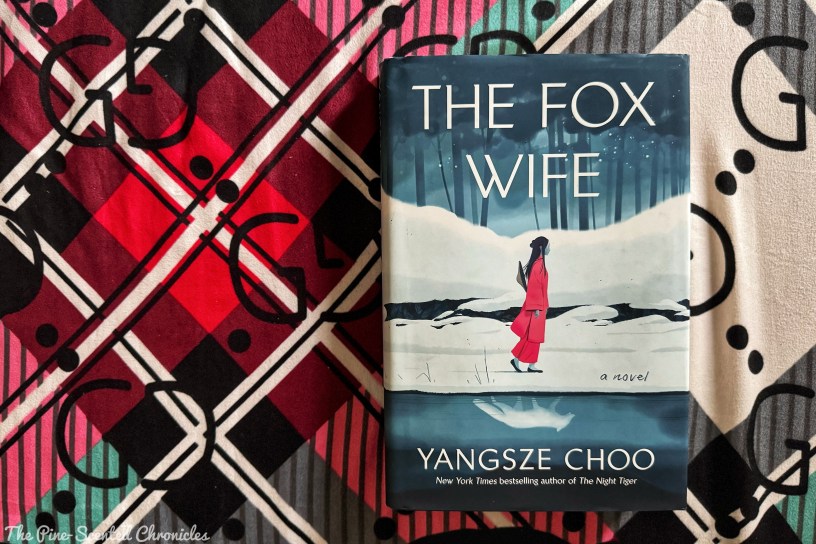
A Little Dose of Folklore
As a young girl, Malaysian writer Yangsze Choo lived a peripatetic existence. Due to her father’s profession – he was a diplomat – Choo’s family moved frequently. Her formative years were spent in Thailand, Germany, Japan, and Singapore. Every new city, and new environment, ushered a different version of Choo. Oftentimes, she was the interloper looking from the outside. She was rootless, a patchwork of different identities, always the stranger. She had to catch up lest she lose her identity. In these new worlds, she found comfort in the images of the familiar, particularly that of the jungle. As a young child, she was fascinated by the raw and wild beauty of the jungle as seen from the window of the white bungalow her family once occupied. When she finally settled in the United States, these images still tickled her imagination as an adult.
These vivid images from her childhood would eventually form the very fabric from which her stories would flow from. It was to writing that she turned to after leaving her management consultancy job to look after her family. Initially writing exclusively for herself, she took a leap of faith in 2013 when her debut novel The Ghost Bride was published. It is a fantasy novel inspired by the practice of ghost marriages and is infused with elements of Chinese mythology. Her second novel, The Night Tiger, published in 2019, was also riddled with elements of mythology, that of her native Malaysia. The novel earned Choo several accolades. In 2022, Choo’s sophomore novel was listed on the Big Jubilee Read, a list of 70 books by Commonwealth writers produced to commemorate Queen Elizabeth II’s Platinum Jubilee. Choo has made mythology the bread and butter of her works. This remained true with her latest novel, The Fox Wife.
Like in her sophomore novel, Choo’s third novel transports the readers to the past. The story opens in the first decade of the 20th century. The Qing Empire was on the cusp of collapsing after nearly three centuries of lording over China. Prolonged political instability and the interference of Western powers continue to undermine what was once a formidable empire. Manchuria, where the Manchu-led Qing dynasty traced its provenance, was encroached upon by both the Russians and the Japanese. It was a tumultuous period, to say the least. The year was 1908 and aboard a train heading south from Manchuria toward the city of Dalian was a beguiling woman. However, she was no ordinary woman. She was a fox who took on the form of a woman. She can present herself either as a human or as a pure white fox with dainty black feet but she cannot switch back and forth without a set of challenges.
The wind was blowing from the west, an autumn wind that smelled of damp yellow earth and rain. The grass bowed under heavy seed heads, and in the distance, gathering clouds were pierced by shafts of bright late sunshine. I’d stood at the top of a valley watching the dusty white road below as it wended its way across the wide sweep of the hills. Sun and rain together are what people call a day for a fox’s wedding, though that’s just folk superstition. We get married just the way you do, by choosing a lucky day that all parties agree on. In any case, I hadn’t been thinking of getting married at all.
Yangsze Choo, The Fox Wife
She is called by many names such as huxian, “immortal, transcendent fox being” or “fox fairy”; hujing or hulijing, “fox spirit”; huyao, “fox demon”; hushen, “fox god”. Chinese folklore brims with legends of fox spirits. They are revered as celestial beings but also reviled as life-devouring demons who tempt and beguile humans by transforming into beautiful men and women. The titular fox wife used to live a happy existence in the grasslands of Kirin with her husband, a black fox. However, their lives were shattered when their cub was killed by a local hunter. She has since left her husband and embarked on a journey to hunt for the man who commissioned the death of her daughter, Bektu Nikan, a Manchurian photographer. After two years of fruitless search, she finally earned a lead that brought her on the train to Dalian.
Upon arriving in Dalian, she bought a pair of geese on a whim. This randomness caught the attention of the wife of the owner of the local medicine shop. The stranger then offered the fox a job. The fox was left with no recourse as she had no place to stay. She also had no source of food. She agreed to the offer and gave her name as Hu Xue’er which literally translates to Fox Snow or Snow Fox. She was referred to as Snow but her new employers, the Huang family, referred to her as Ah San (Number Three). Snow was tasked to look after Huang Tagtaa, the widowed mother of the shop owner. Tagtaa has earned a reputation for being a difficult master. She was very selective about her servants. However, Tagtaa felt a connection with Snow. The Huang matriarch instinctively recognized that Snow was different. They got along quite nicely.
At the Huang household, Snow met Tagtaa’s grandson, Bohai, and his wealthy friends Chen and Lu. Bohai was preparing to return to Japan to pursue his medical studies. However, his grandmother was worried about Bohai because of the mysterious Huang curse that plagued several generations of the family. Historically, the firstborn son perishes before he turns twenty-four because of the people with no shadows. Their death coincidentally comes shortly after the birth of a second son. Ironically, the family can cure all ailments but for the curse that plagued them. The twenty-three-year-old Bohai was initially shielded from the curse; he had four older sisters and no brothers. Bohai’s father, however, was expecting a son with his concubine. The curse was now imminent and Bohai was about to be the doomed son. To ensure his safety, Tagtaa, along with Snow, accompanied her grandson.
A second plotline soon emerges. In Mukden, the ancient capital of the Manchu dynasty, the lifeless body of a young woman was found frozen in the snow outside a restaurant. Sixty-three-year-old private detective Bao was called onto the crime scene. He was hired to uncover the woman’s identity. While he was renowned for smoothing out creases and plot holes, Bao has the uncanny ability to spot a lie. This was a gift from his childhood when he was in contact with foxes, with one helping him through a devastating disease through his nanny’s prayer to the fox gods. This, however, did not come without a price. As compensation for his healing and recovery, Bao’s shadow fades as he ages. During his investigation, he heard rumors involving a female fox who might have something to do with the young woman’s death. As a fox enthusiast, this further piqued Bao’s interest. Like in the case of Snow, he embarked on a journey to get to the bottom of the case.
I stifled a snort. Sixty isn’t old to me. At sixty, humans are just beginning to understand that the weather will never obey them; that true love strikes at most twice in a lifetime; and that by saying yes in your youth, you may bind yourself unwisely to another’s cause. But that was beside the point.
Yangsze Choo, The Fox Wife
It was inevitable that the novel’s tangled threads overlap with each other. The events spiraled out of control, beyond everyone’s control. Family conflicts reeled all of the novel’s key players together, setting up a cathartic conclusion. On one end of the spectrum is a grieving mother seeking revenge. Her hatred for her cub’s killer weighed heavily on her. Snow, however, was no mere vengeful fox-cum-woman. As foxes tend to live longer, she has accrued a sea of wisdom belied by her demure demeanor. Nota bene: foxes are not spirits as many might assume. As Snow clarified, “Ghosts and foxes, though often confused by people, are quite different. We are living creatures, just like you, only usually better looking.” Snow’s She can turn on the charm and throughout the story, she goes through a wide range of emotions. She was prompted to confront her grief and the events of the past. Snow’s part of the story was conveyed from her personal point of view, providing an intimate glimpse into her psychological landscape.
She would also encounter two more characters who she was immediately able to identify as among her ilk. The first one was Shirakawa or Shiro. Snow’s childhood friend, he grew into a decadent adult. The other fox was Kurosaki, a black fox with a scar on his face. These three foxes were literally living on the edge. Stereotypes and superstitions – two major themes in the story – threaten their safety. While revered for being supernatural, they are reviled for their wiliness. They are seen as highly sexual beings who can drain life and happiness out of humans. Foxes caught by humans often meet a horrible end. As Snow confesses: “We make our living beguiling people, disappearing when society becomes too suspicious of us.” They have the uncanny ability to confound and make people forget about themselves. Seduction can be dangerous. On the other hand, foxes can be vulnerable. Choo invests in vividly describing the characteristics of foxes, providing a different perspective.
On the other side of the spectrum is an aging sleuth who is both solving a mystery and pursuing a childhood fascination. His section of the story was conveyed from a third-person point of view. As his sleuthing leads him to new mysteries, the nagging question of a fox’s involvement lingers at the back of his mind. The two plotlines eventually collided as events tangled together. Choo was laying the groundwork for an unexpected and climactic end. As Snow confronts her past, Bao’s cases are evolving. Old connections reemerge and as Snow’s path converges with them, Choo is slowly building up the tension and the mystery. Intricate narratives emerge from a seemingly simple plotline about a mother’s desire for vengeance. As the two voices alternate, the story meanders. Coincidences start to emerge, further muddling the water. Meanwhile, historical contexts provide a lush backdrop.
Folklore, history, and tradition converged for a rich tapestry. The finer details capture familiar and equally interesting subjects. The fox’s mortality, for instance, was contrasted by Bao’s looming confrontation with his mortality. The novel also subtly explores the role of women in a patriarchal society and the difficulties they have to face. One female character voiced her opposition to marriage because she grasps how it can end in misery and even dehumanization. She finds a different motivation in money which she sees as a safety net against men’s objectification of women. She tells Bao: “If you don’t have money, you get sold.” Elsewhere, Choo provides a vivid portrait of rural northern China in the early 20th century while providing a window into their traditions and different beliefs. But with the looming presence of Western influences, these traditions are on the cusp of being dismantled.
Loneliness. I’d lived with it for almost two years, that achign void when the snow fell like an endless soft curtain. Dark nights, alone. Freezing dawns, also alone. No mewling chirp to greet me, no sweet child to nuzzle into my warmth. There was a prinkling in my chest as though my breasts were swelling with milk again A burning flush rose in my cheeks.
Yangsze Choo, The Fox Wife
The story does develop at a slow. The different points of view provide contrasting means to understand and appreciate the story. Snow’s point of view is intimate and makes the readers part of the story. Bao’s, on the other hand, prompts the readers to step back and be a more objective observer. The slow pace was intentional. It was also deceptive as the novel was riddled with intricate details and the slow pace works to its advantage as it allows the build-up of mystery and tension. Adhering to literary traditions, one key element of the story was the footnotes and marginalia. As Choo notes, this is an old Chinese literary tradition, and “some comments were by famous people or were considered so interesting that they were reprinted along with the text in new additions.”
The Fox Wife is a masterful blend of adventure, history, mystery, folklore, and romance. All of these wonderful elements were woven together into a rich tapestry by Choo’s accessible and descriptive writing. The story was not what it seemed at the onset. From a simple plotline about a mother’s grief emerged an intricate story that integrates traditions, social commentaries, history, and folklore. The story tackles second chances and the consequences of our choices while subtly probing into the role of women in a patriarchal society. It also underlines our fascination with stories and folklore. It doubles as a homage to literary traditions. These subjects were explored through equally interesting characters whose complexities and obscure connections rendered the story riveting complexions and textures. Overall, The Fox Wife is a riveting and magical tale.
It seemed that ‘they’ had very pale, almost indiscernible shadows. In the daytime, you couldn’t tell because they moved around. But at night, bright lamplight from a single source was the best way to notice. I don’t know where he got these ideas from, but they made me shudder, though it was a blazing hot day. The cicadas were screeching away and the stones in the courtyard were too hot to touch, yet I had chills as though I were running a fever.
Yangsze Choo, The Fox Wife
Book Specs
Author: Yangsze Choo
Publisher: Henry Holt and Company
Publishing Date: 2024
No. of Pages: 384
Genre: Historical, Fantasy
Synopsis
In the last years of the dying Qing Empire, a courtesan is found frozen in a doorway. Her death is clouded by rumors of foxes, which are believed to lure people by transforming themselves into beautiful women and handsome men. Bao, a detective with an uncanny ability to sniff out the truth, is hired to uncover the dead woman’s identity. Since childhood, Bao has been intrigued by the fox gods, yet they’ve remained tantalizingly out of reach – until perhaps, now.
Meanwhile, a family who owns a famous Chinese medicine shop can cure ailments but can’t escape the curse that afflicts them – their eldest sons die before their twenty-fourth birthdays. When a disruptively winsome servant named Snow enters their household, the family’s luck seems to change – or does it?
Snow is a creature of many secrets, but most of all she’s a mother seeking vengeance for her lost child. Hunting a murderer, she will follow the trail from northern China to Japan, while Bao follows doggedly behind. Navigating the myths and misconceptions of fox spirits, both Snow and Bao will encounter old friends and new foes, even as more deaths occur.
New York Times bestselling author Yangsze Choo brilliantly explores a world of mortals and spirits, humans and beasts, and their dazzling intersection. Epic in scope and full of singular, unforgettable characters, The Fox Wife is a stunning novel about old loves and second chances, the depths of maternal love, and ancient folktales that may very well be true.
About the Author
Yangsze Choo was born in the Philippines, the fourth generation of a Malaysian family of Chinese descent. Because of her father’s profession as a diplomat, Choo grew up in various countries. Before she turned fifteen, she was raised in Thailand and Germany. She also spent a part of her childhood in Japan. After attending a boarding school in Singapore, she moved to the United States to study. She attended Harvard University. Post-university, she worked as a management consultant. To look after her family, she left her job.
It was while looking after her children that Choo focused on her writing; she would usually write at night. Her memories of childhood spent in Malaysia formed the fabric of her works. At the start, her writing was for personal purposes. Eventually, in 2013, she published her debut novel, The Ghost Bride. It was as selected as a Best Book by Oprah.com and was adapted into a Netflix Original series. In 2019, The Night Tiger was published. It earned the distinction as one of 70 works in the Big Jubilee Read, a campaign to celebrate the Platinum Jubilee of Elizabeth II. In 2024, her third novel, The Fox Wife, was published.
Choo is currently residing in California with her family and loves to eat and read (often at the same time).
 The Pine-Scented Chronicles