Unsung Voices
In the ambit of global literature, Japanese literature stands tall and proud. It was built on a long tradition of pushing the limits of writing and storytelling, hence transforming the vast literary landscape. It has a literary heritage that spans centuries and its influences reverberate across time. This underscores Japanese literature’s incontrovertible role in the ambit of world literature. Japanese literature boasts a rich and extensive list of outstanding writers and storytellers whose works have captivated the world over. Among them are Yukio Mishima, Jun’ichirō Tanizaki, Osamu Dazai, Natsume Sōseki, Haruki Murakai, and Shūsaku Endō. They have shaped the landscape of Japanese literature during the 20th century. Japanese literature’s contribution to the world of literature includes three Nobel Laureates in Literature: Yasunari Kawabata (1968), Kenzaburō Ōe (1994), and Kazuo Ishiguro (2017).
With the highly-heralded literary careers of the names mentioned above, one can barely notice a glaring dichotomy. There is a lack of a prominent female voice; one can’t help but notice how 20th-century Japanese literature is lopsidedly dominated by men, at least the portion of this vast literary territory that is made available to Anglophone readers. Ironically, The Tale of Genji, long recognized as one of the first novels to ever be published, was written by a noblewoman, Lady Murasaki Shikibu. Nevertheless, several female Japanese writers left an indelible mark on the rich tapestry of Japanese literature. Among them is Sawako Ariyoshi (有吉 佐和子 Ariyoshi Sawako). Making her literary debut in 1954, just two years after graduating from university, she wove a prolific literary career that elevated her to being one of Japan’s most recognized female writers.
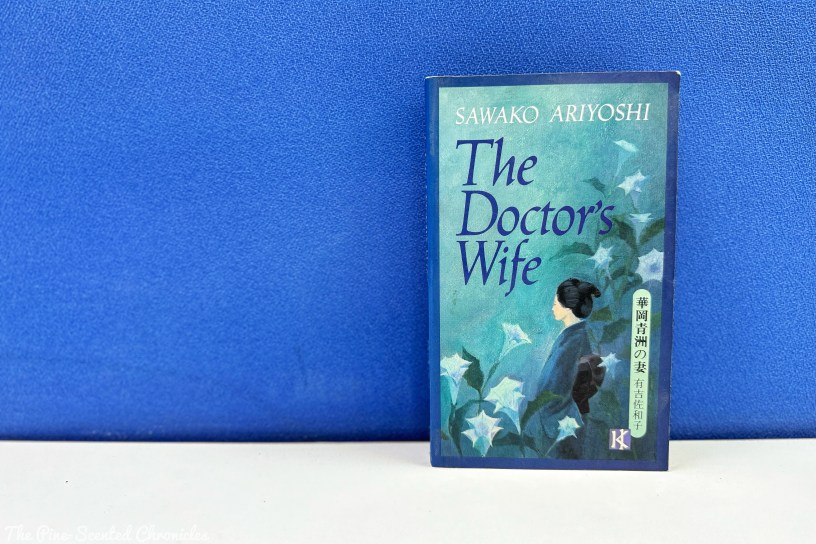
Among Ariyoshi’s most recognized and notable works is 華岡青洲の妻 (Hanaoka Seishū no tsuma). Originally published in 1967, the novel was subsequently translated into English in 1978 as The Doctor’s Wife although the Japanese title literally translates to Hanaoka Seishū’s Wife. At the heart of the novel is Kae. Born to an affluent family in the Wakayama region – Ariyoshi was born in the city of Wakayama – Kae, as a young girl, was fascinated by the beautiful woman in their neighborhood. Otsugi’s beauty and wit were admired by Kae; Otsugi was also the wife of the local doctor-surgeon, Naomichi Hanaoka. Otsugi’s beauty is renowned well beyond their community. She is said to be the most beautiful woman in the Kishu Province. From the onset, Kae was riveted by Otsugi and her enchanting aura. This admiration inevitably extended to Otsugi’s entire family.
Others also stared, since Otsugi seldom came to public gatherings. Her presence that day reminded them of her past, and her youthfulness after bearing seven children amazed them. Women over forty were generally haggard and unattractive from childbearing and years of hard labour. But Otsugi looked at least ten years younger than her age and quite elegant and dignified in her funeral attire. Kae may not have been the only one to see a halo.
Sawako Ariyoshi, The Doctor’s Wife
Kae became overjoyed when, one day, Otsugi visited her father to ask that Kae marry her son, Seishū, the heir apparent to his father’s medical practice. Kae’s father was reluctant to accept the offer primarily due to the glaring dichotomies in their social status. Kae’s father was also concerned about Kae’s age by the time that Seishū completed his medical studies and would be able to marry his daughter; he was attending medical school in Kyoto at the time his mother made the offer. Should Kae wait for Seishū to complete his studies, she would already be twenty-four years old. She would then be too old to marry. He eventually relented due to his daughter’s wish and his wife’s persuasion. As a compromise, Otsugi arranged for the marriage to take place despite the groom’s absence.
A young and impressionable bride, Kae then joined the Hanaoka household where she lived while waiting for her husband. Despite having not met her husband, Kae was able to adjust to her new role and world. She felt at home and accepted. She learned how the Hanaoka household operates and even started helping her sisters-in-law, Okatsu and Koriku, weave cloths at the loom. Kae learns that the cloths are sold. The money earned from the sale is saved by Otsugi and sent to her son. Kae found a profound sense of accomplishment performing menial tasks in her new role as a doctor’s wife. Ironically, Kae’s love for her husband who she has yet to meet continues to grow. At the same time, she continues to revere her mother-in-law. She was hoping to build a strong bond with her. It seemed that Kae and Otsugi’s relationship would flourish as Kae played the role of a dutiful daughter-in-law devoutly.
In the three years before Seishū returned home, Kae and Otsugi were able to form a close and loving relationship. However, The dynamics of their relationship were drastically altered when Seishū finally returned home to take over his father’s practice. It was at this juncture that the fault lines hiding beneath Kae and Otsugi’s relationship started to manifest; it was more fragile than Kae thought. With her son’s return, Otsugi started to ignore her daughter-in-law. Kae was gutted; she was instantly demoted from being a beloved daughter to an outcast. It marked the deterioration of what was once a flourishing relationship. The chasm between the two women was born out of the desire to earn Seishū’s attention. There could only be one woman in his life and Otsugi palpably viewed her daughter-in-law as competition. Their relationship became fraught with jealousy and malice.
The older woman had no scruples taking the limelight and monopolizing her son’s attention: the beautiful intimacy between the two—the bride and the mother-in-law who had sought her—terminated upon the arrival of the loved one they had to share. She was a wedge between the young couple and this bitter feud would last for decades. This competitive relationship with her mother-in-law ignited the fire in Kae; underneath the servile façade was an equally strong personality. She was willing to wrest control of her husband’s life. While a rivalry was brewing between the two women, they united on one front. The two doctor’s wives – as the story moves forward, it is easy to forget that Otsugi herself was a doctor’s wife – both wanted Seishū to succeed in his endeavors. They were both willing to make sacrifices to help the man at the center of their life succeed.
The first requirement is good health. Other essentials are courage, a strong will, and an understanding of the nature of the medical profession, although the woman may not know how to take a pulse. You’re aware that a doctor has to be available day and night. Illness, after all, doesn’t choose its visiting hours. If he should happen to be out on call, it’s up to his wife to manage in the interim. For example, if a gravely sick or injured person arrives she must be able to handle the emergency A confident, capable woman does not become alarmed at the sight of blood or serious infirmities. Instead, she cleans the wound and so on.
Sawako Ariyoshi, The Doctor’s Wife
The Doctor’s Wife, however, was no ordinary story. It was inspired by the story of a real individual. Seishū Hanaoka (October 23, 1760 – November 21, 1835) was a Japanese surgeon during the Edo period. When not preoccupied with the feud between the two women, the novel captured Seishū’s journey to becoming one of the most renowned surgeons in history. As a young doctor, he was fixated on performing successful operations on patients believed to be too weak to survive the procedure. He extensively researched the use of plant extracts in creating painkillers which eventually led to experimentations with his own anesthesia; these experiments involving animals were detailed in the story. The perfection of his anesthesia formula allowed him to perform the first known operation under anesthesia in 1805. This comes way ahead – nearly four decades – before the more recognized breakthroughs of ether in the United States and chloroform in England.
In the medical field, Seishū is highly regarded despite the passage of time because of his breakthrough. Ariyoshi’s fictionalized account of his life recalls an age-old adage. Behind every successful man is a woman. The Doctor’s Wife, however, is a far cry from being an inspirational story about a woman behind a great man. Indeed, both Kae and Otsugi were instrumental in Seishū’s journey to success. They were always there to lend a helping hand. However, the novel probes into the follies of a male-centric society that focuses on the achievements of men which inevitably prompts women to submit themselves to men. Women had no recourse but to make sacrifices for the men in their lives, particularly men who forged power and influence. In the case of Kae and Otsugi, they were forced to compete against each other for Seishū’s affection and even respect.
For Seishū’s approval, Kae and Otsugi tested each other’s limits which was evocatively, and perhaps ironically captured following Seishū’s successful perfection of his anesthetic formula which worked well on the animals. To complete his experiments, he needed to use it on humans to determine the proper dosage. This was an opportunity for Kae and Otsugi to step up and they did. It was at this juncture that their intense rivalry came to a head. Not to be outdone by the other, each volunteered to be the subject of his experiment. It was, on the surface, a comedic sequence. Neither woman allowed a leeway, finally prompting Seishū to acquiesce in their desire to be the subjects of his experiment. But even in this instance, where life can hang on a thread, both women were competitive, resulting in devastating consequences.
While his mother and wife fought for his approval and affection, Seishū was largely nonchalant of the rivalry. He was so absorbed in his studies, research, and experiments that he did not notice the sacrifices both women were making to help him succeed. Seishū also failed to recognize the tension between his wife and mother; in a way, he enabled it. However, it was not only Kae and Otsugi who had to make sacrifices. Seishū’s two sisters passed on the opportunity of getting married to help their brother complete his degree; to reiterate, twenty-four is deemed too old for marriage. Seishū’s sisters not only had to weave to earn money but also had to keep the household running. This further underlines the glaring gender divide in Japanese society. While Kae’s vision was clouded by her rivalry with her mother-in-law, the convenience of their setup to men was not lost in Koriku’s eyes.
It was alarming and disheartening to see weeds prosper while the food crops were lying ruined. And, after all the unreasonable spring rain, the rainy season had followed giving an impression of endless dreariness. The faces of the farmers expressed the unhappy prospect of two consecutive years’ poor harvest. Their rice crops had fared badly because the young plants had become waterlogged and had rotted before their roots were secure in the soil.
Sawako Ariyoshi, The Doctor’s Wife
The undermining of the women’s sacrifices, however, lasted beyond their lives. Upon their deaths, the two women and Seishū were all buried in a row. Owing to his achievement, Seishū’s tombstone was larger than either his wife or mother. Their fate was aptly encapsulated in the novel’s final sentence: If you stand directly in front of Seishū’s tomb, the two behind him, those of Kae and Otsugi, are completely obscured. This is a further reiteration of how men’s achievements and breakthroughs will always be valued, celebrated, and even entombed while the sacrifices made by those around them to make these breakthroughs possible, particularly the women, are often dismissed, muted, and written off. While this subject was probed in the context of Japanese society, it is a reality that persisted and continues to persist across the world.
In its own right, the story of Seishū Hanaoka’s life deserves its own highlight. It is a reminder that not all breakthroughs are made in the West; his contributions were not recognized for the longest time due to Japan’s isolation. However, in The Doctor’s Wife, Ariyoshi provides a different perspective upon which to examine his breakthroughs. The story gave voices to women who are often overlooked and are constantly living under the shadows of men. It probes into how, historically, the sacrifices and contributions of women – and by extension, families – are constantly overlooked. It explores how these societal conditions, ever-present, force women to an unenviable position of having to fight for the approval and respect of men in general. The novel makes them seen and heard. The Doctor’s Wife is an evocative and thought-provoking novel, astutely woven together by Ariyoshi, about the unsung sacrifices women and families make.
Don’t you think men are incredible? It seems… that an intelligent person like my brother… would have noticed the friction between you and Mother… But throughout he shrewdly pretended he didn’t see anything… which resulted in both you and Mother drinking the medicine… Well, isn’t it so? I think this sort of tension among females… is… to the advantage… of… every male. And I doubt that any man would volunteer to meditate in their struggles.
Sawako Ariyoshi, The Doctor’s Wife
Book Specs
Author: Sawako Ariyoshi
Translator (from Japanese): Wakako Hironaka and Ann Siller Kostant
Publisher: Kodansha International
Publishing Date: 1967 (1981)
No. of Pages: 174
Genre: Historical
Synopsis
The Doctor’s Wife, a novel based on the life of the first doctor in the world to perform surgery for breast cancer under a general anesthetic.
About the Author
Sawako Ariyoshi (有吉 佐和子 Ariyoshi Sawako) was born on January 20, 1931, in Wakayama City, Japan. Ariyoshi spent part of her childhood in Indonesia before returning to Japan in 1941. To escape the offensive on Tokyo, she moved back to her grandmother in Wakayama. Following the conclusion of the war, Ariyoshi and her family moved back to Tokyo where she attended high school. At Tokyo Women’s Christian University, Ariyoshi studied literature and theater, completing her degrees in 1952. Post-graduation, she joined the staff of a publishing company and worked for a theatrical dance troupe.
Shortly after graduation, Ariyoshi started contributing to literary journals and even publishing short stories, and scripts for stage, television, and radio. Among her earliest works were Rakuyō no Fu (1954; Verse of the Setting Sun) and Jiuta (1956; Ballad). The latter was nominated for the Bungakukai Prize for New Writers and the Akutagawa Prize. In 1959, she published her first major novel, Kinokawa (The River Ki). Following the novel’s success, Ariyoshi won a Rockefeller Foundation grant to spend the 1959-196o school year at Sarah Lawrence College, just north of New York City. Among Ariyoshi’s most recognized works are Hanaoka Seishū no tsuma (1967; The Doctor’s Wife), Kōkutso no hito (1972; The Twilight Years), Hishoku (1964; Without Color), and Fukugō osen (1975; The Complex Contamination). Ariyoshi’s works deal with a bevy of social issues ranging from pollution, racism, and ageism.
One of the most prolific and renowned female Japanese writers, Ariyoshi was nominated for many literary awards. She won the first Mademoiselle Reader’s Award for Tsudaremai (1962; Linked Dance), the sixth Fujin Kōron Readers’ Award, and the twentieth Art Selection Minister of Education Award, both for Izumo no Okuni (1969; Kabuki Dancer). She died of acute heart failure on August 30, 1984.
 The Pine-Scented Chronicles