
First Impression Friday will be a meme where you talk about a book that you JUST STARTED! Maybe you’re only a chapter or two in, maybe a little farther. Based on this sampling of your current read, give a few impressions and predict what you’ll think by the end.
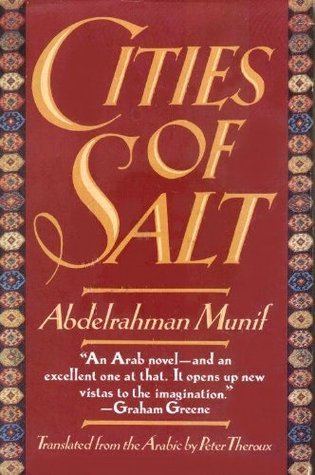
Synopsis:
Set in an unnamed Persian Gulf kingdom in the 1930s, this remarkable novel tells the story of the disruption and diaspora of a poor oasis community following the discovery of oil there. The meeting of the Arabs and the Americans who, in essence, colonize the remote region is a cultural confrontation in which religion, history, superstition, and mutual incomprehension all play a part.
Powerful political fiction that it is, CITIES OF SALT has been banned in several Arab countries, including Saudi Arabia. This novel, the first volume in a trilogy, has been translated from the Arabic to the English by Peter Theroux. (Source: Goodreads)
Happy Friday everyone! Well, it is already Saturday. Nevertheless, I am glad we could all make it through yet another workweek, although some barely made it. I hope everyone ended the work week on a high note and is diving into the weekend without much worry, perhaps even unscathed. I hope you were able to accomplish all your tasks for the week. Props to everyone for making it through the workweek. It is time to slow down, unwind, and dive into the weekend! Woah. Time is passing us by. We are already in the second half of the year’s eleventh month. If only we can slow down time. We are inching ever closer to the conclusion of 2024 and the commencement of a new year. How time flies! I hope that the year has been kind and great for everyone. Before the year ends, I hope your hard work gets recognized and repaid. I hope the remainder of the year will be brimming with good news, blessings, and pleasant surprises. More importantly, I hope everyone will be healthy in body, mind, and spirit.
But before I could dive into the weekend, let me cap another blogging week with a fresh First Impression Friday update. No blogging week concludes without this bookish update which has, over time, become an integral part of my book blogging ritual. It used to be an interlude, a quick pause to figure out my initial feelings about the book I was reading. Over time, these updates have turned into springboards for my book reviews. The past few months have been chaotic, reading-wise. There are no common themes to tie them up; I have been mixing up the books I read. Last month, for instance, I finished all books shortlisted for the 2024 Booker Prize just before the literary award-giving body announced the winner last November 12. Congratulations to Samantha Harvey for winning the prestigious prize for her novel Orbital. While it was not one of the books I was rooting for, it was one of the books that immediately made me think that it would be awarded the Prize. If you get what I mean.
Anyway, I am currently focusing on books that are part of my ongoing reading challenges. This is not a new one because, historically, I usually scramble toward the year. For my 2024 To 24 Reading List – the most imperative of my reading challenges – I am now down to my last two books. The second to the last book on the list I read is my current read, Abdelrahman Munif’s (عَبْد الرَّحْمٰن بِن إِبْرَاهِيم المُنِيف) Cities of Salt. First published in Arabic in 1984, as مدن الملح (Mudun al-Milḥ), it is the first book of a quintet; I guess it is time now for me to look for the succeeding books. Regardless, the novel transports readers to an oasis called Wadi Al-Uyoun situated in an unnamed country on the Persian Gulf. The village was home to the Atoub tribe and was helmed by Miteb Al-Hathal. The story’s main plot driver was the discovery of oil in the region in the early 20th century. Current readers will know that the region is home to some of the richest oilfields in the world.
Munif captured the discovery of oil with precision and vivid details. This was the catalyst for the entry of Americans to the region; again, a contemporary reader will immediately recognize this even sans the direct reference to Americans. The denizens of the village were naturally bewildered by the presence of the Americans who were searching for oil. Slowly, the Americans’ presence took on a more permanent role when they brought along with them heavy pieces of machinery and equipment that made the desert surface shiver. The denizens were curious but also saw it as an ominous sign; the children even threw stones at the machine from a distance just to check out what it was. The locals’ irreverence and apprehension, however, were dismissed by the “invading” foreigners who proceeded with their plans. They drilled the ground and even built houses.
However, it was not only equipment that the Americans brought along with them. They brought with them their American demeanor and style of living. They were trying to create a vestige of a home away from home. However, this is detrimental to the locals who bear witness to their carousing and disruptive behavior. Miteb tried to appeal to the king to exile the Americans. However, his pleas fell on deaf ears. With precision, Munif was laying out the groundwork for what I surmise would be the quintet’s major themes. For one, it is a vivid portrayal of the intersection of the East and the West. Throughout history, the West has been known to foray into the East for resources. When the overseas empires rose to power, they were guided by the three Gs: God, gold, and glory. The case of the discovery of oil was no different, sans the first G. Subject-wise, these are familiar territories. However, I am cognizant that each individual, community, or even country has a unique story and this is what is propelling me forward.
I am nearly midway through the book – at over 600 pages long, it is quite hefty – and I am currently in the section where the city of Harran is currently being built. This made me realize that maybe the title of the first book pertains to the sweat and tears of everyone who built these metropolises from the oases and the arid deserts. Apparently, it has a deeper meaning. Regardless, the rise of Harran also ushers a new subject: modernization. In the Bedouin tribe’s story, on the other hand, we read about the looming loss of identity as traditions are dismantled by Western ideals. The story is propped with several characters but mainly they are denizens of the wadi. I am not sure if the Munif will provide a perspective of the Americans; maybe in this book or in the succeeding books. I just have to read and see how the story develops.
There is so much to look forward to in this book; I am glad I made it part of my 2024 Top 24 Reading List. It is a work of petrofiction and provides me intimate glimpses into how the discovery of oil adversely impacted the community and the people. This is one of the reasons why the book and the quintet are essential to contemporary Arabic literature. I sure hope I get to obtain the other books in the quintet; it seems that the last two books are yet to be translated. How about you fellow reader? What book or books have you read over the weekend? I hope you get to enjoy whatever you are reading right now. Happy weekend!
 The Pine-Scented Chronicles