Of Espionage and Primitive Life
American literature, without a doubt, is one of the most diverse and the most encompassing literatures out there. It is a vast and lush literary ecosystem inhabited by different different genres and subgenres. The influence of American literature in the contemporary landscape of world literature cannot be understated. It birthed some of the world’s most highly-regarded writers whose works have transcended time and physical boundaries. Its rich literary history boasts names such as Herman Melville, Harriet Beecher Stowe, Edgar Allan Poe, Mark Twain, Walt Whitman, and Louisa May Alcott, among others. They are flanked by Nobel Laureates in Literature such as John Steinbeck, Pearl S. Buck, William Faulker, and Ernest Hemingway. The current roster of American writers is carrying the torch of this heritage. Among them is Rachel Kushner.
Born on October 7, 1968, in Eugene, Oregon to two scientists, Rachel Kushner first worked as a journalist after attending graduate school. After earning her Master of Fine Arts degree in creative writing at Columbia University, Kushner stayed in New York City where she worked as an editor at Grand Street and BOMB. As a journalist, she wrote extensively about contemporary art, earning her numerous features in Artforum. In 2008, she made her literary debut with the publication of Telex from Cuba, born out of an idea that seized her following the completion of her MFA in 2000. An immediate critical success, Telex from Cuba was a finalist for the 2008 National Book Award. Her sophomore novel, The Flamethrowers (2013), elevated Kushner to global recognition. It was also a finalist for the National Book Award and was longlisted for the International Dublin Literary Award. Her third novel, The Mars Room (2018), meanwhile, was shortlisted for the Booker Prize.
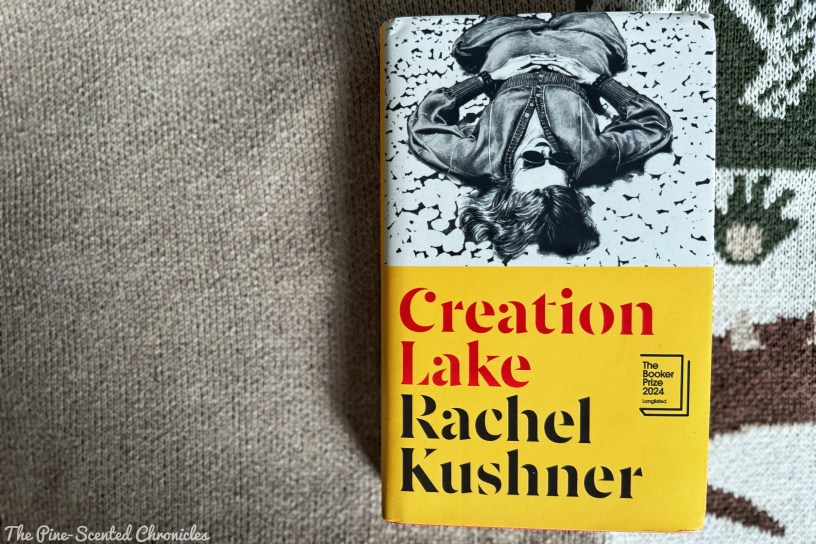
Like her third novel, Kushner’s latest novel, Creation Lake (2024), was shortlisted for the prestigious Booker Prize. Creation Lake is written from the perspective of a thirty-four-year-old female American undercover agent who we come to know as Sadie Smith, her latest alias. She used to work for the Federal Bureau of Investigation (FBI) but was fired after botching a job; she was found guilty of entrapment. She has since become a mercenary agent working under the employ of shadowy, private entities. Infiltrating secretive organizations, such as drug cartels, was a hallmark of her trade, even when she was with the Bureau. It was this highly-touted skill that became useful in her mercenary life, earning her her latest mission. One of the shadowy organizations enlisted her services to infiltrate a radical farming collective called Le Moulin located in Guyenne Valley, a remote region of France.
Bad people are honored, and good ones are punished. The reverse is also true. Good people are honored, and bad people are punished, and some will call this grace, or the hand of God, instead of luck. But deep down, even if they lack the courage to admit it, inside each person, they know that the world is lawless and chaotic and random. This truth is stored in their salt. Some have access. Others don’t. A gift or a curse, that my salt is right here, with me all the time? A gift. I’d rather be driven by immutable truths than the winds of some opinion, whose real function is to underscore a person’s social position in a group, a belief without depth. These boys in the library would profess to share beliefs.
Rachel Kushner, Creation Lake
As part of the plot to infiltrate Le Moulin, Sadie seduces Lucien Dubois; on top of her top-tier skills for espionage, Sadie is endowed with good looks. Lucien was immediately whipped for Sadie, and, in no time, she moved into his apartment. As part of his job, Lucien had to move to Marseille, prompting him to Sadie with him. It was all part of Sadie’s grand plans. The pieces of the puzzle were slowly falling into their places, particularly after Lucien invited Sadie to stay at his family’s estate in the Guyenne Valley, not far outside Vantôme. Without ado, she took the long drive and moved into and occupied the expansive but empty estate. With her newfound connection with Lucien, Sadie was closing in on her real target Pascal Balmy, an anarchist who was the leader of Le Moulin. As fate would have it, Pascal was Lucien’s close friend.
It did not take time before Sadie crossed paths with Pascal. Believing that Sadie was a translator, Pascal invited her to the commune, asking her to translate the Moulinards’ collaborative book into English. He introduced her to the rest of the commune and walked her through the daily routines in Le Moulin. He apprised the visitor of the commune’s structure and how it works. Sadie went through the motion with the practiced eye of a career spy. The commune, Sadie’s contacts were led to believe, is a danger to major capitalist interests. In her time at the Bureau, Sadie was indoctrinated with the propaganda that activists are branded as “terrorists” if they plan to disrupt capitalist or government operations. For the Moulinards, their most urgent concern was how industrialization, encroaching into their section of the country, planned to divert local water sources to mega-basins for their own use without any regard for the local farmers who depend on the water.
Slowly, Sadie found herself immersed in the life at the commune. In her interactions with the members of the commune, she was integrating into the commune’s nucleus. This was, however not the crux of the story. As Sadie was finding a footing within the community, she was also drawing toward Bruno Lacombe, a philosopher who served as the commune’s intellectual figurehead. With Bruno an integral part of the commune, their intersection was inevitable. At first, Sadie dismissed the email communications between Bruno, Pascal, and the members of the commune as laughable; she was able to infiltrate their private communications. Bruno’s regular emails to the commune contained various philosophical, anthropological, and historical concepts. The novel opens with a philosophical treatise pondering the early years of Homo Sapiens and Neanderthals. Albeit bewildering for a novel marketed as an espionage novel, the opening sequence sets the tone for the rest of the story.
Infiltrating the communications between Bruno and the Moulinards was critical for Sadie’s contacts. These shadowy figures wanted to know if Bruno’s emails revealed any of the Moulinards’ revolutionary plans that would disrupt regional government projects and initiatives. Some of the construction equipment sent by corporations to start the water diversion project had been sabotaged. These corporations had reasons to believe that the Moulinards – whom they considered anarchists – were the masterminds behind the attacks. However, contrary to what her contacts expected, Sadie could not unearth anything illicit or conspiratorial, anything that would implicate the Moulinards. Instead, while wading through the emails, something within Sadie was aroused. The ideas that Bruno espoused were slowly taking root in her.
People might claim to believe in this or that, but in the four a.m. version of themselves, most possess no fixed idea on how society should be organized. When people face themselves, alone, the passions they have been busy performing all day, and that they rely on to reassure themselves that they are who they claim to be, to reassure their milieu of the same, those things fall away. What is it people encounter in their stark and solitary four a.m. self? What is inside them? Not politics. There are no politics inside of people. The truth of a person, under all the layers and guises, the significations of group and type, the quiet truth, underneath the noise of opinions and “beliefs,” is a substance that is pure and stubborn and consistent.
Rachel Kushner, Creation Lake
It was unexpected but Sadie met her match in Bruno. More than Sadie, Bruno was the novel’s most enigmatic character. He was a former revolutionary from the 1968 student movements in France. The more Sadie got embroiled in the affairs of the commune, the more she found herself slowly and unexpectedly seduced by Bruno’s ideas. Bruno outrightly rejects capitalism and modernity as a whole. His eccentricity made him take residence in the network of caves beneath his farm. He also advocated for pre-industrial, almost primitive modes of living. Bruno’s emails extensively discuss his theories about the Neanderthals, which he developed while living in his subterranean world. To Sadie, Bruno’s anti-civilization stance seemed like the actions and words of a lunatic. Before she knew it, however, she was getting more intrigued by his ideas and his rejection of modernity. His ideals were prompting Sadie to reflect on deeper issues.
One can surmise that the unexpected connection Sadie started to feel toward Bruno stemmed from their parallels. They were both isolated from society as a whole. Sadie’s profession required her to disconnect from the rest of society lest she compromise her identity. Meanwhile, the catalyst for Bruno’s retreat to this subterranean world is a tragic accident; however, this incident humanizes Bruno, providing a different dimension to the often stoic philosopher. In the throes of this incident, he rejected the most mundane of human interactions and communicated primarily through email communications. They stare into the great void, him at the great depth of the dark cave while she at the stars in the night sky. For Sadie, the stars provided a semblance of company in a world where she was isolated by her circumstances. On the subject of isolation – prevalent in the story – the setting, Guyenne Valley, itself was an allegory of isolation – vast and quiet.
Creation Lake is more than just an espionage novel. It is a novel that explores ideas, imbibed through Bruno. The novel also captures the intricacies of activism and the lives of activists. In the commune, frictions among the members are ever-present. While they generally agree on their goals, they have conflicting ideas about how to achieve them. With different personalities living under the umbrella of the commune, disagreements were inevitable. Some advocated for violence while some rejected it. Some members were pushing for radical actions that would lead to the collapse of capitalism. This contrasts with other members’ view that even without intervention capitalism will naturally collapse on its own. One thing, however, was palpable: the Moulinards were more concerned with intellectual discourses regarding activism rather than taking actual action.
Bruno’s intellectual ruminations, on the other hand, usher discourses and even inquiries on a plethora of subjects. The email carried extensive and thoughtful discussions of archeology, anthropology, and evolution. Bruno was obsessed with Neanderthals, homo sapiens, and the ancient origins of our species, as evidenced by his emails. In a way, the questions espoused by Bruno with his inquiries subtly capture the trajectory of humanity. In its vast and diverse universe, the novel references war – the French Revolution and the Second World War – and even the development of language. There were also repeated references to Guy Debord, a Marxist theorist who Pascal styled himself after. During his youth, Burno also was an ally of the French revolutionary intellectual. Some of the subjects discussed, however, did not move the plot forward.
Modern people who build bomb shelters, planning to survive some version of apocalypse, also do not count, he said. Yes, they go underground, but not in mind of a human continuum, a community. They think, I’ll be the clever one, the one who survives mass death. But why would you want to survive mass death? What would be the purpose of life, if life were reduced to a handful of armed pessimists hoarding canned foods and fearing each other? In a bunker, you cannot hear the human community in the earth, the deep cistern of voices, the lake of our creation. In my cave, he said, under my cave, welling up from deeper passages, I hear so many things. Not just the drip of water.
Rachel Kushner, Creation Lake
Beyond the philosophies and musings that permeated the story, Creation Lake is a story of a woman in search of her own identity. Akin to most literary spies, Sadie was devoid of a personal past. Her profession does not allow her to have a single identity. For every mission, she had to don a new mask and then discard it as soon as she completed the mission. As such, she is a melting pot of different identities. Sadie cannot define her true self as her views and beliefs are disposable depending on her mission. This reflects our current reality as we have also grown accustomed to creating different personas for particular situations. In wading through the email communications between Bruno and the Moulinards, Sadie was also discovering more about herself. Bruno was opening doors for her. His ideals and intellectual pursuits prompted Sadie to confront her own perspective of life and even her core beliefs.
Multifaceted and multilayered, Creation Lake is a complex novel, an interesting addition to the Booker Prize shortlist. Kushner introduces two interesting characters who belong on opposite sides of the spectrum but share several parallels. The contrasting personalities of Sadie and Bruno provide the story interesting complexions and textures, further complemented by the intellectual discourses and inquiries espoused by Bruno and elevated by Kushner’s gorgeous prose. It probes into a vast territory of subjects such as the origins of humanity and the trajectory of civilizations, intricacies and ironies of activism, and individual motivations. It is a novel of ideas that also tackles the complexities of identities, definitions of the true self, and the isolation and disconnection from the tumult and demands of society. It will not be for everyone Creation Lake is a lush tapestry, an interesting addition to Kushner’s oeuvre
People tell themselves, strenuously, that they believe in this or that political position, whether it is to do with wealth distribution or climate policy or the rights of animals. They commit to some plan, whether it is to stop old-growth logging, or protest nuclear power, or block a shipping port in order to bring capitalism, or at least logistics, to its knees. But the deeper motivation for their rhetoric—the values they promote, the lifestyle they have chosen, the look they present – is to shore up their own identity. It is natural to attempt to reinforce identity, given how fragile people are underneath these identities they present to the world as “themselves.” Their stridencies are fragile, while their need to protect their ego, and what forms that ego, is strong.
Rachel Kushner, Creation Lake
Book Specs
Author: Rachel Kushner
Publisher: Jonathan Cape
Publishing Date: 2024
No. of Pages: 404
Genre: Literary, Psychological, Philosophical
Synopsis
Sadie Smith – a thirty-four-year-old American undercover agent of ruthless tactics and bold opinions – is sent by her mysterious but powerful employers to a remote corner of France. Her mission: to infiltrate a commune of radical eco-activists influenced by the beliefs of an enigmatic elder, Bruno Lacombe, who has rejected civilisation, lives in a Neanderthal cave, and believes the path to enlightenment is a return to primitivism.
Sadie casts her cynical eye over this region of ancient farms and sleepy villages, and finds Bruno’s idealism laughable, but just as she is certain she’s the seductress and puppet master of those she surveils, Bruno Lacombe is seducing her with his ingenious counter-histories, his artful laments, his own tragic story.
Beneath this taut, dazzling story about a woman caught in the crossfire between the past and the future lies a profound treatise on human history. Creation Lake is Rachel Kushner’s finest novel yet – a work of high art, high comedy and irresistible pleasure.
About the Author
Rachel Kushner was born on October 7, 1968, in Eugene, Oregon, USA to two scientists. Her mother is part of a family of St. Louis Unitarians from Cuba while her father is of Jewish ancestry. In 1979, Kushner and her family moved to San Francisco, California. At 16, Kushner began her bachelor’s degree in political economy at the University of California, Berkeley, with an emphasis on United States foreign policy in Latin America. Post-university, she moved back to San Francisco where she worked at nightclubs. At 26, she enrolled in the fiction program at Columbia University and earned a Master of Fine Arts degree in creative writing in 2000. After completing her master’s degree, Kushner stayed in New York City and pursued a career in journalism. She was an editor at Grand Street and BOMB. She has written widely on contemporary art, including numerous features in Artforum.
While completing her master’s degree, Kushner birthed the idea for what would be her debut novel. In July 2008, Telex from Cuba was published. The novel was warmly received by the critics; the book was a finalist for the 2008 National Book Award. Kushner’s sophomore novel, The Flamethrowers (2013), earned her more accolades and cemented her status as a rising literary star. It was shortlisted for the James Tait Black Memorial Prize and the National Book Award, and longlisted for the Women’s Prize for Fiction and the International Dublin Literary Award. The Mars Room (2018) was shortlisted for the Booker Prize and won the Prix Médicis. Her most recent novel is Creation Lake (2024) which was also shortlisted for the Booker Prize and nominated for the National Book Award.
Kushner also published a short story collection and a collection of essays. She was also the 2013 Guggenheim Fellow. In the same year, she earned an Honorary PhD from Kalamazoo College. In 2016, she earned the Harold D. Vursell Award from the American Academy of Arts and Letters.
Kushner lives in Los Angeles, California, with her husband Jason Smith and their son Remy
 The Pine-Scented Chronicles