The Fragility of Memory
In 1994, the Swedish Academy announced Japanese writer Kenzaburō Ōe as the Nobel Prize in Literature awardee. With a prolific career that spanned almost seven decades, he, with precision, crafted a successful career that produced a plethora of novels, short stories, novellas, and essays. Most of these works are fundamental in studying contemporary Japanese literature, establishing himself as a major and influential force in contemporary, particularly post-war Japanese literature. It was behind this diverse and extensive body of work that the Swedish Academy commended Ōe who with poetic force creates an imagined world, where life and myth condense to form a disconcerting picture of the human predicament today. Ōe was the second Japanese writer to earn one of the if not the most prestigious literary prizes; the first was Yasunari Kawabata, awarded in 1968.
Ōe was born and raised in the Japanese countryside, in a village surrounded by the forests of the island of Shikoku. No member of his clan had ever left the village but when he was eighteen, Ōe took the radical step of moving to the nation’s capital. In Tokyo, he attended the University of Tokyo where he studied French literature under the tutelage of Professor Kazuo Watanabe, a specialist on Francois Rabelais. While in university, Ōe immediately captured the interest of Tokyo’s literary circles, starting with Shisha no ogori (1957; Lavish Are the Dead), published in the magazine Bungakukai. A year later, he published his debut novel, Memushiri kouchi (1958; Nip the Buds, Shoot the Kids). It earned heaps of praise. Meanwhile, his short story Shiiku (1958; The Catch) won the Akutagawa Prize, a major literary prize. From these early successes, he picked up momentum and established, book by book, one of the most extensive oeuvres in the ambit of Japanese literature.
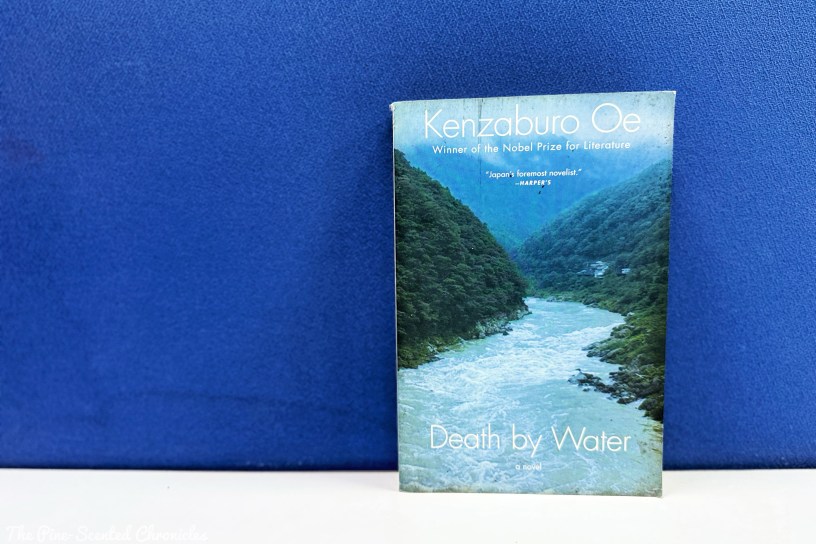
Among this long list of works is Death by Water. Originally published in 2009 in Japanese as 水死 (Suishi, “Drowning“), it was made available to Anglophone readers in 2015 with the translation of Deborah Boliver Boehm. At the heart of the novel was Kogito Choko or Kogii for short, an internationally recognized and highly accomplished writer who was already in his seventies. Death by Water is the fifth book featuring Kogito Choko who is widely considered to be the Kenzaburō Ōe’s alter ego. They share several parallels, including writing books that carried the same titles. They also share the same family background. Both the writer and the book’s hero shared the struggle of raising a developmentally challenged but musically talented son. The novel’s protagonist also writes books with a thinly veiled alter ego. When we first met Kogito, he traveled from Tokyo to his childhood home on the Japanese island of Shikoku.
So why didn’t I go ahead and start to draft the book? Because I realized clearly that I didn’t possess the literary finesse to pull it off. But even while I was floundering around, not at all certain that I would be able to survive as a young novelist, I remained essentially optimistic. Someday, I vowed, I will write the drowning novel.
Kenzaburō Ōe, Death by Water
The primary reason for Kogito’s sudden trip home was a message from his sister Asa. Her sister is granting Kogito access to a red leather trunk left behind by their father who perished shortly after the Second World War. Asa was tasked by their mother to keep the trunk after their mother’s death; their mother explicitly instructed that Kogito would only be granted access to the trunk containing her husband’s letters and documents only a decade after her own passing. Ten years have since passed and the time for reckoning has arrived. For the longest time, despite having established a celebrated literary career, he has been haunted by the death of his father who, when Kogito was still ten, drowned. The circumstances surrounding his drowning were unusual. When he drowned, Kogii’s father had with him the red leather trunk. When the trunk was later recovered, it was returned to the family and was guarded fiercely by his wife and eventually, Kogii’s younger sister.
When Kogii finally had permission to access the contents of his father’s trunk, Asa promptly arranged for her brother to get the trunk at the family’s countryside home referred to as the Forest House. In going through his father’s trunk, Kogii was pinning his hope, hoping to find answers the answers that were long obscured from him. But this is just the surface. For the longest time, Kogii was planning to write what he hoped would be his literary career’s most defining work, his proverbial swan song. He hoped that what the trunk contained would provide him the foundation for the “drowning novel” he had long envisaged. In fictionalizing his father’s death, he also hoped to cope with his long pent-up grief. His sister was cognizant of her brother’s intention, hence, her resolve not to let her brother have the trunk until their mother’s stipulated period lapsed. She was afraid that he would place the family in disrepute if her brother completed his writing project prematurely.
Imagine Kogii’s disappointment when the trunk yields very minute clues about his father. Long haunted by a dream of seeing his father float away in a small boat at night, Kogii has long been fixated on the life his father led. The veil of mystery and enigma enveloping his memories of his father was pierced by the revelation that the trunk barely offered him anything to go on with; somehow, his sister and mother had an iota about this. This puts into motion a creative crisis where Kogii questions his writing abilities. He has hit a slump. With no clarity achieved, Kogii abandoned his drowning novel in despair and returned to Tokyo where his creative crisis was exacerbated by bouts of vertigo. He took his disappointment on his disabled but musically-inclined son Akari, creating a wedge between them. Kogii detached himself from his family and society. It was so dire that his daughter remarked that she was “afraid Papa could end up like King Lear, wandering lost in the wilderness without even a Fool to accompany him.”
A semblance of inspiration came in the form of the Caveman Group who Kogii encountered during his return to Shikoku. The Caveman Group is an avant-garde theater collective that was made up of devout followers of Kogii. An experimental theater group, they were pushing the boundaries of interactive drama; audience members threw stuffed dogs at the actors. They admired Kogii’s extensive oeuvre and were devoted to dramatizing Kogii’s canon; they also adapted Natsume Sōseki’s Kokoro. They have already dramatized one of Kogii’s works and were working on further stage adaptations. Their paths crossing with Kogii’s was serendipitous, to say the least. The Group hoped that Kogii would also provide them his critique and input and more ideas on how to proceed with their various undertakings. They also plan to adapt Kogii’s final work upon its completion.
Early one morning on the cycling path beside the canal near my house, I suddenly swooned and started to fall backward, only to be caught from behind by an unseen Good Samaritan. A moment later I found myself in a sitting position, with my entire weight supported by one of this invisible stranger’s strong, resilient thighs. I have to confess that I’ve thought more than once about how odd the tableau would have appeared to a passerby who didn’t understand the situation.
Kenzaburō Ōe, Death by Water
The Caveman Group’s enthusiasm for Kogii’s works worked like magic. The radical activism of Masao Anai, the group’s leader, was the antithesis of Kogii’s recent sedentary life. The Group’s palpable interest, almost passion for Kogii’s works breathed new life into the writer’s waning confidence. Revitalized, Kogii resumed his probe into the past and, in the process, confronted his own feelings about what had transpired in the past. Following his father’s death, he was struck by guilt and regret over his inability to rescue his father who went boating on the river amidst the threat of a torrential storm. In probing into the past, Kogii was also confronting the fragility of memory. One childhood memory stands out. Kogii recalls an episode in his childhood when he overheard his father talking with a group of soldiers. He heard them plotting a suicide attack on Emperor Mikado. The memory has not left him since and was only exacerbated by his father’s perplexing death.
Memory, however, is a slippery slope. As Kogii would eventually realize, reconstructing memory is not only a daunting undertaking but basically an improbable task. Our innate prejudices preclude us from objectively examining our memories. Further, different perspectives provide contrasting versions of the past, prompting us to reexamine how we perceive the past. It is human compunction to believe a version of the past that most closely resembles the way we remember it. Kogii’s mother and sister, for instance, were reluctant to remove the lid of the past lest it would elicit a different reaction from Kogii. Other voices, such as that of Daio’ one of Kogii’s father’s disciples, further added voices to what Kogii thought he knew. This cloud that shrouded memory is metaphorical. a depiction of the pandemonium that settled on Japan following the end of the Second World War.
Death by Water, like most of Ōe’s works, is deeply personal. It was fraught with autobiographical elements. His alter ego was a crucible through which he diverged and probed into his personal history from a different perspective. This provided layers of introspection in which Kogii grappled with his own complicated emotions and memories. His father’s spectral presence continued to haunt him. The ghost of his father and his unresolved memory have inevitably become a part and parcel of who Kogii is. In his attempt to unveil the truth, Kogii was, in effect, peeling layers of himself. As much as the story was a reckoning with grief and loss, the story doubled as a search for identity. The novel also probes into complex family dynamics, with the novel underlining how our families shape our identities and how we view the world. Two father and son relationships were at the forefront of the story. Kogii and Akari’s relationship has been prominently featured in the works of Ōe while he added a different texture to the story with his exploration of his confused memory of his father. Kogii’s mother’s was also omnipresent.
Viewed from another lens, writing Death by Water was a coming to terms with one’s mortality. Kogii was cognizant of his own mortality, thus, completing his “drowning novel” is imperative for him. It is akin to coming full circle. As he prepares to embark on a journey to his hometown, Kogii feels a “poignant sense that my life as a novelist might soon be approaching its end.” Kogii was subtly preparing for his death, thus, his confrontation with the past and his memories. It made him wonder about his work’s legacy. It comes as no surprise then that discourses on his works, amplified by the Caveman Group, were germane to the story. To some, it can come across as narcissistic. Nevertheless, reading Kogii’s conflicts about his memory and his ruminations about his creative processes were among the novel’s most compelling facets. This was complemented by discourses on artistic meanings and inquiries into political ideologies and national traditions.
My husband used to read the books of Kunio Yanagida, and he told me that according to Yanagida there is a clear difference between fantasy and imagination, because imagination has some basis in reality. So what Kogii’s doing is writing mostly about real things, which he augments by using his imagination. He has a very good memory for tales his grandmother and I used to tell him, and because he used folklore as a sort of launching pad for his imaginings, when we read his early books there wasn’t a single thing to make us think, Gee, this right here is some really far-fetched fantasy.
Kenzaburō Ōe, Death by Water
Kogii, however, was not the only character confronting his past. Unaiko, a member of the Caveman Group and undoubtedly one of its most innovative and popular members, used the theater as a form of escape from her own past traumas. As a part of the Group, Unaiko was instrumental in the development of the Tossing the Dead Dogs. She uses this approach as a springboard for a deeper, and more personal and sinister piece. A playwright, she was working on recreating a local female uprising against male oppressors. Unaiko then occupies the distinction of being the story’s symbol of female resistance against the right-leaning patriarchy. Her play is bound to stir the pot. It earned the ire of hardline nationalists who wanted to mute the play even if it entailed getting their hands dirty to protect their values. The play involved a high-ranking political figure. This further underlines the political nature of the story. Beyond the fragility of memory and personal histories, politics was one of the many layers of the novel.
With several layers and various threads, the novel has the tendency to digress and meander. This can be overwhelming and chaotic in the grand scheme of things. Apart from the main themes of legacy, death, and memory, the characters go on long discussions about literature, music, and theater; the novel is steeped in cultural touchstones. The work of T.S. Eliot was part of some of these discussions; the book’s title was derived from one of the sections of Eliot’s The Waste Land. The works of Eliot also appear in Ōe’s other novels, such as Rouse Up O Young Men of the New Age! Beethoven, Edward Said, and local folklore were also interjected into the story. In a way, Ōe was coaxing the readers not only to examine the intricacies of his oeuvre but to get lost in them. There were also discourses on mental disability and the confrontation of past traumas. For the most part, it works.
Death by Water is, without a doubt, a complex and lush story. In what was supposed to be symbolically his last work – he later published one more Choko Kogito novel – Ōe explores a plethora of themes. Deeply personal and introspective, memory and the past were the heart of the story, as much as the writer himself. In the story of Choko Kogito, we read about a celebrated writer who, cognizant of his mortality, was winding up his affairs. His conflicted understanding of the past makes up for a compelling read. Loss, grief, and the ways we understand our memories and the past are also riveting. These were flanked with the probe into concerns that reverberate on a national scale. The story underscores the role of women in contemporary Japan. Politics intertwined with feminism and also cultural touchstones as the book doubles as an examination of Ōe’s literary heritage. To say the novel has a lush tapestry is an understatement and a disservice to Ōe. Death by Water, for all its smorgasbord of subjects and themes, provides a unique experience into Ōe’s literary universe.
In my dreamy vision, the relentless torrents of rain had saturated the leaves of the trees with such a vast amount of waer that the entire forest seemed as ddep and as wet as an ocean. For an average man – with the violent wind whipping around his legs as he struggled to make his way through the darkness, slipping and sliding on the rain-soaked earth – remaining upright would have been a matter of life and death. That isn’t hyperbole by any means; everyone knows it’s possible to drown in a cupful of water, and if a hiker lost his footing and tumbled facedown onto the forest floor, which had been transformed by the incessant downpour into a rushing river of mud, it would be very easy to perish.
Kenzaburō Ōe, Death by Water
Book Specs
Author: Kenzaburō Ōe
Translator (from Japanese): Deborah Boliver Boehm
Publisher: Grove Press
Publishing Date: October 6, 2015 (2009)
No. of Pages: 442
Genre: Literary, I-Fiction
Synopsis
In Death by Water, Kenzaburo Oe’s recurring protagonist Kogito Choko returns to his hometown in search of a red suitcase rumored to hold documents revealing the details of his father’s death during World War II. Since his early days as a novelist, Choko planned to fictionalize his father’s fatal drowning in order to fully process the loss and he has long been driven to discover why his father was boating in the river during a torrential storm. When the contents of the suitcase turn out to offer little clarity, Choko abandons his new novel in creative despair. But when he collaborates with an avant-garde theater troupe, Choko is revitalized and he finds the will to continue investigating his father’s legacy for both personal and familial closure.
About the Author
To learn more about the recipient of the 1994 Nobel Prize in Literature, Kenzaburō Ōe (大江 健三郎), click here.
 The Pine-Scented Chronicles