
Eleven. That is the number of months that have already elapsed in 2024. This means we are already in the final month of the year and that over the horizon is a fresh set of 365 blank slates waiting to be painted with memories. Speaking of memories, I hope everyone will take only positive and uplifting memories from 2024. I can’t believe that 2024 is about to draw to a close. I hope that 2024 has gone well for everyone. As the year slowly inches to its inevitable conclusion, I hope everyone has achieved or is on track to achieving their goals this year. A pat on the back for everyone who already completed their goals. For those who are just about to start, keep going. In any endeavor, the start is always the most challenging part. With this, I hope the remainder of the year will be filled with blessings, positive news, and answered prayers. I hope you get repaid for everything you worked hard for from the start of the year. I hope that everyone will get to savor the fruits of their labor. I hope everyone stays healthy, in mind, body, and spirit.
Reading-wise, the past few months have been chaotic. I have been reading an eclectic mix of books because there were no clear directions or themes I wanted to pursue. I read all the remaining Booker Prize-shortlisted books. I also had a mini-foray into the works of Nobel Laureates in Literature. Both were in October. In November, I had a mini-run of African literature immediately followed by a mini-run of Latin American literature. They were, nevertheless, tied up, albeit loosely, through other means. Some of the books I read were part of my ongoing reading challenges. This is not unusual as I usually cram toward the end of the year. Nevertheless, I am grateful I was able to complete my 2024 Top 24 Reading List in November. I have now turned my attention to the last five books on my 2024 Beat the Backlist Challenge list. I am also hoping to complete my 2024 Top 10 Books I Look Forward To List; if ever, it would be the first time I will complete this list before the year ends.
Anyway, here was how my October reading journey shaped up. Happy reading!

Intermezzo by Sally Rooney
After completing all Booker Prize-shortlisted books, I turned my attention to one of this year’s most looked forward books, Sally Rooney’s Intermezzo. Shooting to fame in 2017 with her debut novel, Conversations with Friends, Rooney has since established herself as one of the most recognized writers in the present. Her writing alone made me want to read her succeeding books despite a less-than-stellar outing with Normal People. This then brings me to Intermezzo, her latest novel. Intermezzo chronicles the story of brothers Peter and Ivan Koubek. Following the recent demise of their father, they were left to confront their stormy relationship. Peter, in his mid-thirties, was a successful lawyer, a stark dichotomy to the struggling Ivan, a chess prodigy who recently graduated from university and was trying to make ends meet. As the story unfolds, we get to learn more about them and their past. On top of their tumultuous relationship, we read about their romantic affairs. Peter was in a relationship with college student Naomi although he was trying to get back with Sylvia, his long-time lover who broke up with him following an accident a couple of years before; Sylvia and Peter were star-crossed lovers. Meanwhile, Ivan fell in love with Margaret, a woman in her mid-thirties he met while participating in a chess exhibition in the countryside. While Rooney’s earlier works were marketed as “millennial” novels, Intermezzo is a more profound examination of grief, loss, the intricacies of relationships and families, and even generational gaps. Like her other works, however, a moment of catharsis toward the end of the story provides clarity and ties all the novel’s loose ends together. I must say I find this more moving than Normal People or Beautiful World, Where Are You.
Goodreads Rating:


Woman of the Ashes by Mia Couto
As mentioned above, the focus of my reading journey in the final stretch of the year is the books that are part of my ongoing reading challenges. Among the 24 books I listed on my 2024 TOp 24 Reading List was Mia Couto’s Woman of the Ashes. Before the pandemic, I had never heard of the Mozambican writer who I learned is widely recognized, earning accolades across the world, including the prestigious Neustadt International Prize for Literature in 2014. These were just among the reasons for the inclusion of Woman of the Ashes on my 2024 Top 24 Reading List. Originally published in 2018, the novel transports us to 1894 when 15-year-old Imani’s village of Nkokolani finds itself in the middle of two looming and divisive powers: a group of different ethnic groups, led by the terrifying emperor Ngungunyane and the intruding Portuguese. King Dom Carlos’ latest emissary to the region is Sergeant Germano de Melo. Imani and Sergeant de Melo’s paths inevitably intersected when the Portuguese enlisted her assistance as an interpreter. A double-layered story with alternating perspectives, Imani tells the story of her family and why they moved from the coast while the letters Sergeant de Melo sent to his superiors in Portugal provide a glimpse into his character and his growing concern. This is the same in the case of Imani whose family sided with the Portuguese. However, internal strife within Imani’s family captured how divided they were between the Crown and the African Emperor. The first book in the As Areias do Imperador (Sands of the Emperor) trilogy, Woman of the Ashes makes me look forward to reading more of Couto’s works and the succeeding books in the trilogy; African writers, I have observed, have a compunction for writing historical trilogies.
Goodreads Rating:


The House of Power by Sami Bindari
From Mozambique, I traveled north to Egypt, a literary region I have come to know through Nobel Laureate in Literature Naguib Mahfouz. However, my literary guide this time is Sami Bindari who I first encountered during the pandemic. His novel, The House of Power immediately piqued my interest. Curious about what the book has in store, I included it in my 2024 Beat the Backlist Challenge. This underlines my growing interest in Egyptian literary works, and by extension, Arabic literature. At the heart of The House of Power is Saleh Hawari, a peasant living on a feudal estate called the Palace; it can be surmised that it is the titular house of power. The Palace looms large and dictates nearly every facet of Saleh’s and his fellow peasants’ lives. Education was for not the peasants – most were unable to read or write – but it was a path that Saleh resolved to pursue. This was until tragedy struck, leaving him with no recourse but to give up his thoughts on education and a career. As a peasant, the only work available for him is tilling the cotton fields. However, even getting the job was a struggle fraught with several obstacles which impeded his path. With persistence and fortune smiling on him, Saleh overcame these initial challenges but more trouble was headed his way. His association with Yasmeen, the town harlot, did not make life easier for him; they were always the subject of rumors. From a frail worker, Saleh became a reliable worker. However, upward mobility for people of his class is virtually impossible. Class differences and social chasms permeate the story. The House of Power underscores the struggles of modern Egypt, making it a riveting read.
Goodreads Rating:

God Dies by the Nile by Nawal El Saadawi
From one Egyptian writer to another. If my foray into Egyptian literature is sparse, more so is my exploration of the works of female Arabic writers. Because of this, I was happy when I encountered Nawal El Saadawi’s God Dies by the Nile. It was just recently that I encountered the Egyptian writer. My interest in El Saadawi was further piqued when I learned she is a literary titan, not only in the ambit of Egyptian and Arabic literature but in world literature as a whole; she is referred to as the Simone de Beauvoir of the Arab world. Without ado, I read God Dies by the Nile which is set in Kafr El Teen, a village along the Nile where, like in Bindari’s Palace, the situation was dire. Peasants toil the land for its meager harvests and occupy mud huts that jotted the river. What little they earn goes to food for the family. The story, however, is not a mere exploration of social classes. At the heart of the story is Zakeya whose family was exploited by the oppressive patriarchal system. Members of her family were raped, falsely imprisoned, or disappeared. At the helm of this oppressive system was the town’s corrupt mayor, flanked by the town’s most influential men: the Imam of the village mosque, the barber and local healer, and the Head of the Village Guard. They help the Mayor procure young girls. One of the girls who caught the mayor’s eyes was Nefissa, one of two of Zakeya’s nieces who recently took boarding with her. The slender novel captures the level of moral corruption that permeates the Egyptian countryside, with politics as its crucible. I wish the book was longer but I appreciate the glimpses it provided me of El Saadawi’s oeuvre, making me want to explore it further.
Goodreads Rating:
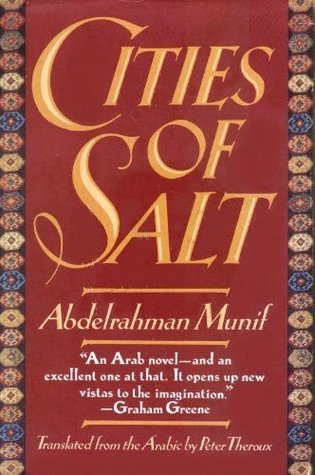
Cities of Salt by Abdelrahman Munif
For the third consecutive book, I read a work of Arabic literature. Before the pandemic, I have never come across Abdelrahman Munif (عَبْد الرَّحْمٰن بِن إِبْرَاهِيم المُنِيف). Through an online bookseller, I came across one of his books, Cities of Salt. With my interest piqued, notwithstanding how I barely knew about Munif, I obtained the book. Besides, I can sense that the book and the writer will expand my reading horizon, hence, its inclusion on my 2024 Top 24 Reading List. First published in Arabic in 1984, as مدن الملح (Mudun al-Milḥ), it is the first book of a quintet works of petrofiction written by Munif. The novel transports readers to Wadi Al-Uyoun, an oasis in an unnamed country on the Persian Gulf. The discovery of oil in the region disrupted the oasis’s harmony. With the discovery of oil came American interest; Munif vividly captured their entry into the Arabian countries. The villagers were bewildered by their presence which slowly became permanent when heavy pieces of machinery and equipment entered the village. The villagers were curious but also saw it as an ominous sign. The locals’ irreverence and apprehension, however, were dismissed by the invaders who proceeded with their plans, drilling the ground and even building makeshift houses. Over the coming years, we read how the discovery of oil altered the village and in its stead, an urban center called Harran rose. But more than the discovery of oil, Munif explores how the Americans’ presence altered the landscape of Wadi Al-Uyoun and its neighboring towns, how modernization dismantled tradition, and the prominent role of politics and lobbying. Overall, Cities of Salt is an insightful and vivid story steeped in history. I hope I get to obtain the succeeding books in the quintet.
Goodreads Rating:

Until August by Gabriel García Márquez
From the Middle East, my literary journey next brought me to Latin America, to a more familiar name. Since reading One Hundred Years of Solitude, I have been a fan of Nobel Laureate in Literature Gabriel García Márquez. I have since read more of his works. This brings me to his latest translated novel, Until August. I think it is his first book to be published posthumously. It drew even more controversy when it was revealed that the book’s publication went against the Colombian writer’s wishes to destroy the manuscript after his death; the English translation was published on his 97th birthday. The book was originally planned to be a collection of four stories but circumstances did not allow García Márquez to complete it. At the heart of the story was Ana Magdalena Bach who was happily married to Doménico Amarís, the director of a musical conservatory, for nearly three decades. In her mid-forties, Ana Magdalena decided to make an annual pilgrimage. Every August, she travels to an unnamed Caribbean island to pay respect to her dead mother. During her visits, she takes on a lover, usually one-night stands with strangers whom she was attracted to. This then became part of her annual pilgrimage. Beyond her extra-marital affairs, Ana Magdalena grapples with her inner turmoil. Music plays a prominent role in the story. The novel did remind me a bit of Memories of My Melancholy Whores because it probed into sex and aging; ironically, García Márquez shelved Until August to work on this novel. Interestingly, Until August is García Márquez’s first novel to have a female protagonist. I do agree with literary pundits, this is one of the Colombian writer’s minor works.
Goodreads Rating:

The Invention of Morel by Adolfo Bioy Casares
The last book on my 2024 Top 24 Reading List was Adolfo Bioy Casares’ The Invention of Morel which I first encountered back in 2019. With the book left gathering dust on my bookshelf, it has become imperative for me to read the book, hence, its inclusion on my 2024 Top 24 Reading List. Apparently, Bioy was the protégé of Jorge Luis Borges, a literary titan, not only within the ambit of Argentine literature but also world literature as a whole. This made me look forward to reading The Invention of Morel even more. Originally published in Spanish in 1940 as La invención de Morel, the deceptively slender novel was Bioy’s first major work, the work that catapulted Bioy to fame. The novella takes the form of a journal written by an anonymous narrator who was on the run and arrived on Villings Island, an abandoned island where he settled. Before it was abandoned, visitors to the island contracted a mysterious sickness resembling radiation poisoning. The anonymous writer’s fear of being caught, however, was stronger than his fear of contracting the same disease. Soon, loneliness affects the narrator’s state of mind, until his tranquility is disrupted by the sudden appearance of people. While they could provide him company, he opted to remain incognito lest they have him arrested. Enter Faustine whose beauty mesmerized the narrator. She was often joined by a man named Morel but when he tried to approach them, it seemed that they could not see him. The Invention of Morel is quite an intriguing novel but it is this layer of intrigue that belies the deeper themes embedded into it. It is such a unique reading experience that I am looking forward to reading more of Bioy’s works.
Goodreads Rating:

Dona Flor and Her Two Husbands by Jorge Amado
My literary journey next transported me to Brazil. Through must-read lists, I encountered Jorge Amado. This naturally piqued my interest, precipitating what would be my first official foray into his oeuvre in 2021. Showdown was an interesting book although clearly not among my favorites. Nevertheless, it made me more curious about Amado’s other works. Three years later, I have read my third book by the prolific Brazilian writer, Dona Flor and Her Two Husbands. The novel is set in Bahia, Amado’s birthplace. The story commences ominously with the death of Waldomiro Guimarães, “Vadinho”, the husband of the titular Dona Flor. During the first Sunday of Carnival in Bahia, he died while dancing the samba, dressed as a woman. Dona Flor not only had to endure the wake and burial but also stories about his decadence. The story then moves back into the past where we read about her childhood. She was raised by her domineering widowed mother who wanted her children to enter into gainful marriages. Dona Flor abided by her mother’s wishes but was adamant that she would marry the man she loved. Vadinho, on the other hand, was the bastard son of a prominent figure. He was belligerent but Dona Flor loved him. After mourning Vadinho, Dona Flor attracts the local pharmacist, Dr. Teodoro Madureira, who was Vadinho’s antithesis. He was kind and considerate. Without ado, Dona Flor accepted his proposal. He provided her a worry-free life. Just when everything settled into a comfortable harmony, Dona Flor’s life was disrupted by a ghost from the past. Dona Flor and Her Two Husbands is an interesting probe into the dichotomies of good and evil. More than that, the novel underscores the diversity of Amado’s works, at least from the three books I read so far.
Goodreads Rating:

Amulet by Roberto Bolaño
I concluded my November reading month and, thus, my mini-foray into the works of Latin American literature, with another familiar writer. Like most of the writers whose oeuvres I explored in the past five years or so, it was through must-read lists that I first encountered the critically acclaimed and celebrated Chilean writer Roberto Bolaño. I have since read his two most critically acclaimed works, The Savage Detectives and 2666. They are also among my most memorable reads. I wasn’t planning on reading Amulet but here I am, making it the third book by Bolaño I read. Originally published in 1999 in Spanish as Amuleto, the story is narrated by Auxilio Lacouture, dubbed the mother of Mexican poetry. First introduced in The Savage Detectives, she opens the story: This is going to be a horror story. A story of murder, detection and horror. But it won’t appear to be, for the simple reason that I am the teller. Told by me, it won’t seem like that. Although, in fact, it’s the story of a terrible crime. The opening line sets the tone for the story which, I learned, was predicated on the 1968 Movement in Mexico, particularly the army invasion of the National Autonomous University of Mexico (UNAM) on September 19, 1968, to quell student political protests. Resisting the invasion of the military, Auxilio locked herself up in a fourth-floor lavatory cubicle “for thirteen days”. During this period, she was seized by the flood of memories and reflections, mainly from the time she arrived in Mexico in 1965 to 1976 when Belano left Mexico. Like in the case of The Invention of Morel, I find it a challenge to sum up the overall experience with the book. It is quite ironic because these books are rather slender.
Goodreads Rating:
Reading Challenge Recaps
- My 2024 Top 24 Reading List: 24/24
- 2024 Beat The Backlist: 15/20; 102/60
- 2024 Books I Look Forward To List: 8/10
- Goodreads 2024 Reading Challenge: 118/100*
- 1,001 Books You Must Read Before You Die: 16/20
- New Books Challenge: 16/15
- Translated Literature: 56/40
*Updated my Goodreads goal from 80 to 100.
Book Reviews Published in November
- Book Review # 555: A Fine Balance
- Book Review # 556: Intermezzo
- Book Review # 557: Orbital
- Book Review # 558: Held
- Book Review # 559: Creation Lake
- Book Review # 560: Death by Water
November was another unexpectedly busy month. I guess this is preparing me for what lies ahead this December. Nevertheless, despite the tedium, I am glad I was able to sneak in some book reviews. I am glad I was able to sustain the writing momentum I gained in the past three months. I was able to publish six book reviews, which is just a book review shy of my October output. It is still a good number. One thing is glaring, however. All but one book I reviewed during the month are books I read this year. Further, three were books shortlisted for the 2024 Booker Prize, including the eventual winner, Orbital. At least I have fewer 2024 pending book reviews come 2025. HAHA. On the other hand, I still have quite a huge backlog from 2023; I have over sixty books pending. Nevertheless, as the year inches to a close, I will still try to work on closing the gap. The mantra, as always, will be to take it one step at a time; although a little sense of urgency might help.
Like how it has been in the past few months, my December reading journey is going to be a mixed bag. The priorities, of course, are my active reading goals and reading challenges. I can say I have now checked all the books in my 2024 Top 24 Reading List. However, I still have five in my 2024 Beat the Backlist Challenge and two on my 2024 Top 10 Books I Look Forward To List. Thankfully, I was able to obtain one of the last two books in the latter. I just hope I obtain a copy of the last book on the said list. Currently, I have commenced a mini-foray into the works of American literature because four of the last five books in my Backlist Challenge are works of American writers; I am currently reading Nathaniel Hawthorne’s The Scarlet Letter. I will eventually pivot toward Japanese literature upon completing all the works of American writers in my Backlist Challenge; the last one, interestingly, is Yukio Mishima’s Thirst for Love.
I also have more reasons to dedicate the last stretch of the year to works of Japanese literature. For the first time in years, I haven’t hosted a Japanese literature month. I was swamped with other books that piqued my interest. Furthermore, the translation of Haruki Murakami’s latest novel was released last month; my copy of the book is currently in transit. I have also obtained several recently translated works by Japanese writers I wanted to read, including Hiromi Kawakami’s Under the Eye of the Big Bird. I was not expecting the sheer volume of translated Japanese novels but I am all for it.
How about you fellow reader? How is your own reading journey going? I hope you enjoyed the books you have read. For now, have a great day. As always, do keep safe, and happy reading everyone!
 The Pine-Scented Chronicles