
Happy Wednesday everyone! Wednesdays also mean WWW Wednesday updates. WWW Wednesday is a bookish meme hosted originally by SAM@TAKING ON A WORLD OF WORDS.
The mechanics for WWW Wednesday are quite simple, you just have to answer three questions:
- What are you currently reading?
- What have you finished reading?
- What will you read next?

What are you currently reading?

Just like that, we are already a week down into 2025. How has the year been so far? I guess it is still too early to ask that question. Nevertheless, I hope that everyone’s 2025 will be brimming with good news, healing, and positive news. I hope this new year will usher in prosperity. The year is still in its infancy and I am cognizant that many are establishing their goals. For most, the year’s start has become synonymous with crafting goals and targets for the rest of the year. I wish the best for everyone. I hope everyone will achieve their goals and even dreams this year. In all facets of life, I want to achieve several goals this year. In reading and writing alone, I have several I want to achieve this year. For one, I already set my Goodreads goal to 100 books, the first time I am doing so from the onset.
Because I was not able to hold a Japanese literature month last year, I have resolved to dedicate the first two months of the year to books written by East Asian writers. I have already been to South Korea through Yeon Somin’s The Healing Season of Pottery. I crossed the border to China with Bai Hua’s The Remote Country of Women. Interestingly, despite its vast influence, Chinese literature is a literary territory I have rarely dipped my toes into. I am hoping to redress this with this foray into works of East Asian literature. Anyway, The Remote Country of Women is set in the latter years of the Cultural Revolution. For the most part, the story alternates between the perspectives of the two main characters: Sunamei, a thirteen-year-old Mosuo girl in 1975, and Liang Rui, an initially destruction-embracing revolutionary. The novel has an interesting premise because the Mosuo ethnic group living in the hinterlands close to the Tibetan border is known to be matrilineal. This realization made me understand the story better. I am nearly done with the book and I must say, the story is riveting.
What have you finished reading?

While I resolved to dedicate the first two months of the year to reading books written by East Asian writers, I actually commenced my 2025 reading journey with a non-Asian writer. It was during the pandemic when I first came across the award-winning writer. The Overstory was ubiquitous but it did not immediately pique my interest. A couple of months later, I would encounter Powers once again when his novel Bewilderment was shortlisted for the Booker Prize. It was then that I resolved to read his works; I loved Bewilderment – and eventually The Overstory – and was even rooting for it to win the prestigious literary prize. It did not win the Prize but it won a fan in me. I wasn’t even aware that Powers was releasing a new work until the Booker Prize longlist was released. His latest novel, Playground, was longlisted for the Booker Prize again.
I wanted to read Playground but it took some time before I was able to obtain a copy of the book. The Pulitzer Prize-winning writer’s latest novel introduces four characters from diverse backgrounds who have contrasting personalities. Rafi Young and Todd Keane developed an unlikely friendship. Rafi was smart but was born to a poor family. Todd was also smart but was born into affluence. Their paths crossed when Rafi was awarded a scholarship sponsored by Todd’s father. Over chess, their friendship flourished; Todd introduced chess to Rafi. Their paths diverged when they both entered university. Rafi pursued literature while Todd pursued computer sciences. Rafi then met and fell in love with Tahitian woman Ina Aroita. When Rafi introduced her to Todd, Todd also fell for her. The last member of the quartet was Evelyne Beaulieu, a French Canadian oceanologist. Their paths converged on the Pacific island of Makatea where the denizens are holding a referendum on whether to allow the building of floating cities in their vicinity. Playground is a novel of ambition and ideas with a plot twist toward the end that ties it all together. It was interesting, innovative, and altogether riveting. With his latest novel, Powers consolidated his stranglehold as a masterful chronicler of the contemporary’s conditions.
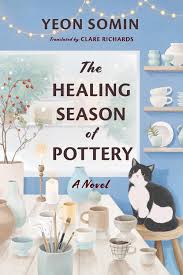
The official commencement of my foray into the works of East Asian writers was Yeon Somin’s sophomore novel, The Healing Season of Pottery. The book was ubiquitous toward the end of 2024, prompting me to obtain a copy of the book. The curious cat in me simply cannot resist. Yeon Somin joins the ranks of Korean writers who have been making waves globally. I guess this is in part due to the success of Han Kang who won the International Booker Prize in 2016, and eventually the Nobel recognition. Korean writers’ presence in prestigious literary prizes has not escaped my attention. A spate of heartwarming stories has also been released, among them is Hwang Bo-reum’s Welcome to the Hyunam-dong Bookshop. An addition to this growing list is Somin’s The Healing Season of Pottery.
Originally published in 2023, The Healing Season of Pottery is Somin’s sophomore novel. At the heart of the story is a young woman named Jungmin. One day decided to leave her job as a television writer. She was tired of how the show she was working with was capitalizing on the misfortune of others. This leads Somin to a pseudo-quarter-life crisis. Thirty, single, and with no iota about what to do with her life, she was in a quandary. Caught in an impasse, she moved to her hometown of Ilsan. The change in landscape, however, barely did little to assuage her anxieties. A bout with depression made her hole up in her new apartment. It was at this juncture that she decided to go out and look for a cozy café. However, instead of a café, she entered a pottery studio where she was welcomed by two old women on their wheels. Jungmin was served with coffee which she enjoyed. When she inquired about the source of the coffee, the women explained that the flavor came not only from the good quality of the coffee but also because of the mug which was made in the pottery studio. Thus commenced her journey to healing and rediscovering her self. Heartwarming and tender, it was indeed reminiscent of Welcome to the Hyunam-Dong Bookshop.
What will you read next?


 The Pine-Scented Chronicles