
Happy Wednesday everyone! Wednesdays also mean WWW Wednesday updates. WWW Wednesday is a bookish meme hosted originally by SAM@TAKING ON A WORLD OF WORDS.
The mechanics for WWW Wednesday are quite simple, you just have to answer three questions:
- What are you currently reading?
- What have you finished reading?
- What will you read next?

What are you currently reading?

Just like that, we are already a week down into 2025. How has the year been so far? I hope that everyone’s 2025 is going great. I hope it will be a year of prayers answered and goals achieved. I hope it will usher in good news, healing, prosperity, and positive news for everyone. The year is still in its infancy and I am cognizant that many are establishing their goals. For most, the year’s start has become synonymous with crafting goals and targets for the rest of the year. It is my fervent wish that everyone achieve their goals and even dreams this year. In all facets of life, I want to achieve several goals this year. In reading and writing alone, I have several I want to achieve this year. For one, I already set my Goodreads goal to 100 books, the first time I am doing so from the onset. It is also my goal to end the year with more translated books than books originally written in English.
With this in mind, I commenced my reading year by immersing myself in the works of Asian writers. This is driven mainly by my failure to hold a Japanese literature month last year, the first time in a while I was unable to do so. This literary journey across East Asia next took me to China with Yan Lianke’s Dream of Ding Village. The novel transported me to rural Henan province. The guide across the landscape is twelve-year-old Ding Qiang. He is a spectral presence who witnesses the events unfolding in his village. Qiang dies at the start of the story after he is poisoned by one of the locals. You see, the locals blamed his father for the malady that seized the village. A decade ago, Ding Hui’s father, Ding Hui, became the village’s blood kingpin. However, they did not foresee the fever epidemic it would bring. Symptoms of AIDS started to manifest. The book has a promising premise and it has my full attention. I can’t wait to see how it all unfolds.
What have you finished reading?

I am slowly gaining momentum. In the past week, I managed to complete three books that took me across East Asia, starting in China. Admittedly, despite its prominence and vast landscape, Chinese literature is a part of the literary world I rarely ventured into. However, I have been trying to redress by reading more works written by Chinese writers; in 2023, I read three novels written by Chinese writers, the most I read in a year. This foray into East Asian literature is one way to do it. It was during the height of the pandemic when I first encountered Bai Hua. I came across his novel The Remote Country of Women through an online bookseller. Curious about what the book has in store, I obtained a copy of it.
Set in the latter years of the Cultural Revolution, The Remote Country of Women alternates between the perspectives of the novel’s two main characters: Sunamei, a thirteen-year-old Mosuo girl in 1975, when the chapters centered around her begin; and Liang Rui, a self-absorbed man who was also a weary witness to the Cultural Revolution. Sunamei’s story is presented in the third-person point of view while Liang Rui narrates his own story. The titular remote country of women transports the readers to the hinterlands close to the Tibetan border. This portion of the country was inhabited by the Mosuo ethnic group. The Mosuos are known to be matrilineal. They do not recognize the institution of marriage and do not take a single spouse. Life in the countryside was captured through Sunamei as we follow her journey to womanhood. Her baptism of fire, so to speak, also captures the tradition and culture of the ethnic group she is part of. Meanwhile, Liang Rui was basically a prisoner on a farm. He managed to escape from his incarceration by pretending to be sick with tuberculosis. Soon, he made his way to the remote country of women where his path crossed with Sunamei’s. The Remote Country of Women addresses themes of the repression and freedom of sexuality, the brutality of modernity, and the fluidity of gender roles. It was a riveting read that provided me insights into a culture and group of people I had previously not read about.

From an unfamiliar writer to a familiar writer. From China, my next read took me to a more familiar territory, Japanese literature. It has been years since I first encountered Jun’ichirō Tanizaki through must-read lists. Since reading Some Prefer Nettles, he became one of my mainstays. The highly-touted writer, along with his contemporaries Yukio Mishima and Yasunari Kawabata, is one of the reasons why Japanese literature has grown on me and became one of my favorite literatures. Japanese literature is literally a comfort zone. Five years since I read my first Tanizaki novel, I have read my fifth, The Key.
Originally published in 1956 in Japanese as 鍵 (Kagi), the novel takes the form of a diary. The first diary was written by an anonymous fifty-five-year-old university professor married to Ikuko who was at least a decade his junior. The second diary was written by Ikuko. The couple has a daughter named Toshiko. The diaries contained the respective writer’s deepest and most sinister thoughts. It contained their major concerns. For the professor, his major concern was his wife. He confesses the sexual difficulties he was having with his wife. He complained about Ikuko’s insatiable appetite, her conservative attitude, and her rejection of his sexual preferences. Ikuko, on the other hand, wrote about her husband’s inability to satisfy her. Her husband attributed this to the dichotomy in their ages. As the story unfolds, the couple grows paranoid, believing that each is reading the other’s diary. They feign ignorance but they also keep reiterating in their respective diaries that while they are aware of each other’s diaries, they have never read them. Their personal issues were exacerbated by the arrival of Kimura, a teacher who they chose as a prospective husband for their daughter. Despite Toshiko’s lack of interest in him, Kimura has become a prominent presence in their household. It was the typical Tanizaki. I was not surprised by the sexual overtones. What fascinated me was how Tanizaki carefully laid out the psychological profile of the characters. Overall, The Key was another memorable Tanizaki read.
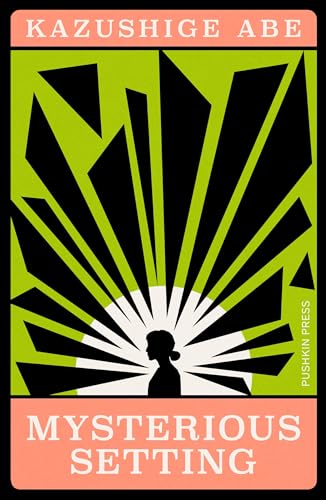
I did not realize it but it seems that I have been alternating familiar writers with unfamiliar writers. Rounding up my three-book romp in the past week was Kazushige Abe’s Mysterious Setting. Before 2024, I had never heard of the Japanese writer nor had I encountered any of his works. In his native Japan, Abe is a prolific writer who earned various accolades for his works, including the Noma Literary New Face Prize, Tanizaki Prize, and Akutagawa Prize. It may have escaped my notice but I was surprised to learn that Abe is married to Mieko Kawakami, another favorite writer of mine. Further, he joins a growing list of Japanese writers whose earlier works are being translated.
Originally published in 2006 as ミステリアス・セッティング, Mysterious Setting charts the fortune of a young girl named Shiori. At a young age, she dreamed of becoming a traveling troubadour who serenades the world. The word caught her fancy when she first encountered it and looked it up; it described the life she wanted for herself, it was her calling. Life, however, has other plans. Everyone who heard her sing was confused about her dream. She was tone deaf and was unable to hold a tune. Shiori also believes that everyone who heard her sing dies violently. Shiori’s artistic expression isolated her from everyone around her, including her family. Her younger sister Nozomi even finds ways to cause her distress, resorting to emotional, physical and sexual abuse. In contrast, Shiori’s cries sound like music to everyone’s ears. The world was cruel to her but she still tries her best. When she moved to Tokyo, Shiori found herself grappling with even crueler realities of life. Her gullibility and vulnerability were taken advantage of. Her life took a turn when Manuel, a Peruvian drummer she befriended, entrusted her with a suitcase nuke. The fate of the rest of the city then rests on Shiori’s shoulders. Mysterious Setting is quite a wild ride that pulls one into different directions. I guess it is the novel’s charm despite its palpable bleakness.
What will you read next?


 The Pine-Scented Chronicles