
Happy Wednesday everyone! Wednesdays also mean WWW Wednesday updates. WWW Wednesday is a bookish meme hosted originally by SAM@TAKING ON A WORLD OF WORDS.
The mechanics for WWW Wednesday are quite simple, you just have to answer three questions:
- What are you currently reading?
- What have you finished reading?
- What will you read next?

What are you currently reading?

How has the year been so far? I hope that everyone’s 2025 is going great. I hope it will be a year of prayers answered and goals achieved. I hope it will usher in good news, healing, and prosperity for everyone. The year is still in its infancy and I am cognizant that many are establishing their goals. For most, the year’s start has become synonymous with crafting goals and targets for the rest of the year. The Chinese New Year is just over the horizon so for those who haven’t started on their goals, you can still catch up. I fervently wish that everyone achieves their goals and even dreams this year. I want to achieve several goals this year in all facets of life. In reading and writing alone, I want to achieve several this year. For one, I already set my Goodreads goal to 100 books, the first time I am doing so from the onset. It is my goal to end the year with more translated books than books originally written in English.
With this in mind, I commenced my reading year by immersing myself in the works of East Asian writers. This is driven mainly by my failure to hold a Japanese literature month last year, the first time in a while I was unable to do so. Speaking of Japanese literature, I am reading my fourth novel written by Shūsaku Endō. As per the book’s introduction, Wonderful Fool is the third novel by the Japanese writer to be translated to English. It charts the fortunes of Gaston Bonaparte, a Frenchman descended from Napoleon Bonaparte who decided to visit – or perhaps stay – in Japan. He first went to his pen friend Takamori; they never met and corresponded about seven years ago. Takamori He was learning Japanese but after staying with Takamori’s family for a couple of days, he decided to move and not take advantage of the family’s hospitality. He thought that this hospitality is ubiquitous in Japan. He was in for a ride. Gaston, or Gas, is incredibly naïve and innocent and in a foreign territory this can both be a blessing and a curse. What I find compelling about the book is that it is about to provide me with a different dimension of Endō’s body of work.
What have you finished reading?

After a rather slow start to open the year – and I guess I was quite busy i the past few week – I am slowly building and gaining momentum. In the past week, I managed to complete three books that took me across East Asia, starting in China. Despite its prominence and vast landscape, Chinese literature is a part of the literary world I rarely ventured into. It is unfortunate but I have been trying to expand my foray into Chinese literature. This foray into East Asian literature is one way to do it. This venture also underscores how little I know about Chinese writers. For instance, I first encountered Yan Lianke during the most recent Big Bad Wolf Sale. I came across his novel, Dream of Ding Village which, without ado, I included it in my ongoing literary adventure.
Originally published in 2006, as 丁庄梦 (Dīng zhuāng mèng), the novel transported me to the Chinese countryside, to the titular Ding Village tucked in the province of Henan. Guiding the readers across this landscape is twelve-year-old Ding Qiang. From the onset, it was established that he was an omniscient presence; he was poisoned and died when he was twelve. The circumstances surrounding his poisoning is the main plot driver. His father, Ding Hui, is renowned across the village as the man who brought the blood trade to the village. Villagers sold their blood to him for a meager price. He then sells the blood to blood merchants in the cities. He was the personification of greed. He wanted so much to get ahead of everyone that he unsuspectingly contaminated his fellow villagers with AIDS and HIV. Now locals are sick with the fever. The mortality rate in the village of 800 escalated. Fears of death hovered. Understandably, the locals were angry at Hui and his brother Liang. Serving as the voice of reason is their father, Shuiyang, or Grandpa. Grandpa tried to assuage the villager’s anger. The novel was based on actual events which Lianke extensively researched on, at one point even posing as an assistant to an anthropologist. Beyond the scandal, the novel captures the strain placed by totalitarianism on small villages. Overall, Dream of Ding Village is a compelling and insightful read.

From China, my next read took me to the Korean Peninsula. Over the couple of years, I have noticed the growing interest in Korean literature. It maybe because of the rising popularity of KPop. However, I also consider another event as germane to the rise of Korean literature. In 2016, Han Kang’s The Vegetarian won the International Booker Prize. Nearly a decade later and three more translated novels, Kang earned the distinction of becoming the first female Asian Nobel Laureate in Literature. The Vegetarian’s success, it seems, revived the interest in Korean literature. More Korean works are nominated for the International Booker Prize.
More Korean works are also made available to Anglophone readers. Among them is Kim Ae-ran’s 2011 novel 두근두근 내인생 (Dugeun Dugeun NaeiNsaeng) which was translated to English in 2021 as My Brilliant Life. At the heart of the novel is seventeen-year-old Areum. He takes the readers first to the story of his conception. His mother, Mira, was the only girl born to a family of five children. When she was sixteen, she was impregnated by Daesu, a taekwondo student. They were unsure of how to proceed with their life but Mira’s father straightened the details out. Daesu, however, had very little prospect. He was a natural pessimist. Areum, on the other hand, grew up to be a smart child. However, he was also sick with progeria, a disease that cause rapid aging. The novel was, in a way, his coming-to-terms with his mortality. The first of two plotlines captures his family life in countryside Korea. The second plotline paints a portrait of his stay at the hospital. It was while convalescing that he came into contact a young girl who was also as sick as him. Despite the bleakness that hovered above the story, the story beacons with Areum’s positivity. My Brilliant was a tearjerker or a read; I did not expect it to be that heavy.
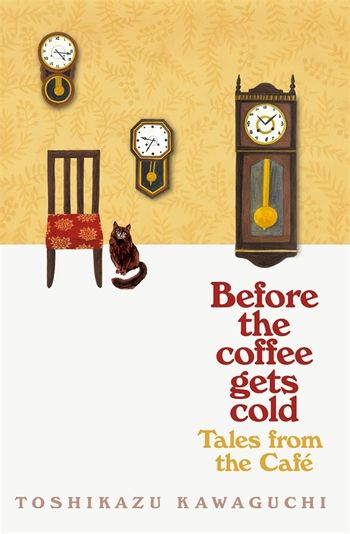
Rounding up my three-book romp was a familiar name in Toshikazu Kawaguchi who has gained global recognition with his Before the Coffee Gets Cold series. The story was born out of a play that Kawaguchi wrote. The series has since gained popularity and Kawaguchi has followed up his initial success by publishing sequels to the first book, the carrier of the series’ title. Tales from the Café is the second book in the series and was originally published in 2017 as この嘘がばれないうちに . Of course, I am not one to miss out on this literary sensation.
Like its predecessor, Tales from the Café is divided into four sections and introduces new characters. It transports the readers back to the Funiculi Funicula café tucked in one of Tokyo’s alleys. The café is renowned for transporting customers back in time or, in rare circumstances, forward in time. Time travelers, however, must adhere to a stringent set of rules. The present cannot be changed and time travelers can only meet people who have visited the café. Further, time travel is only possible through one chair which is always occupied by a female ghost; she takes the comfort room once a day, presenting an opportunity for those who want to travel through time. The most important rule, however, was that the travelers should be back before the coffee gets cold. The first customer in the second book is Gohtaro Chiba, who goes to the past to visit his best friend, Shuichi. The second chapter centers on Yukio Mita, the brother of café regular Kyoko Kijima. Katsuki Kurata’s circumstance is interesting as he travels to the present day y café from the past, hoping to meet his former girlfriend, Asami. Rounding up the stories is the story of Kiyoshi Manda, a detective. The diversity in the characters’ stories make this series both heartwarming and relatable.
What will you read next?


 The Pine-Scented Chronicles