
Hello, readers! It is Monday again! As it is Monday, welcome to another #5OnMyTBR update. The rule is relatively simple. I must pick five books from my to-be-read piles that fit the week’s theme.
This week’s theme: No Prompt
Because there is no prompt this week, I decided to feature books written by writers whose oeuvres I have not explored before. This is from a past prompt I have not participated in.

5OnMyTBR is a bookish meme hosted by E. @ Local Bee Hunter’s Nook where you chose five books from your to-be-read pile that fit that week’s theme. If you’d like more info, head over to the announcement post!

Title: Panorama
Author: Dušan Šarotar
Translator (from Slovene): Rawley Grau
Publisher: Peter Owen Publishers
Publishing Date: 2016 (2014)
No. of Pages: 206
Synopsis:
Deftly blending fiction, history, and journalism, Dušan Šarotar takes the reader on a deeply reflective yet kaleidoscopic journey from northern to southern Europe. In a manner reminiscent of W.G. Sebald, he supplements his engrossing narrative with photographs , which help to blur the lines between fiction and journalism. The writer’s experience of landscape is bound up in a [ersona yet elusive search for self-discovery, as he and a diverse group of international fellow travellers relate in their distinctive and memorable voices their unique stories and common quest for somewhere they might call home.

Title: Embers
Author: Sándor Márai
Translator (from Hungarian): Carol Brown Janeway
Publisher: Penguin Books
Publishing Date: 2003 (1942)
No. of Pages: 249
Synopsis:
As darkness settlers on a forgotten castle at the foot of the Carpathian mountains, two men sit down to a final dinner together. They have not seen one another in forty-one years. At their last meeting, in the company of a beautiful woman, an unspoken act of betrayal left all three lives shattered – and each of them alone. Tonight, as wine stirs the blood, it is time to talk of old passions and that last, fateful meeting.
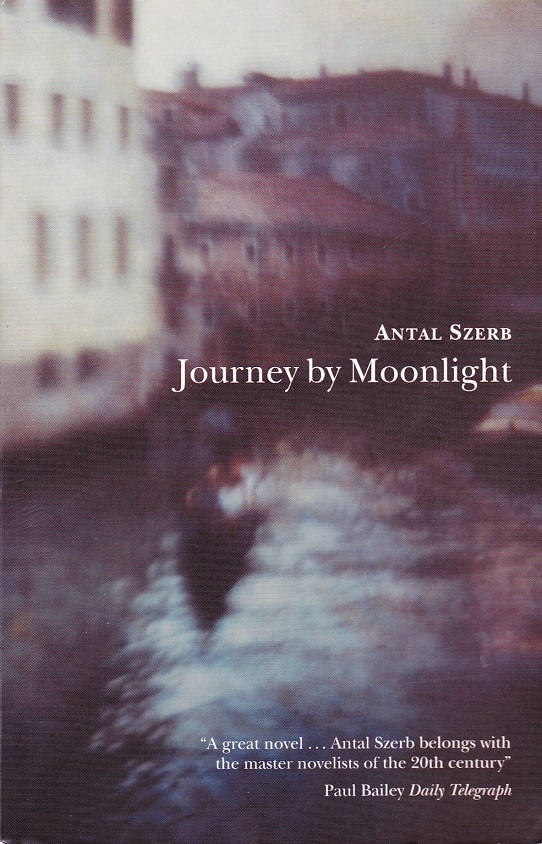
Title: Journey by Moonlight
Author: Antal Szerb
Translator (from Hungarian): Len Rix
Publisher: Pushkin Press
Publishing Date: 2002 (1937)
No. of Pages: 236
Synopsis:
A major classic of 1930s literature, Antal Szerb’s Journey by Moonlight (Utas és Holdvilág) is the fantastically moving and darkly funny story of a bourgeois businessman torn between duty and desire.
‘On the train, everything seemed fine. The trouble began in Venice …’
Mihály has dreamt of Italy all his life. When he finally travels there on his honeymoon with wife Erszi, he soon abandon her in order to find himself, haunted by old friends from his turbulent teenage days: beautiful, kind Tamas, brash and wicked Janos, and the sexless yet unforgettable Eva. Journeying from Venice to Ravenna, Florence and Rome, Mihály loses himself in Venetian back alleys and in the Tuscan and Umbrian countryside, driven by an irresistible desire to resurrect his lost youth among Hungary’s Bright Young Things, and knowing that he must soon decide whether to return to the ambiguous promise of a placid adult life, or allow himself to be seduced into a life of scandalous adventure.
Journey by Moonlight (Utas és Holdvilág) is an undoubted masterpiece of Modernist literature, a darkly comic novel cut through by sex and death, which traces the effects of a socially and sexually claustrophobic world on the life of one man.
Translated from the Hungarian by the renowned and award-winning Len Rix, Antal Szerb’s Journey by Moonlight (first published as Utas és Holdvilág in Hungary in 1937) is the consummate European novel of the inter-war period. (Source: Goodreads)

Title: The Communist
Author: Guido Morselli
Translator (from Italian): Frederika Randall
Publisher: New York Review of Books
Publishing Date: 2017
No. of Pages: 316
Synopsis:
Walter Ferranini has been born and bred a man of the left. His father was a worker and an anarchist; Walter himself is a Communist. In the 1930s, he left Mussolini’s Italy to fight Franco in Spain. After Franco’s victory, he left Spain for exile in the United States. With the end of the war, he returned to Italy to work as a labor organizer and to build a new revolutionary order. Now, in the late 1950s, Walter is a deputy in the Italian parliament.
He is not happy about it. Parliamentary proceedings are too boring for words: the Communist Party seems to be filling up with ward heelers, timeservers, and profiteers. For Walter, the political has always taken precedence over the personal, but now there seems to be no refuge for him anywhere. The puritanical party disapproves of his relationship with Nuccia, a tender, quizzical, deeply intelligent editor who is separated but not divorced, while Walter is worried about his health, haunted by his past, and increasingly troubled by knotty questions of both theory and practice. Walter is, always has been, and always will be a Communist, he has no doubt about that, and yet something has changed. Communism no longer explains the life he is living, the future he hoped for, or, perhaps most troubling of all, the life he has led.

Title: Seven Houses in France
Author: Bernardo Atxaga
Translator (from Spanish): Margaret Jull Costa
Publisher: Vintage Books
Publishing Date: 2012 (2009)
No. of Pages: 250
Synopsis:
1903, and Captain Lalande Biran, overseeing a garrison on the bank of the Congo, has an ambition: to amass a fortune and return to the literary cafes of Paris.
His glamorous wife Christine has a further ambition: to own seven houses in France, a house for every year he has been abroad.
At the Captain’s side are an ex-legionnaire womaniser, and a servile, a treacherous man who dreams of running a brothel. At their hands the jungle is transformed into a wild circus of human ambition and absurdity. But everything changes with the arrival of a new officer and brilliant marksman: the enigmatic Chrysostome Liège.
 The Pine-Scented Chronicles