Cats and Mortality
Within the vast ambit of Japanese literature—one of the world’s most influential and diverse literatures—is a growing subgenre riddled with cats, the most unassuming of animals. These are ubiquitous, and devout readers of Japanese literature have, at one point in time, encountered one of these works. More often than not, cats are crucibles when conveying a particular message or idea that cannot be directly expressed. They are also lenses through which the changes taking place in Japan are captured. After all, Japanese writers have gained a reputation for interweaving the physical background into the psychological landscape of their characters. Take the case of Natsume Sōseki’s I Am A Cat, one of the earliest works of Japanese literature to feature a cat as the main protagonist. The “cat” was an observer of human foibles, and on the whole, of the Meiji era (1868-1912) society. In particular, I Am A Cat captured the middle class’ growing fascination with intellectual pursuit.
Sōseki’s beloved classic was followed up by more works featuring cats. Jun’ichirō Tanizaki, an equally revered name in Japanese literature, made his contribution to this growing subgenre with his novella 猫と庄造と二人の女(, Neko to Shōzō to futari no onna; trans. A Cat, a Man, and Two Women) in 1936. Cats are leitmotifs in the works of Haruki Murakami, a global icon. For instance, 海辺のカフカ(, Umibe no Kafuka, 2002; trans. Kafka on the Shore) featured a character, Nakata, who can speak to cats while the titular Kafka gravitated toward cats. Toru Okada, the main character in ねじまき鳥クロニクル (Nejimaki-dori kuronikuru, 1994-1995; trans. The Wind-up Bird Chronicle) also loved cats, more so than any of the women he encountered. Further, more works of Japanese literature are being made available to Anglophone readers; there has been a remarkable increase in demand for works not originally written in English. Along with this came previously untranslated works featuring cats.
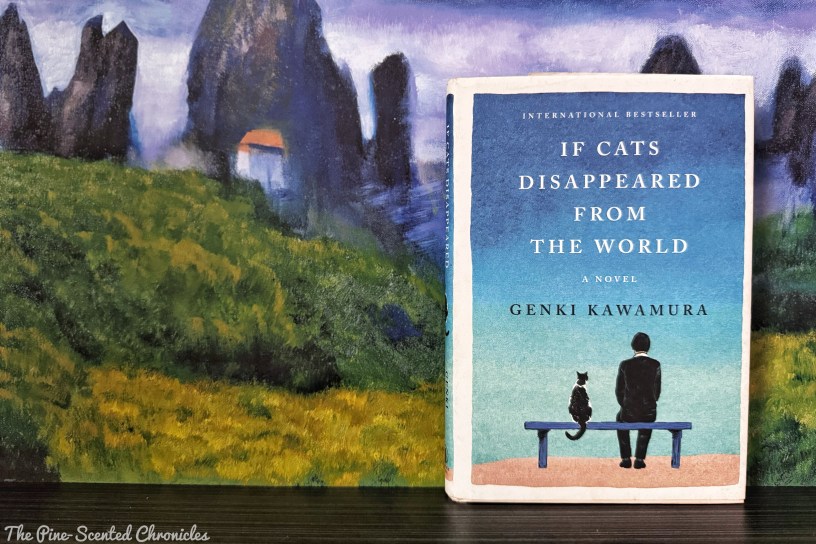
Among the books made available to English readers is Genki Kawamura’s If Cats Disappeared from the World. Originally published in 2012 as 世界から猫が消えたなら (Sekai kara neko ga kietanara), the book was first released in English in 2018 with a translation by Eric Selland. The protagonist is a young Japanese postman by trade. The book begins with him writing a letter to someone about the most unusual week he has had. Diagnosed with terminal brain cancer, the young man was given by his doctor a couple of months to live, leaving him dumbfounded, broken, and lost. One day, when he returned home, he found an unusual visitor waiting for him to come home: the Devil himself. The Devil offered him an odd proposition. The narrator’s life will be prolonged by one day at a time. However, in exchange, an object will disappear from the world; the Devil had the prerogative to choose which object to disappear.
Mobile phones have been around for only about twenty years, but in just that short time they’ve managed to take complete control over us. In just twenty short years something that we don’t really need has come to rule our lives, making us believe that we can’t do without it. When human beings invented the mobile phone, they also invented the anxiety of not having one.
Genki Kawamura, If Cats Disappeared from the World
Rather than the ominous image of the Devil one is accustomed to, the Devil the narrator encountered was the antithesis of the ordinary man’s preconceived image. The Devil the narrator met was, interestingly or perhaps ironically, a spitting image of himself. The Devil was dressed in Hawaiian shirts, prompting the narrator to nickname him Aloha. Aloha is also cheerful and amiable although Aloha’s enthusiasm sometimes irks the narrator. It was palpable that he was resolute in inking the deal with the narrator, his 107th client. The narrator found it a challenge deciding but he ultimately agreed to the deal. Which object should disappear first? Aloha initially thought of getting rid of chocolates. However, he eventually decided to make phones disappear. Before the phone disappeared, the narrator was allowed one last call. The following day, phones no longer exist.
His impending mortality was a catalyst for the narrator to reconnect with people from his past. He first reconnected with his former girlfriend. Their relationship lasted three years but it ended seven years ago on a trip to Argentina. Interestingly, it was she who the narrator called on his final phone call. Phones played a germane role in their relationship because it was the primary means by which they communicated. His girlfriend initially had no telephone but eventually procured a landline. The narrator is more loquacious over the phone than he is in person. The narrator also informed his former girlfriend of his impending demise. With their shared interest in movies, his former girlfriend invited the narrator to a private showing of a movie the following day. Aloha, however, was one step ahead of them. It would be the narrator’s last movie.
Like in the case of his former girlfriend, the disappearance of movies paved the way for the postman to reconnect with Tatsuya, his childhood friend. It was a conflicted decision. Tatsuya now owns a movie rental store. The postman also informed Tatsuya of his illness and enlisted his former friend’s help. Staring at a blank illuminated screen, the postman imagined the movie of his life. When he was about to go home after spending several hours at the theater, the postman collapsed outside the theater but woke up the following day on his own bed, much to his surprise. Apparently, Aloha carried him home. The next object to disappear was the clocks. Unlike the first two objects that disappeared, the postman was less concerned about the disappearance of clocks. His father, with whom he was long estranged, was a watchmaker. Because of their detachment, he only felt a pang of guilt.
In calculated steps, Kawamura was laying out the stage for the ultimate act. The titular cat was Cabbage, a cat his family owned. Cabbage was more than just a cat. Cabbage reconnects the postman to his mother who loved cats. His mother died four years earlier due to cancer. Cabbage also played an important role in the postman’s mother’s life. The family previously had a cat they named Lettuce. He was more than a pet as he was treated as a member of the family. Following Lettuce’s death, the postman’s mother fell into depression. She managed to rise above depression with Cabbage’s arrival. When she died, the postman looked after Cabbage. His relationship with his father, on the other hand, went downhill. With his death looming, the postman was worried about who would look after his cat. But there are also more pressing questions the postman had to grapple with.
If you’re trying to separate out the scores of “meaningless things” in the world from everything else, you’ll eventually have to make a judgment about human beings, about our existence. In my case, I think that it’s all the movies that I’ve enjoyed and the memories I have of enjoying them over the years that give my life some meaning. They’ve made me who I am.
Genki Kawamura, If Cats Disappeared from the World
Cabbage holds a very important place in the postman’s life. The cat was a connection to the past, particularly to his mother. In his dying days, the postman was struck with the realization of his mother’s seminal role in his life. She was the glue that held all their family’s different pieces together. She tried to mend her husband and son’s fragile relationship. She was also the one who taught the postman how to cope with life, along with the pleasant and unpleasant surprises that occasionally spring out. It was from his mother that the postman gained his love for cats, providing him insights into the nature of cats. Cabbage was no mere pet. He was symbolic, and his germane role in the novel’s grand scheme was amplified as the story inches toward its inevitable conclusion. With Aloha’s magical touch, Cabbage started to talk. This also allowed Cabbage to share some of his nuggets of wisdom with the postman.
If Cats Disappeared from the World is a multilayered novel. On the surface, it explores the irony that comes with the knowledge of one’s looming mortality. Death was a prominent presence in the story. Consequently, this juncture in the postman’s life is ripe for introspection. His impending demise – amplified by the Devil’s odd proposition – provided the protagonist the avenue to embark on a philosophical and emotional journey with daily objects as the crucible for his realizations. The novel is subtly about making tough choices. While Aloha makes the final decision of which objects to disappear, the postman is allowed space to make Aloha change his mind. However, as the story progresses, there are certain objects that the postman is unwilling to let go of. He had second thoughts about letting go of his prized collections of comics or action figures. This is contrary to the values the Japanese have been renowned for, that of minimalism and detachment from inanimate objects.
On the other hand, the postman had no scruples about making useful objects like phones or clocks disappear. He placed more importance to certain objects. On the other hand, he failed to see the importance of the others. Aloha’s proposition, however, would make the postman realize the importance of these objects he has forsaken. Each object that disappeared – they seemed innocuous at the onset – was attached to an important part of the postman’s life. However, these are parts of his life he has long forgotten. They played a germane role in a particular phase of the postman’s life. However, the passage of time has rendered them seemingly futile. This was reflective of the postman’s view on his relationships with the people around him. It was palpable that the postman held strong emotions for the people he held dear. However, he did not take the time to keep these relationships. They – his father, his former girlfriend, Tatsuya – were pushed to the back of the postman’s mind.
Over the years, the postman started losing his most important connections. But with his looming death came a splash of cold water. He is living a life bereft of genuine connections which left him with a sense of unfulfillment. In his thirties, he felt isolated, with no one to express his concerns to. His isolation made him feel pangs of regret for the moments he had lost. The only one keeping him company was Cabbage. It was no surprise that when he reconnected with his former girlfriend and best friend, he immediately told them of his affliction. This makes one understand that Aloha’s choices of objects he wanted to disappear were deliberate. In a way, Aloha was guiding the postman toward a semblance of enlightenment. As he approaches the twilight of his life, the postman realizes the importance of interconnectedness and maintaining meaningful and genuine relationships with the people around him.
Once you become aware of your impending death, you have to make a compromise in accepting the loss of the life you wish you could have led and the reality of your imminent death. Sure, there will always be regrets and broken dreams, but you have to go easy on yourself. Over the last few days, I’ve come to realize that there is certain beauty in those regrets, they are proof of having lived. Maybe I will regrets some of my decisions when the moment comes, but that’s ok, No matter how you slice it, life is full of regrets anyway.
Genki Kawamura, If Cats Disappeared from the World
On the other hand, the novel underscores how oftentimes we fail to recognize the importance of a thing that disappeared until it is already too late. What do we truly hold dear to us? However, there is a hopeful, and even playful tone to the story despite the inevitable conclusion. Kawamura poses universal questions. The quandary that the postman found himself in resonates universally. This was complemented by the relatability of the characters. The protagonist looms above them. Alone and on the cusp of death, he felt like his life was meaningless. He was about to give up and let the fates draw his cards. He made mistakes in his life but he was not morally corrupt. He was vulnerable but was not ignorant. There was a lot about life he is yet to understand. Aloha, on the other hand, provided comic relief although he was also imbued with a layer of wisdom which made him an equally riveting character.
If Cats Disappeared from the World is a straightforward story about the tapestry of human existence. The postman is like most of us; there is wisdom in keeping him anonymous. We often fail to see the importance of minute details and the small pieces that make us who we are. With every object that disappeared was a piece of the postman but it was only at the last minute did he realized their importance. It is only when we lose things do we realize their importance. Beyond death, the novel explores the intersections of themes such as the values of memory, impossible decisions and the consequences of our actions, and unanswerable questions. The novel is thought-provoking and emotionally charged. The book’s message was clear. If Cats Disappeared from the World is a melancholic yet playful tapestry that reminds us that life is about establishing genuine connections and finding meaning in the seemingly inconsequential. It is a story about embracing the people we love and living life without regrets.
In a world without clocks, I could really take my time to think about things in a deep way. It seemed to me that there were all kinds of rules made up by human beings, rules that begin to fall apart when you examine them closely. I eventually came to the realization that the ways we have of measuring things—like, say, temperature, or the reflectance of light that produces color—are artificial human creations, just like time. Basically humans just applied labels to the things they sensed.
Genki Kawamura, If Cats Disappeared from the World
Book Specs
Author: Genki Kawamura
Translator (from Japanese): Eric Selland
Publisher: Flatiron Books
Publishing Date: March 2019 (2012)
No. of Pages: 168
Genre: Literary
Synopsis
The young postman’s days are numbered.
Estranged from his family and living alone, with only his cat, Cabbage, to keep him company, he was unprepared for the doctor’s diagnosis that he has only months to live. But before he can tackle his bucket list, the devil shows up to make him an offer: In exchange for making one thing in the world disappear, the postman will be granted one extra day of life. And so begins a very strange week that brings the young postman and his beloved cat to the brink of existence.
With each object that disappears, the postman reflects on the life he’s lived, his joys and regrets, and the people he’s loved and lost.
Genki Kawamura’s timeless tale is a moving story of loss and reconciliation, and of one man’s journey to discover what really matters most in life.
About the Author
Genki Kawamura (川村元気, Kawamura Genki) was born on March 12, 1979, in Yokohama, Kanagawa, Japan. Kawamura graduated from Sophia University with a degree in journalism. Before pursuing a career in writing, Kawamura was a producer. He has an extensive vitae that includes movies such as Say Hello for Me (2007, Sono toki wa kare ni yoroshiku), Villain (2010, Akunin), and Confessions (2010, Kokuhaku). He also worked alongside renowned filmmakers such as Hosoda Mamoru (The Boy and the Beast, 2016) and Shinkai Makoto (Your Name, 2016). In 2010, Kawamura was chosen by US magazine The Hollywood Reporter for its “Next Generation Asia” list. In 2011, he became the youngest person to receive the Fujimoto Award, an award given to outstanding movie producers.
He also served as a director and screenwriter for some films, including the movie adaptation of his debut novel, 世界から猫が消えたなら (2012, Sekai kara neko ga kietanara; trans. If Cats Disappeared from the World). He backed up the success of his debut novel with his succeeding novels: Oku otoko (Million Dollar Man), Hyakka (A Hundred Flowers), and Shigatsu ni Nareba Kanojo wa (April, Come She Will). These books were adapted into film with Kawamura as the screenwriter. He also directed the adaptation of Hyakka.
 The Pine-Scented Chronicles