
We chalked up the first month of 2025 just like that. How time flies. It still feels like yesterday when we welcomed 2025 with quite a fanfare. How has the year been so far? I hope that it has gone great. If it went otherwise, I hope that you will have a reversal of fortune in the coming months. We still have eleven months to pursue our passions, embark on new journeys, and achieve our goals. I hope that the rest of the year will be one of healing, positive news and energies, and prayers answered. If your goal this year is just to make it from one point to another, that is more than fine. For those who have set their goals, I wish you all the best. More importantly, I hope everyone stays healthy, in mind, body, and spirit.
The new year means setting up new goals. Reading-wise, I have quite lofty ones although I wanted to lay low for a bit because the past few months have been quite hectic. Nevertheless, I am hitting the ground running. For the first two months of the year – or maybe the entire first quarter – I have resolved to read works of East Asian literature. This is driven by several factors. The primary reason is that I was not able to hold a Japanese literature month last year for the first time in a while; Japanese literature has been a staple of my annual reading journey. Second, Korean writer Han Kang was awarded the Nobel Prize in Literature last year, making her the first female Asian writer to earn the highest distinction in literature. An English translation of an earlier work by Kang has also been just released. Another reason is that Chinese literature remains a largely unexplored territory for me.
So before I move on to the next month of the year, let me share how my foray into works of East Asian literature shaped up. Happy reading!

Playground by Richard Powers
Interestingly, I kicked off my 2025 reading journey not with a work by an East Asian writer but by a work by a non-Asian writer. It was during the pandemic when I first came across Richard Powers. The Overstory was ubiquitous but it was Bewilderment that first caught my fancy. I loved Bewilderment – and eventually The Overstory – and was even rooting for it to win the Booker Prize. In 2024, I wasn’t even aware that Powers was releasing a new work until the Booker Prize longlist was released; his latest novel, Playground, was longlisted for the award. I was looking forward to reading the book but it took some time before I was able to obtain a copy of the book. The Pulitzer Prize-winning writer’s latest novel charts the fortunes of four characters who came from diverse backgrounds and have contrasting personalities. Rafi Young and Todd Keane developed an unlikely friendship. Both were smart but Rafi was born to a poor family while Todd was born into affluence. Their paths crossed when Rafi was awarded a scholarship sponsored by Todd’s father. Their friendship flourished over chess but their paths soon diverged when they both entered university. Rafi pursued literature while Todd pursued computer sciences. The third of the quartet was Tahitian woman Ina Aroita who Rafi fell in love with. Todd would also fall for her. The last member of the quartet was Evelyne Beaulieu, a French Canadian oceanologist. Their paths converged on the Pacific island of Makatea where the denizens are holding a referendum on whether to allow the building of floating cities in their vicinity. Playground is an ambitious novel which can make it a challenging read. A plot twist toward the end that ties all of the different threads together. The story was innovative and altogether riveting. With his latest novel, Powers consolidated his stranglehold as a masterful chronicler of the contemporary’s conditions.
Goodreads Rating:

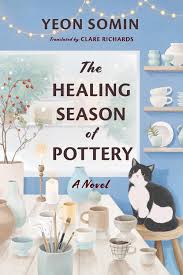
Healing Season by Yeon Somin
To officially commence my foray into the works of East Asian writers, I read Yeon Somin’s sophomore novel, The Healing Season of Pottery. The book piqued my interest in late 2024 when it was ubiquitous. The curious cat in me simply cannot resist. Somin joins the ranks of Korean writers who have been making waves globally. I guess this is in part due to Han Kang’s International Booker Prize success in 2016, and eventually the Nobel recognition. A spate of heartwarming stories has recently been released, among them Hwang Bo-reum’s Welcome to the Hyunam-dong Bookshop. An addition to this growing list is Somin’s The Healing Season of Pottery. Originally published in 2023, The Healing Season of Pottery charts the fortune of Jungmin. She finds herself at a critical juncture after leaving her job as a television writer after she can no longer take of how the show was capitalizing on the misfortune of others. A pseudo-quarter-life crisis ensues. Thirty, single, and with no iota about what to do with her life, she was in a quandary. For a change in scenery, she moved to her hometown of Ilsan. However, the move did little to assuage her anxieties. A bout with depression made her hole up in her new apartment. The break the monotony, she decided to go out and look for a cozy café but instead of a café, she entered a pottery studio where she was welcomed by two old women on their wheels. Jungmin enjoyed the coffee. When she inquired about the source of the coffee, the women explained that the flavor came not only from the good quality of the coffee but also because of the mug which was made in the pottery studio. Thus commenced her journey to healing and rediscovering herself. Heartwarming and tender, it was indeed reminiscent of Welcome to the Hyunam-Dong Bookshop.
Goodreads Rating:


Remote Country of Women by Bai Hua
From South Korea, my literary journey next took me to an obscure part of China. Admittedly, despite its prominence and vast landscape, Chinese literature is a part of the literary world I rarely ventured into although I have been trying to redress this by reading more works written by Chinese writers. This foray into East Asian literature is one way to do it. It was during the height of the pandemic when I first encountered Bai Hua and his novel The Remote Country of Women through an online bookseller. Set in the latter years of the Cultural Revolution, The Remote Country of Women alternates between the perspectives of Sunamei, a thirteen-year-old Mosuo girl in 1975, when the chapters centered around her begin; and Liang Rui, a self-absorbed man who witnessed the atrocities of the Cultural Revolution. The titular remote country of women is located in the Chinese hinterlands close to the Tibetan border. The remote country was inhabited by the Mosuo ethnic group; they were known to be matrilineal, not recognizing either the institution of marriage or taking a single spouse. Sunamei’s journey to womanhood also details life in the countryside. Through her story, the novel captures the tradition and culture of the ethnic group she is part of. Meanwhile, Liang Rui was a prisoner on a farm who managed to escape by pretending to be sick with tuberculosis. Soon, he made his way to the remote country of women where his path crossed with Sunamei’s. The Remote Country of Women addresses themes of the repression and freedom of sexuality, the brutality of modernity, and the fluidity of gender roles. Overall, it was a riveting read that provided me insights into a culture and group of people I had previously not read about.
Goodreads Rating:

The Key by Jun’ichirō Tanizaki
From an unfamiliar writer to a familiar writer. My next read took me to a more familiar territory, Japanese literature. I first encountered Jun’ichirō Tanizaki through must-read lists. Since reading Some Prefer Nettles, he became one of my mainstays. The highly-touted writer is among the reasons why Japanese literature has grown on me and becomes one of, if not my favorite literature. Five years since I read my first Tanizaki novel, I read my fifth, The Key. Originally published in 1956 in Japanese as 鍵 (Kagi), the novel is comprised of two diaries. The first diary was written by an anonymous fifty-five-year-old university professor married to Ikuko who was at least a decade his junior. The second diary was written by Ikuko. The diaries contained their deepest and most sinister thoughts and also their major concerns. The professor’s major concern was the sexual difficulties he was having with his wife. He complained about Ikuko’s insatiable appetite, her conservative attitude, and her rejection of his sexual preferences. Ikuko, on the other hand, wrote about her husband’s inability to satisfy her. The couple grew paranoid, believing that each was reading the other’s diary; they were aware of each other’s diaries but insisted they had never read them. Their domestic issues came to a head with the arrival of Kimura, a teacher they chose as a prospective husband for their daughter. Despite Toshiko’s lack of interest in him, Kimura became a prominent presence in their household. The sexual overtones did not surprise me; this is Tanizaki territory. What fascinated me was how Tanizaki carefully laid out the psychological profile of the characters. Overall, The Key was another memorable Tanizaki read.
Goodreads Rating:
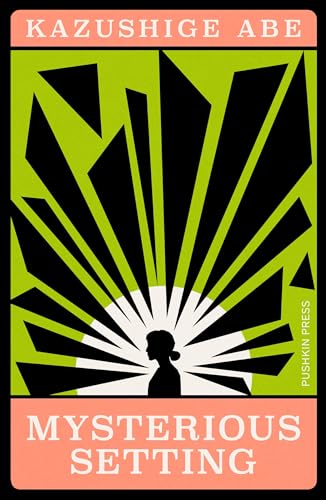
Mysterious Setting by Kazushige Abe
I did not realize it but it seems that I have been alternating familiar writers with unfamiliar writers. Before 2024, I had never heard of the Kazushige Abe nor had I encountered any of his works. His book Mysterious Setting has been getting attention. It was no surprise because, in his native Japan, Abe is highly acclaimed, earning accolades such as the Noma Literary New Face Prize, Tanizaki Prize, and Akutagawa Prize. Abe, I also learned, is the husband of Mieko Kawakami, another favorite writer of mine. Originally published in 2006 as ミステリアス・セッティング, Mysterious Setting charts the fortune of Shiori. When she was young, she dreamed of becoming a traveling troubadour who serenades the world. When she first encountered the word troubadour and looked up its meaning, she knew it was what she wanted to become; it described the life she wanted. Life, however, can be cruel. Shiori was tone-deaf and was unable to hold a tune. Her artistic expression isolated her from everyone around her, including her family. Her younger sister Nozomi finds ways to cause her distress, resorting to verbal and even physical abuse. Ironically, Shiori’s cries sound like music to everyone’s ears. The world was cruel to her but she still tried her best to be optimistic. When she moved to Tokyo, Shiori found herself grappling with even crueler realities of life. Her gullibility and vulnerability were taken advantage of. Her life took a turn when Manuel, a Peruvian drummer she befriended, entrusted her with a suitcase nuke. The fate of the rest of the city then rests on Shiori’s shoulders. Mysterious Setting is quite a wild ride that pulls one in different directions. I guess it is the novel’s charm despite its palpable bleakness.
Goodreads Rating:

Dream of Ding Village by Yan Lianke
Beyond the four classics of Chinese literature and the Chinese Nobel Laureates in Literature, my knowledge and appreciation of Chinese literature is measly at best. I also don’t know that many Chinese writers. For instance, I first encountered Yan Lianke during the most recent Big Bad Wolf Sale. I came across his novel, Dream of Ding Village which, without ado, I included in my ongoing literary adventure. Originally published in 2006, as 丁庄梦 (Dīng zhuāng mèng), the novel transported me to the Chinese countryside – the countryside features prominently in the works of Chinese literature I read so far – to the titular Ding Village tucked in the province of Henan. Guiding the readers across this landscape is twelve-year-old Ding Qiang who was poisoned and died when he was twelve; this was established early on. The circumstances surrounding his poisoning are the main plot driver. His father, Ding Hui, is the village’s blood kingpin having brought the blood trade to the village. Villagers sold their blood to him for a meager price. He in turn sells the blood to blood merchants in the cities. The personification of greed, he wanted to get ahead of everyone. His greed unsuspectingly contaminated his fellow villagers with AIDS and HIV. Now locals are sick with the “fever.” Villagers were getting sick and fears of death hovered. Understandably, the locals were angry at Hui and his brother Liang. The voice of reason was their father, Shuiyang, or Grandpa. Grandpa tried to assuage the villager’s anger but for naught. The novel was based on actual events that Lianke extensively researched, at one point even posing as an assistant to an anthropologist. Beyond the scandal, the novel captures the strain placed by totalitarianism on small villages and its denizens. Dream of Ding Village is a compelling and insightful read.
Goodreads Rating:

My Brilliant Life by Kim Ae-ran
From China, my next read took me back to the Korean Peninsula. It is palpable how over the past couple of years, the interest in Korean literature has been growing. This can also be attributed to the growing popularity of KDrama and the impact of KPop. More and more works of Korean writers have been nominated for the International Booker Prize. More Korean works are also made available to Anglophone readers. Among them is Kim Ae-ran’s novel 두근두근 내인생 (Dugeun Dugeun Naeil saeng) which was originally published in 2011 but was only translated to English in 2021 as My Brilliant Life. At the heart of the novel is seventeen-year-old Areum who we immediately learn was on the brink of dying. However, his story takes the readers first to how he was conceived. His mother, Mira, was the only girl born to a family of five children in the Korean countryside. When she was sixteen, she was impregnated by Daesu, a taekwondo student. Young and inexperienced, they were unsure of how to proceed but Mira’s father straightened the details out. A natural pessimist, Daesu had very little prospect. Areum, on the other hand, grew up to be a diligent and smart child. However, he was diagnosed with progeria, a disease that causes rapid aging. The novel was, in a way, his coming to terms with his mortality. The first of the novel’s two major plotlines captures his family life in countryside Korea. The second plotline takes place mainly in the hospital. It was while convalescing that he came into contact with a young girl who was also as sick as him, or at least that was what it seemed from the onset. Despite the bleakness that hovered above the story, the story beacons with Areum’s positivity. My Brilliant was a tearjerker of a read; I did not expect it to be that heavy.
Goodreads Rating:
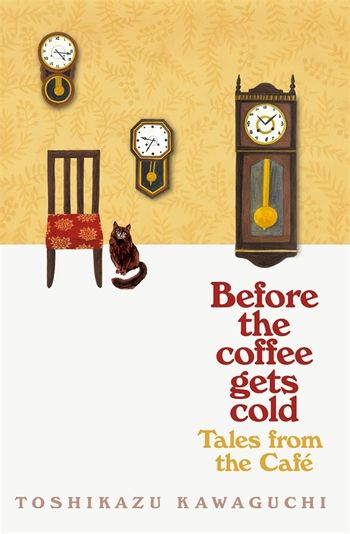
Tales from the Café by Toshikazu Kawaguchi
China, Korea, and then back again to Japan. I just knew that this reading journey was going to be filled with works of Japanese literature. Toshikazu Kawaguchi has gained global recognition with his Before the Coffee Gets Cold series; the story was born out of a play that Kawaguchi wrote in 2010. The first book has since gained popularity, prompting Kawaguchi to follow its success by publishing sequels to the first book. Tales from the Café is the second book in the series and was originally published in 2017 as この嘘がばれないうちに. Like its predecessor, Tales from the Café is divided into four sections and introduces new characters; this fragmented structure has become popular in Japanese literature. These characters, though not directly connected, found themselves in Funiculi Funicula café – the titular café – tucked in one of Tokyo’s alleys. The café gained popularity for transporting customers back or forward in time. Prospective time travelers, however, must adhere to a stringent set of rules. First, the present cannot be changed. They can only meet people who have visited the café. Time travel is only possible through one chair which is always occupied by a female ghost; she vacates it once a day to take the comfort room. The most important rule, however, was that the travelers should be back before the coffee gets cold. The four characters who we met in the café had various concerns. Gohtaro Chiba wanted to visit his best friend, Shuichi. Yukio Mita wanted to meet his mother. Katsuki Kurata’s circumstance is interesting as he travels to the present-day café from the past, to meet his former girlfriend, Asami. Rounding up the stories is the story of Kiyoshi Manda, a detective. The diversity in the characters’ stories makes this series both heartwarming and relatable.
Goodreads Rating:

Wonderful Fool by Shūsaku Endō
Before the pandemic, I had not read any works by Shūsaku Endō although I kept on encountering his novel Silence in several must-read lists; I was looking forward to reading the book. Even though I was a little underwhelmed by the book, it did not preclude me from exploring further the Japanese writer’s body of work. This year, Wonderful Fool became the fourth book by Endō I read. As per the book’s introduction, Wonderful Fool is the third novel by Endō to be translated into English. The novel introduces Gaston Bonaparte, a Frenchman descended from Napoleon Bonaparte. The crux of his story was when he decided to visit – or perhaps stay – in Japan. He first went to visit and stay with his penfriend Takamori; they never met and only corresponded through mail about seven years ago. Gas, as he was familiarly referred to, was still learning Japanese. After staying with Takamori’s family for a couple of days, he decided to move because he did not want to take advantage of the family’s hospitality; he didn’t have much money with him. He thought that their hospitality was ubiquitous in Japan. He was in for a ride. Gaston is incredibly naïve and innocent and in a foreign territory, this can both be a blessing and a curse. He easily trusted people and always tried to see the good in their actions despite being presented with a glaringly different dimension of their personality. His journey across Japan made him encounter prostitutes, lowlifes, and even criminals. Brimming with enthusiasm, he always tried to see the good in them. He was the proverbial and titular wonderful fool. Compared to Endō’s other works, Wonderful Fool is lighter – this is a different dimension of Endō’s oeuvre – although it also subtly paints an interesting – not the wonderful one – portrait of Tokyo.
Goodreads Rating:

Miles from Nowhere by Nami Mun
From Japan, my next read took me to the Korean Peninsula. Well, at least the book I read was written by a Korean-born American writer. Before the pandemic, I had not encountered Nami Mun before nor had I read any of her works. Through an online bookseller, I came across her novel Miles from Nowhere which, out of whim, I made part of my ongoing reading journey. Interestingly, Miles from Nowhere is just the second book originally written in English that I read this year. Originally published in 2008, Miles from Nowhere is Mun’s debut novel. It transports the readers to the 1980s Bronx and introduces Joon, the heart and primary narrator of the novel. She was born in Korea but her parents migrated to the United States but due to her father’s infidelity, their family was broken. Her mother fell into a near-catatonic state. Joon was then left to fend for herself. Basically abandoned, she decided to seize her own destiny, leaving home and finding herself in a shelter where she met Knowledge, a street-smart and tough lesbian. One winter day, the friends escaped from the shelter, along with Wink, a boy interested in Joon. Soon enough, their friendship started to fall apart. Joon had to learn how to navigate a world that was quite dangerous, especially for a young vulnerable Asian girl like her. At first, Joon worked as an escort which eventually turned into outright prostitution; she was not of legal age yet. She also became addicted. These all happened before Joon turned twenty; the novel spans six years of her life. Despite the darkness that hovered above the story, hope beaconed. Joon’s zest for life was unimpaired by the hardships she had to go through; she learned to see beyond them. This coming-of-age story commanded my attention although some sections can be discomfiting for some readers.
Goodreads Rating:

Marshland by Otohiko Kaga
Concluding my January reading journey – and the first stretch of my foray into the works of East Asian writers – is Otohiiko Kaga’s Marshland. I have listed the book as part of my 2025 Top 25 Reading List, making it the second from the list I read after My Brilliant Life. The novel was originally published in 1985 but the increasing interest in translated works paved the way for its English release in 2024. Set in 1960s Japan, the central figure of Marshland is Atsuo Yukimori, a former soldier and convict now working as an auto mechanic. Despite his troubled past, he found peace although it meant living alone in Tokyo. The harmony of his life was disrupted by his acquaintance with Wakako Ikéhata, a university student he met while taking classes at the local skating rink. They forged an unusual friendship that everyone was critical of. Wakako was the daughter of a university professor. She was beautiful and brilliant but was mentally unstable. As Atsuo travels between Tokyo and Nemuro, his hometown, memories permeate the story. At the same time, Kaga was closing in on the crux of the story. In the late 1960s, Tokyo and other parts of Japan were rocked by student riots. The social upheaval sweeping Japan led to the rise of activism. Wakako, despite her mental frailties, found herself in the middle of one of these student protests, along with some members of the Q-Sect, a radical student organization. When a Shinkansen bombing incident on February 11, 1969, resulted in casualties, the authorities were quick to pin the accusation to Atsuo. The incident outraged the nation, making it imperative for a culprit, any culprit, to be found immediately. Unfortunately, Atsuo, with his criminal record, fits the bill perfectly. Wakako and several members of the Q Sect were also indicted on the charges. Atsuo was sentenced to death while the others were meted with sentences ranging from five years to life. Marshland is an intricate police procedural that is, despite its length, quite absorbing. It also exposes the corruption that permeates major institutions in the Japanese political structure. Overall, Marshland was a rewarding read that kept me at the edge of my seat.
Goodreads Rating:
Reading Challenge Recaps
- 2025 Top 25 Reading List: 2/25
- 2025 Beat The Backlist: 1/20; 11/60
- 2025 Books I Look Forward To List: 0/10
- Goodreads 2025 Reading Challenge: 11/100
- 1,001 Books You Must Read Before You Die: 0/20
- New Books Challenge: 0/15
- Translated Literature: 9/50
Book Reviews Published in January
- Book Review # 567: What You Are Looking For is in the Library
- Book Review # 568: If Cats Disappeared From the World
Like in previous years, my output for January is measly; since 2022, I managed to publish only two book reviews each in January. I thought I was going to break the trend this year but I thought wrong. Balancing work with personal life is quite a challenge; I rendered a total of sixty-five overtime hours this month, the most I ever had in a month since I started working. This is mainly because I was working on a regulatory document that needed to be approved by the Head Office and vetted by a validator. Regardless, I am grateful that I am over the most difficult part. On top of this, I was busy with 2024 year-end wrap-up pieces. I actually thought that I wouldn’t be able to publish any book reviews last month but with sheer determination, I was able to publish two, both of which are for books I read back in 2023. For February, I will try to make up for lost time. I have over one hundred books pending review, over sixty of which are from 2023; I have almost the same number from 2024. I will try to tick off as many as I can. The mantra, as always, will be to take it one step at a time. I hope I find the motivation.
Reading-wise, for February, I will still be stationed in East Asia as I immerse myself in the works of Japanese, Korean, and Chinese writers. I am still hoping to find some works of Taiwanese writers. I already have several books lined up. I am currently reading Mai Jia’s The Colonel and the Eunuch, the third book from my 2025 Top 25 Reading List I read/am reading. I have listed several works of Japanese writers in my 2025 Top 25 Reading Lis, most of which were written by women. I am planning to dedicate March – it being Women’s History Month – to the works of female East Asian writers. I wouldn’t be surprised if the majority of the books I read in February were written by male writers. I already have S.I. Hsiung’s Bridge to Heaven, Keigo Higashino’s The Miracles of the Namiya General Store, Yukio Mishima’s The Frolic of the Beasts, and Kim Un-su’s The Plotters. I hope to obtain works by Nobel Laureates in Literature Yasunari Kawabata, Kenzaburō Ōe, Gao Xingjian, and Mo Yan. The Romance of the Three Kingdoms is also not a bad idea.
How about you fellow reader? How is your own reading journey going? I hope you enjoyed the books you have read. For now, have a great day. As always, do keep safe, and happy reading everyone!
 The Pine-Scented Chronicles
Reading about your extremely busy January, I can’t help feeling a little envious. My year started badly, so I am using all my energy to smooth the way for February to be better…
LikeLike