
First Impression Friday will be a meme where you talk about a book that you JUST STARTED! Maybe you’re only a chapter or two in, maybe a little farther. Based on this sampling of your current read, give a few impressions and predict what you’ll think by the end.
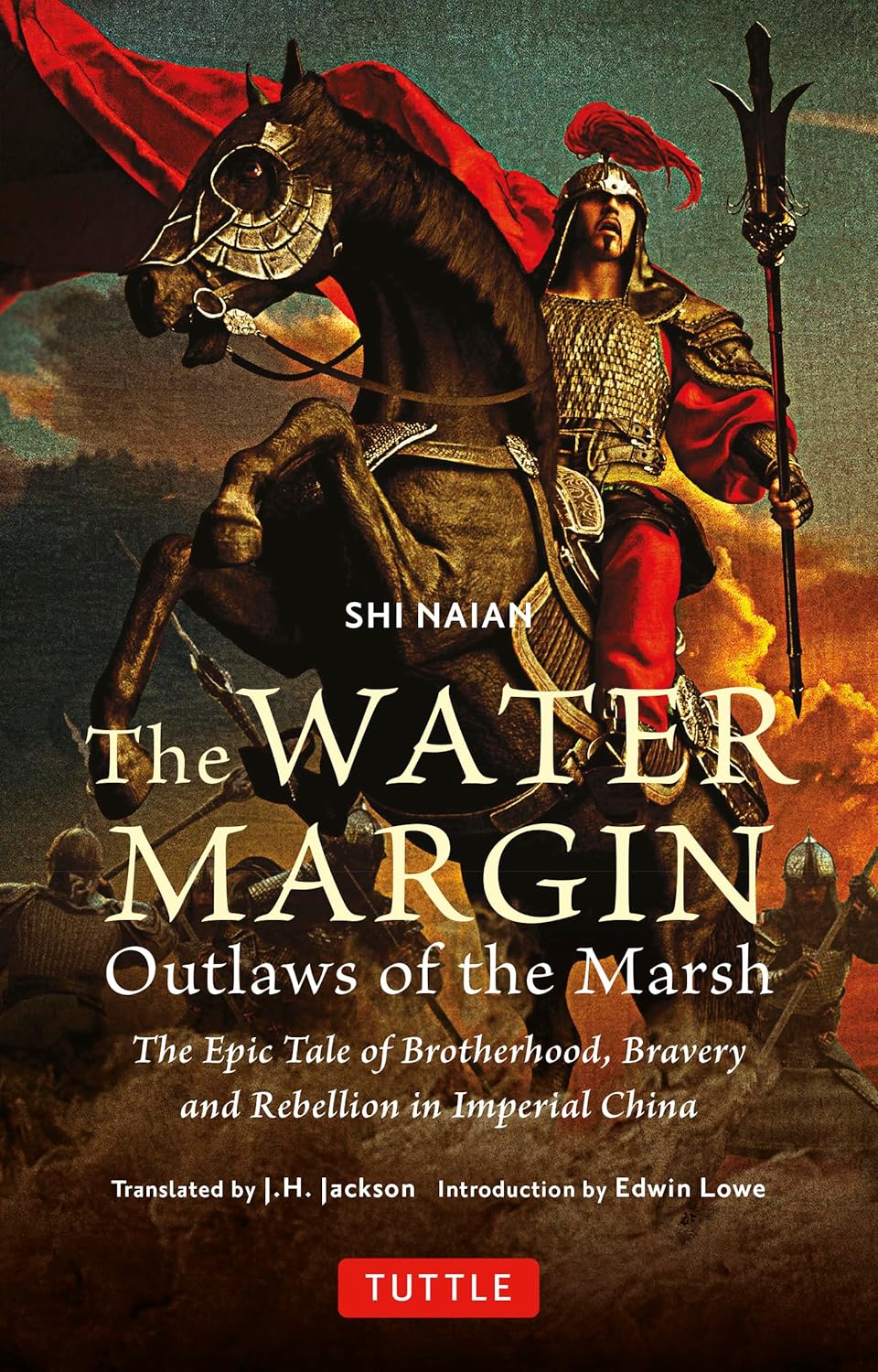
Synopsis:
The Water Margin is an epic tale set in 12th century Imperial China, one of the earliest and greatest masterpieces of Chinese fiction. Weaving historical details and memorable characters, it tells the exciting story of a rebellion against tyranny set amidst the turmoil of a crumbling empire.
In this action-packed story, a band of outlaws are drawn together by fate and a shared desire for justice. They are pursued to remote marshes by corrupt officials, where their popularity among the people grows. Through intricate scheme, epic battles and unexpected treachery, the heroes vow to fight to the death for freedom and for their loyalty to one another.
The book’s cast of characters, all folk heroes in China today, includes:
*Song Jiang: The charismatic leader, who assembles the band of outcasts and leads them into battle against overwhelmingly odds
*Sun Erniang: A brave female warrior whose courage inspires her male comrades
*Pan Jinliang: A beautiful and mysterious temptress and one of the most notorious villains in Chinese literature
*Wu Song: A fierce higher whose reputation for bravery matched only by his love of wine and women
This new edition restores bawdy passages omitted in all other English versions because they were thought to be too racy. A detailed introduction by Edwin Lowe explains how the book’s message of courage and loyalty has captured the imagination of CHinese readers and continues to resonate with them today.
Happy Friday everyone! Well, technically it is already Saturday so happy weekend everyone! Nevertheless, we made it through yet another work week. I hope everyone managed to complete all the tasks they started at the beginning of the week. I hope everyone ended the work week on a high note and is jumping into the weekend worry-free. This also means that we are one week down in February. How time flies! Thankfully, January wasn’t as long as it had been in previous years. If you know what I mean. Anyway, how has your 2025 been? I hope that it is going great. I hope you got a headstart on your goals and that you are on the way to achieving them. If the year went otherwise, I hope you experience a reversal of fortune in the coming months. I hope that 2025 will be a year of prayers answered, healing, and dreams achieved. More importantly, I hope everyone will be healthy in body, mind, and spirit.
Before I could dive fully into the weekend, let me share a fresh First Impression Friday update. Over the years, it has been customary for me to end the blogging-cum-work week with this update. It is an integral part of my book blogging ritual which initially was a space for me to reflect on the book I was reading. It eventually developed into a springboard upon which I built my book reviews. Writing my impressions about a book before I complete it allows me to compare my initial impressions with how it ultimately made me feel. To commence my 2025 reading year, I resolved to read the works of East Asian writers in the first quarter of the year. Several factors made me decide on this, the foremost of which was my inability to host a Japanese Literature Month in 2024; a Japanese literature month has been a staple since 2020. Han Kang’s Nobel Prize in Literature recognition is another driver for this decision. Third, an older work of Han was released in English this month.
Another driver for opening 2025 with works of East Asian Literature is my mealy exploration of the works of Chinese literature. It cannot be denied that Chinese literature is one of the most influential and most extensive literatures out there. Unfortunately, it is largely an unexplored territory for me. Conscious of this glaring dichotomy, I have been trying to redress it by reading more works of Chinese writers. In 2023, I managed to read three, the most I read in a year. This year, I am already on my fourth novel. And it is no ordinary novel. It is one of the Four Great Classical Novels of Chinese literature: Shi Naian’s The Water Margin. My first encounter with the four classics of Chinese literature was Luo Guanzhong’s Romance of the Three Kingdoms which I first encountered during a random excursion to the local bookstore. It was when I first tried to expand my reading horizon about a decade ago. I still haven’t read Romance of the Three Kingdoms although I am looking forward to reading the book.
The Water Margin – or in some versions Outlaws of the Marsh or All Men Are Brothers – is technically the second book from the Four Classics that I read; I read an abridged version of Cao Xueqin’s Dream of the Red Chamber during the first year of the pandemic. Yesterday, I went to the bookstore to find a copy of Lady Murasaki Shikibu’s The Tale of Genji and Romance of the Three Kingdoms. I ended up purchasing a copy of Eiji Yoshikawa’s The Heike Story and The Water Margin; there was no Royal Tyler version of Genji while the bookstore only had the second and third volumes of Three Kingdoms. Nevertheless, I am satisfied with my purchase. I even immediately delved into The Water Margin. There is just no reason for me to delay my foray into the book further.
Originally titled 水滸傳 (Shuihu Zhuan), The Water Margin is one of the earliest novels originally written in vernacular Mandarin. Its first external reference only appeared in 1524 during the Jiajing reign of the Ming dynasty although its provenance was never fully established. Even its authorship is shrouded in a cloud of mystery although it is traditionally attributed to Shi Naian (1296–1372). As discussed in the Introduction, some pundits argued that it could have also been written by Guanzhong. The book’s title is also worth a look into. Nobel Laureate in Literature Pearl S. Buck, when working on the book’s translation, used the title All Men Are Brothers because she felt that the direct translation of the original title, The Water Margin, would get lost on the Anglophone reader. It gets more interesting because J.H. Jackson, the original translator of the version I am currently reading, has little translation credit to his name. Setting these aside, I am looking forward to what The Water Margin has in store for me.
Admittedly, I barely have any iota about what the book was about. Thankfully, the introduction provided me glimpses into what the book was about, thus, helping set some of my expectations. For one, the book is heavily steeped in the teachings and ideals of Confucianism and Buddhism, the two prevailing ideals in China. The novel is set in 1126. The Song Dynasty was slowly losing control of the empire, having lost half of its territory to the invading Jurchens from Manchuria, prompting it to move its capital to the south. The story commences with Marshal Hong Xin traveling to a Taoist monastery. His mission was to seek a cure for a plague currently afflicting the denizens of Kaifeng, the Eastern Capital. Complications arose when Hong commanded the monks of the monastery to free the 108 demons being held captive in the Suppression of Demons Hall.
The 108 demons – their names were listed at the start of the book – are the titular outlaws. The release of the demons would cause trouble. The 108 stars – 36 stars of heavenly spirits and 72 stars of earthly spirits – settled on Earth and established a stronghold in the fictional Liangshan Marsh (梁山泊) area. I can surmise that the novel follows the stories of these outlaws. It is also important to note, as highlighted in the introduction, that the period the story was set in was filled with political and social upheavals. I just started reading the book but I am curious about how these outlaws will solve these concerns, if they will at all. At the minimum, I want to understand their role in this tumultuous period. The introduction mirrors the progression of the story with the opposition against tyranny, or at least that is what I get from it.
As I mentioned, I just started reading the book. There are a lot of things bound to happen; at nearly 800 pages long, the book is surely an eventful one. One aspect I am looking forward to is how the novel captures the atmosphere of China during the 12th century. I am also looking forward to learning more about Chinese society, culture, and history through the book. There are a lot of things to look forward to indeed. How about you fellow reader? What book or books have you read over the weekend? I hope you get to enjoy whatever you are reading right now. Happy weekend!
 The Pine-Scented Chronicles
I read this book back in college, and this was the sole book from the Chinese Classics I managed to finish. Fun fact: The Suikoden game franchise is based on this book, with its title being the Japanese pronunciation of the book’s Chinese name (Shuǐ Hǔ Zhuàn).
LikeLike