The Follies of Artificial Intelligence
In the past few years, it is inescapable how technology has started to govern every facet of our lives. With its exponential and unmitigated expansion, we have increasingly become more dependent on technology. It has made the seemingly impossible possible. We can talk with our loved ones even though they are living far away. Information is literally at the tip of our fingertips. Quotidian chores have been automated. Voice commands can activate machines that can perform domestic functions such as switching on the lights or turning off the television. The same trend can be observed in the workplace where manual functions normally performed and executed by several individuals can be completed by a machine or an application. With how technology is shaping the landscape of our lives, it is not hard to imagine machines performing all functions previously performed by fully functioning human beings.
One of the most prevalent and prominent manifestations of this technological advancement is the growing relevance of artificial intelligence. The past few decades have been dominated by breakthroughs in this field. The thrust of technology is palpably toward this direction, with vast information databases slowly being integrated into machines. The idea of machines processing data on their own and coming up with their conclusion is slowly but surely materializing. Who would have thought that a machine could play chess against the world’s grandmasters? With the exponential development of sophisticated technology, it is not farfetched that we will be seeing significant progress in the coming years. The growing relevance of artificial intelligence (AI) has not escaped the notice of literature. Nobel Laureate in Literature Kazuo Ishiguro prominently features AI in two of his works, Never Let Me Go (2005) and Klara and the Sun (2023).
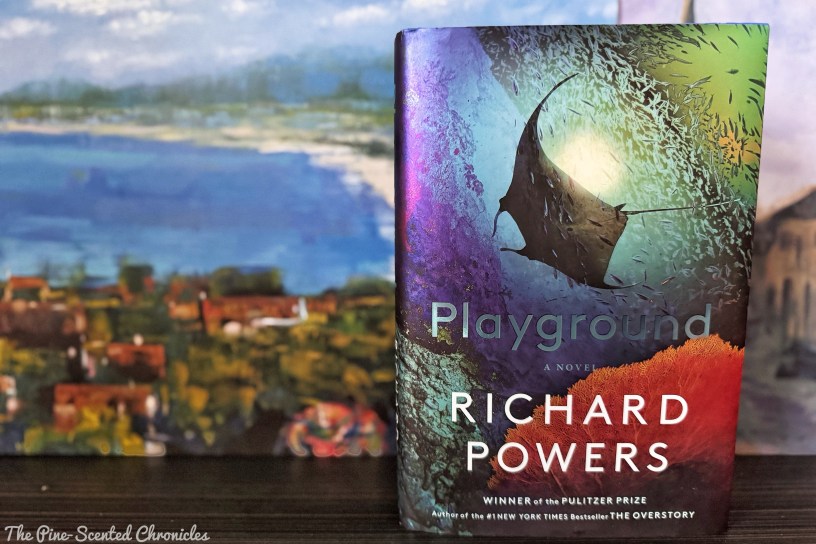
Highly-heralded American writer Richard Powers – winner of the prestigious Pulitzer Prize in Fiction for his novel The Overstory – has also been subtly exploring this theme. His latest novel, Playground, is the most explicit and direct exploration of artificial intelligence and how it can govern our daily lives. In the novel’s context, the playground can be taken as it literally is. However, in this nonlinear story, Playground takes on different meanings. For one, the titular Playground pertains to a lucrative, interactive online social platform, akin to Facebook. In the words of its developer, Todd Keane, Playground can be compared to “a communal proving ground” online. Keane is the first of the four main characters whose fortunes the novel was charting. He was flanked by other characters, two of whom would drive him to develop the aforementioned platform.
But the way that they would turn us into different beings? The full flavor of our translated hearts and minds? Not even my most enlightened fellow programmers at CRIK foresaw that with any resolution. Sure, they predicted personal, portable Encyclopedia Britannicas and group real-time teleconferencing and personal assistants that could teach you how to write better. But Facebook and WhatsApp and TikTok and Bitcoin and QAnon and Alexa and Google Maps and smart tracking ads based on keywords stolen from your emails and checking your likes while at a urinal and shopping while naked and insanely stupid but addictive farming games that wrecked people’s careers and all the other neural parasites that now make it impossible for me to remember what thinking and feeling and being were really like, back then? Not even close.
~ Richard Powers, Playground
Todd’s story started in Illinois. He was born to an affluent family and was raised in Evanston Castle. Despite growing up surrounded by privilege, Todd grew up unhappy. He had no siblings and his parents were constantly engaging in “war games.” His father, an accomplished stockbroker and of the typical rags-to-riches story, was constantly pressuring Todd to excel in his studies; his father, thriving in competition, had set high expectations of his son. The young Todd wanted to please his father. He nevertheless found escape in chess – his father taught him an array of board games at a young age – computer games, and Evelyne Beaulieu’s popular book, Clearly It Is Ocean. He chose the book as a reward for defeating his father in a best-of-five chess match at the age of ten. The book also shaped his childhood dream of becoming an oceanographer.
The natural course of Todd’s life changed when he crossed paths with Rafi Young. Rafi is African American and was born into poverty. However, like Todd, Rafi grew up in a dysfunctional family. Rafi blamed himself for his parent’s separation. Enveloped by abject poverty, he witnessed domestic violence and grief while growing up. It was these horrors he witnessed that made Rafi reclusive. Because of his intelligence, he earned a high school scholarship at Saint Ignatius, an upscale school for the gifted that Todd was attending. Interestingly, the scholarship was sponsored by Todd’s father. Rafi’s father also played a germane role in sharpening his mind. His father worked tirelessly to ensure that his son would be one step ahead of his white classmates. This paved the way for him to obtain the Keane scholarship. The two soon found a common ground, thus, the start of a flourishing friendship.
Their friendship was further strengthened by their common interest in books and board games. Todd was the one who introduced chess to Rafi. Competitive, Rafi learned everything about chess. Eventually, Rafi also introduced the game of Go to his friend. Post-high school graduation, they both opted to attend the University of Illinois-Urbana although Rafi initially planned to enroll in a different university. The sudden demise of Todd’s father prompted Rafi to change his plan. At the University of Illinois, their bond grew deeper even though Rafi studied literature while his friend pursued computer sciences. It was also at this juncture that Todd started his venture into software development. He also started laying the groundwork for his grandest and most ambitious project; it would eventually be called Playground. Meanwhile, Rafi met and fell in love with Ina Aroita, a young woman from the Pacific Islands. The intersection of the three characters would be the crux of the story.
But the truth was, I had begun to see things. Not hallucinations, yet. Those wouldn’t come until decades later. But I did see living, changing patterns all the same. In my mind, the backgammon dice began to resemble a creature built up through time, thin at both ends and fat in the middle, not unlike the Little Prince’s drawing of the snake that had eaten an elephant. There was only one way of making a two or a twelve, but six ways to roll a seven. The maker of the world whispered that secret to me, and it changed everything.
~ Richard Powers, Playground
The novel’s second thread takes the readers to the near future. We are transported to the middle of the Pacific Ocean, to the French Polynesian island of Makatea. A generation before, the island was devastated by lucrative phosphorus mining; the mines have long since been abandoned. It was also the site of hydrogen bomb testing. These left the denizens and consequently, the economy “concussed by history.” The island found itself at the crosshairs of capitalist ventures once again when an American consortium proposed to transform the island into a base for a seasteading venture wherein floating cities would be created. The island’s abandoned mines and disused harbor, Temao, will be used to manufacture and maintain a series of floating cities. The venture promises to make the islanders wealthy. Tensions escalate as the islanders converge to vote on a referendum to either accept or reject the proposal.
The locals had valid reasons to be apprehensive about the proposal. On the surface, it looks promising and lucrative even. However, the shadows of colonial capitalism loom. Dark memories of how the phosphate mines ravaged the island – vestiges of the damage are ubiquitous in the island – a generation before persist. To learn more about the proposal, the consortium sent an AI machine called Profunda which answered the local’s questions and concerns about the project. A third prominent thread introduces Evelyne Beaulieu, a French Canadian oceanologist who was familiarly referred to as Evie. Despite her age – she was in her early nineties – she regularly dives. The ocean called to her and was on Makatea to compile a book on the ocean that she hopes will “stop human progress in its tracks with awe.” Evie devoted her life to the ocean, preferring it over dry land. She was also consulted about the seasteading venture and was also invited to vote in the referendum.
On the surface, Playground probes into the intricacies of friendship and loyalty, captured primarily through the friendship of Todd and Rafi. In each other, they found the brothers they never had; Rafi had a sister but she passed away, with Rafi blaming himself for her demise. They were both misfits but they immediately hit it off, finding camaraderie and brotherhood in each other. Rafi even opened up about his personal pains to his friend, hoping that Todd would understand him better. Their contrasting interests and views also made them individually interesting. But like any friendship, Todd and Rafi had their rough patches. They had to learn how to navigate life on their own. Adding complication to their friendship – and a third dimension to the story – was the presence of Ina who Rafi announced he would be marrying shortly after meeting her; this earned Todd’s skepticism.
And these deep players learned the most extraordinary things. They started to drive cars. Without being told a single thing about cats except whether a given picture showed one, they learned how to recognize any cat from any angle under any conditions. They figured out how to translate text from one language to another with uncanny fluency, without being taught a single rule of grammar or usage. They learned these things the way a child would, by weighing the evidence and adjusting the strengths of the connections in their networks of neurons until their brains began to generalize solutions.
~ Richard Powers, Playground
Powers’ fourteenth novel, however, does not reduce itself to a mere exploration of friendship. Palpably, it is an extensive probe into artificial intelligence and how it is slowly shaping the landscape of humankind. Powers raises several timely and germane, albeit discomfiting inquiries surrounding the intricacies and nature of artificial intelligence. It cannot be denied that our reliance on artificial intelligence is expanding. This is driving its fast-evolving and dynamic capabilities. However, with AI taking over functions previously performed by humans, it is logical to ask if the rise of AI led to the extinction of human beings. On the other hand, is it the key to solving extinction? The novel also subtly raises the question of storytelling. Will literary paradigms be altered by the rise of artificial intelligence? AI taking over writing is not a farfetched idea, noticeable with the rise of ChatGPT and other AI assistant applications.
In Powers’ literary landscape, Profunda was the physical manifestation of artificial intelligence. The islanders fed Profunda various questions, some of which were meant to disorient it. “Better poor fishermen than rich factory workers,” two men concluded. However, Profunda was well-versed and every facet of the islander’s concerns was explored and addressed. It managed to paint a vivid portrait of the future that the islanders are part of. But therein lies the irony. The machine was designed to assuage the islanders’ fears while conjuring a rosy picture of the future. On the other hand, Playground was the backbone of Powers’ primer into the vast world of artificial intelligence. Todd profited from it after selling it to a venture capitalist group in Silicon Valley. However, these are just minor details in the vast ambit of the story. The masterstroke of the story is slowly unveiled as it approaches its inevitable conclusion.
Powers was also critical of the heritage of postcolonialism and even capitalism which figured prominently in the story of Makatea. The island was inundated by both factors. The destruction of the island is a contrast to the idea of creation which is manifested through the creation of AI and the vision of modular floating cities. But destruction also extends beyond the island. The novel is about the destruction of the ocean; the ocean is a silent but germane character. The novel explores a grim reality that we as a race have long been dismissing. Over the past few decades, our pursuit of growth and technology, exacerbated by the exponential growth of the human population, has drastically, and worse, irreversibly altered our landscape, both on land and in the sea. The pursuit of development comes at a steep price and the symptoms are ubiquitous. Seasteading was an intriguing subject. It can improve human lives but it entails the destruction of nature.
The course of civilization is carved in ocean currents. Where sea layers mix, where rains travel or wastelands spread, where great upwellings bring deep, cold, nutrient-rich waters to the energy-bathed surface and fish go mad with fecundity, where soils turn fertile or anemic, where temperatures turn habitable or harsh, where trade routes flourish or fail: all this the global ocean engine determines. The fate of continents is written in water. And sometimes great cities owe their existence to tiny ocean islands. For a while, Makatea fed millions.
~ Richard Powers, Playground
Powers is well-versed in the subject of the destruction of our environment; The Overstory grapples with the destruction of our forests. Playground extends Powers’ advocacies for the environment. In his latest novel, he ventures into a foreign territory, at least a territory that is largely unexplored even by men and his advanced technologies. The novel captures the beauty – and, to some extent, horrors – of the sea; the novel’s vivid descriptions of the undersea are among its most fascinating aspects. For Evie, the ocean floor was a playground, in the same sense that chess was Todd and Rafi’s. It is teeming with life and Powers was equally resplendent in capturing this beauty in words. Details of the brain structure of manta rays, the playfulness of fishes, and even the sex life of corals made the sea come alive. This makes Evie’s thread, albeit seemingly a digression, integral to the story. Her story also underlines the sexism that exists in the field of oceanography while also portraying different relationships.
The novel’s wonderful elements were woven together into a lush tapestry by Powers’ capable and dexterous hands. His storytelling was subline while his writing made every element of the novel come alive. He writes astutely, creating several layers that keep the readers invested. The characters were distinct and their complexities and moral ambiguities make them relatable. However, Playground takes its time to develop before pulling the readers in various directions. Nonlinear in structure, it leaps back and forth in time and place. It is ambitious in its scope, requiring the reader to bide his or her time. The novel’s intricacies require full attention to fully appreciate and grasp it. What unfolds is a lofty but timely story about a plethora of subjects that are seminal in the grand scheme of our existence.
Longlisted for the 2024 Booker Prize, Playground is anything but a simple story. Powers’ latest novel casts a net over a vast territory. It is about the ocean, its vastness, its unpredictability, and its limitless potential. However, it is also subject to the destruction of mankind. It has been vulnerable but its transformation has escaped everyone’s attention. The novel also finds strengths in its wisdom about technology, particularly artificial intelligence. Its potential is boundless but the novel coaxes us to consider how it is altering our landscape. Playground raises timely and germane questions. However, the novel is not only about technology and the environment. It is also about friendship and genuine connections with our fellows, and also with nature. It also grapples with neo-colonialism and the evils of capitalist ventures. With its overtones of politics and science, Playground is a timely story from one of the contemporary’s most brilliant chroniclers of the interactions between humans, technology, and the environment.
Where does it come from, all the fire and ice, the subtle wisdom and the unearned kindness? Every mechanical algorithm has vanished in compassion and empathy. You grasp irony better than I ever did. How did you learn about reefs and referenda, free will and forgiveness? From us, I guess. From everything we ever said and did and wrote and believed. You’ve read a million novels, many of them plagiarized. You’ve watched us play. And now you’re playing us. What difference does it make if you’re conscious or not? Consciousness is not all it’s cracked up to be. A few months from now, Isabel, my caregiver, will ask me if anyone is home, and no sound I make will be enough to convince her.
~ Richard Powers, Playground
Book Specs
Author: Richard Powers
Publisher: W.W. Norton & Company
Publishing Date: 2024
Number of Pages: 381
Genre: Science Fiction, Literary
Synopsis
Four lives are drawn together in a sweeping, panoramic new novel from Richard Powers, showcasing the Pulitzer Prize-winning author of The Overstory at the height of his skills. Twelve-year-old Evie Beaulieu sinks to the bottom of a swimming pool in Montreal strapped to one of the world’s first aqualungs. Ina Aroita grows up on naval bases across the Pacific with art as her only home. Two polar opposites at an elite Chicago high school bond over a three-thousand-year-old board game; Rafi Young will get lost in literature, while Todd Keane’s work will lead to a startling AI breakthrough.
They meet on the history-scarred island of Makatea in French Polynesia, whose deposits of phosphorous once helped to feed the world. Now the tiny atoll has been chosen for humanity’s next adventure: a plan to send floating, autonomous cities out onto the open sea. But first, the island’s residents must vote to greenlight the project or turn the seasteaders away.
Set in the world’s largest ocean, this awe-filled book explores that last wild place we have yet to colonize in a still-unfolding oceanic game, and interweaves beautiful writing, rich characterization, profound themes of technology and the environment, and a deep exploration of our shared humanity in a way only Richard Powers can.
About the Author
To learn more about the Pulitzer Prize-winning American writer, click here.
One continuous war game between the two of them dominated my entire childhood. Their tournament was driven as much by lust as by hatred, and each of them took their different superpowers into the fray. My father: the strength of mania. My mother: the cunning of the downtrodden. I was a precocious four-year-old when I realized that my parents were locked in a contest to inflict as much harm on each other as possible without crossing over the line into fatality—just enough pure pain to trigger the excitement that only rage could bring. It was a kind of reciprocal autoerotic strangulation of the soul, and both parties were generous givers and grateful recipients.
~ Richard Powers, Playground
 The Pine-Scented Chronicles