
Happy Wednesday everyone! Wednesdays also mean WWW Wednesday updates. WWW Wednesday is a bookish meme hosted originally by SAM@TAKING ON A WORLD OF WORDS.
The mechanics for WWW Wednesday are quite simple, you just have to answer three questions:
- What are you currently reading?
- What have you finished reading?
- What will you read next?

What are you currently reading?
It is already the third month of the year! How time flies! It takes its natural course, sans any regard for us. I guess that is the reality of life. Anyway, how has your year been? I hope that it is going your way. I hope that this year will be prosperous, brimming with wealth but more importantly, health. I hope that you are already making progress on your goals and targets. If not, it is still fine. Sometimes simply making it through the day is enough. I fervently wish that everyone achieves their goals and reaches their dreams this year. One of my goals this year, reading-wise, is to complete 100 books; I already set my goal to 100 books. Historically, my initial goal is set at a more conservative level. Should there be no major obstacles, I know I will be able to end the year with at least 100 books. Another goal I have this year is to read more translated works of literature than works originally written in English.
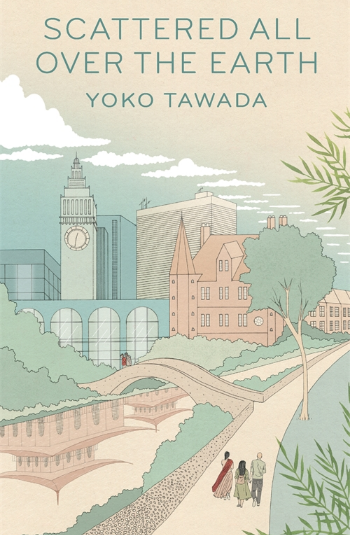
With the second goal in mind, I commenced my reading year with the works of East Asian writers. This was also mainly driven by my failure to host a Japanese literature month in the previous year, the first time in a while I failed to do so. This brings me to Yōko Tawada and her novel Scattered All Over the Earth. This is my third novel by Tawada, making her the third female Japanese writer with whom I read at least three books; the other two being Mieko Kawakami and Yoko Ogawa. Originally published in 2018 as 地球にちりばめられて (Chikyū ni chiribame rarete), the novel was made available to Anglophone readers in 2022. The story started in Denmark where Knut, a linguistics student, was idly watching television. After turning the channels over and over, he was suddenly captivated by a woman he saw on a random talk show. The host was interviewing Hiruko, a woman who comes from a country that no longer exists. She was on a quest to find other speakers of her native tongue so that she could speak it again. The interesting premise is classic Tawada. Like with her two books, she tackles an interesting subject, providing it with her own literary dimensions. It doesn’t always work but I am interested to see, rather read how she spins the tale.
What have you finished reading?

Despite being busy in the past week, I had a prolific reading week. I completed three books, the first of which is one of the reasons why I decided to open my 2025 reading journey with works of East Asian writers. In late 2024, I learned that Han Kang is about to release a new work in early 2025. This development came shortly after she was awarded by the Swedish Academy with the Nobel Prize in Literature, making the Korean writer the first female Asian writer to earn the most prestigious distinction in the ambit of literature. It was in 2017, I believe when I first came across her. This came after her novel The Vegetarian won the International Booker Prize. I was not initially a fan of the book but her succeeding works turned me into a believer. I was beyond happy when her name was announced and I was even more stoked when I learned about the release of We Do Not Part.
Kang’s latest translated novel, We Do Not Part was originally published in 2021 as 작별하지 않는다 (Jagbyeolhaji Anhneunda). The story is voiced by Kyungha, a woman living alone in Seoul. On the brink of depression, her torpor was disrupted by an unexpected call from her friend Inseon who was recuperating in a hospital following a work accident. Unable to attend to her pet bird Ama in Jeju, Inseon asked Kyungha to travel to Jeju to feed Ama. Meanwhile, a snowstorm was sweeping the island province. Kyungha nevertheless was able to make her way to Inseon’s family home; she was on the last flight before the airport was closed due to the snowstorm. At Inseon’s family home, Kyungha learned more about Inseon’s family’s troubled history. Inseon’s family’s history is inevitably tied up with Jeju’s contemporary history. The story, however, focused on the Jeju Massacre which I first learned about in Lisa See’s The Island of Sea Women. Starting in 1948, state-sponsored killings rocked the island; the killing was in the guise of purging the island of communists. While there were no official figures, it was estimated that at least 30,000 people, including 1,500 children, were killed by authorities and by extreme-right militant groups. Kang’s latest novel reminded me of two of her other works: Human Acts in its exploration of Korea’s ruptured history and White Book in the novel’s pensive tone. While it is not as intense as Human Acts, the novel is a compelling read that further underlines Han’s status as a premier chronicler of her country’s ruptured history.

From the Korean Peninsula, my literary journey next took me across the sea, to a very familiar and prolific literary hunting ground, at least for me. Without a doubt, Japanese literature is one of, if not my favorite literatures in the world. For nearly a decade, it kept me fascinated and even wishing for more. The recent spate of translated works of Japanese literature favors me because it provides me an opportunity to explore the limits of Japanese literature further. But while these new works excite me, I also keep on returning to the old reliables. Among them is Yukio Mishima who is one of the writers who made me fall in love with Japanese literature and embrace all its uncertainties and curves. Mishima has also become a staple of my annual Japanese literature month; 2025 is no different.
I concluded my February reading journey with his novel The Frolic of the Beasts, making it the sixth novel written by Mishima I read. Originally published in 1961 as 獣の戯れ (Kemono no Tawamure), The Frolic of the Beasts charts the fortunes of three characters in post-war Japan: Ippei Kusakado, his wife Yūko, and the youthful Kōji. The prologue opens with a picture of them together smiling while standing on the harbor wall in Iro Village, a rural fishing port in Izu Peninsula in Shizuoka Prefecture. Although the picture captured them smiling, an ominous sign was issued by Misima: the picture was taken “a few days before the final wretched incident.” Their story, however, started in Tokyo where Kōji, while studying, worked for a Western ceramics shop in Ginza, Tokyo owned by 41-year-old Ippei. While drunk, Ippei confessed to Kōji his marital troubles. Ippei tried making his wife jealous and even confessing several affairs. Yūko, however, was nonplussed. Kōji fell in love with Yūko and the pair eventually started an illicit affair. Yūko admitted being aware of her husband’s infidelities. Tension escalates and Kōji finds himself in prison. The story’s first chapter opens with Kōji getting released from prison and traveling back to Iro Village where he once again meets with the couple and is taken under their employ. Like the other Mishima novels I read, The Frolic of the Beasts has an interesting and even intriguing premise that delves into the depths of our desires. However, the story never fully develops. The characters remain shrouded in mystery and the plot is disjointed.
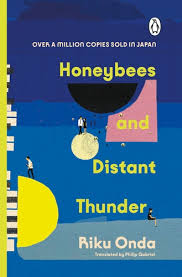
From two familiar writers, my immersion into the works of East Asian writers took me to a new and unfamiliar writer, at least for me. I just mentioned that there has been a remarkable number of Japanese literary works being made available to Anglophone readers. Among them is Riku Onda’s Honeybees and Distant Thunder. It was through an online bookseller that I first encountered Onda and her novel. However, it was when I was on my way home from Japan that I purchased a copy of the book. My interest was piqued. Further, the book was ubiquitous and it seems that it is a literary sensation in Onda’s native Japan. It was for these reasons that I also included the book in my 2025 Top 25 Reading List, making it just the fourth book from the list I read.
Originally published in 2016 as 蜜蜂と遠雷 (Mitsubachi to enrai), Honeybees and Distant Thunder is the third novel by Onda to be translated into English. The novel is centered around the Yoshigae International Piano Competition, a fictional contest set in a rural seaside town. The prestigious contest has attracted some of the world’s young piano prodigies and even veteran musicians. The story, however, focuses on the stories of four characters. Sixteen-year-old Jin Kazama is a relatively unknown prodigy and the son of a beekeeper. His goal was to make it to the finals so that his father would buy him a piano. Aya Eiden, on the other hand, was a former child prodigy but took a break from the concert scene after getting burned out. Aya had previous connections with Masaru Carlos Levi Anatole who is equally renowned. He comes with a pedigree as a pianist and was even dubbed as The Prince of Juilliard. The trio forms the mantel of the story. An interesting plotline came in Akashi Takashima. In his late twenties, he is among the older entrants. He was nevertheless driven by his dream of making it into the music scene so that his son would eventually be proud of him for what he achieved as a musician. Onda takes the readers through each round of competition as more competitors are eliminated. It was a riveting read that also reminds us of the beauty of music. It is a substitute for language and a means to capture the beauty that words cannot seem to describe.
What will you read next?


 The Pine-Scented Chronicles