
Hello, readers! It is Monday again! As it is Monday, welcome to another #5OnMyTBR update. The rule is relatively simple. I must pick five books from my to-be-read piles that fit the week’s theme.
This week’s theme: No Prompt
Because there is still no prompt this week, I decided to feature thick books. To quantify what is thick, these books are at least 600 pages long. As someone who prefers longer books, it is not quite a surprise that I own several books that are at least 600 pages long.

5OnMyTBR is a bookish meme hosted by E. @ Local Bee Hunter’s Nook where you chose five books from your to-be-read pile that fit that week’s theme. If you’d like more info, head over to the announcement post!

Title: Foucault’s Pendulum
Author: Umberto Eco
Translator (from Italian): William Weaver
Publisher: Guild Publishing
Publishing Date: 1989 (1988)
No. of Pages: 641
Synopsis:
Foucault’s Pendulum is a superb entertainment by the author of The Name of the Rose. An enthralling mystery, a sophisticated thriller, a breathtaking journey through the world of ideas and aberrations, the treasures and traps of knowledge, Umberto Eco’s new novel will delight, tease, provoke, and stimulate.
One Colonel Ardenti, who has unnaturally black brilliantined hair, an Adolphe Menjou mustache, wears maroon socks and fought in the Foreign Legion, starts it all. He tells three editors at a Milan publishing house that he has discovered a coded message about a Templar plan, centuries old and of diabolical complexity, to tap a mystic source of power greater than atomic energy.
The editors (who have spent altogether too much time rewriting crackpot manuscripts on the occult by self-subsidizing poetasters and dilettantes) decide to have a little fun. They’ll make a plan of their own. But how?
Randomly they throw in manuscript pages on hermetic thought. The Masters of the World, who live beneath the earth. The Comte de Saint-Germain, who lives forever. The secrets of the solar system contained in the measurements of the Great Pyramid. The Satanic initiation rites of the Knights of the Temple. Assassins, Rosicrucians, Brazilian voodoo. They feed this all into their computer, which is named Abulafia (Abu for short) after the medieval Jewish cabalist.
A terrific joke, they think – until people begin to disappear mysteriously, one by one, starting with Colonel Ardenti.
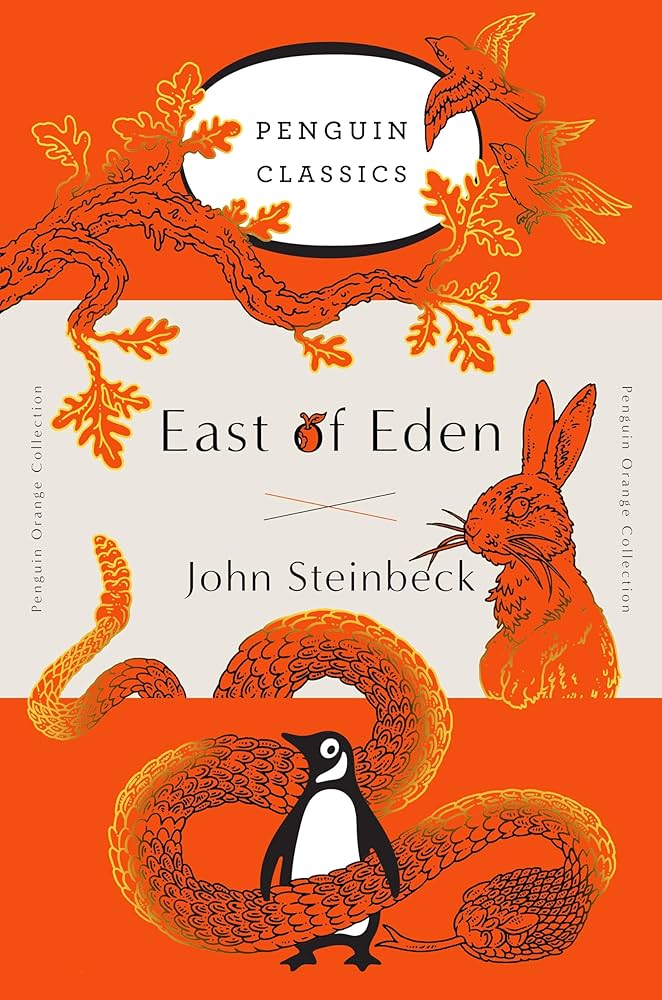
Title: East of Eden
Author: John Steinbeck
Publisher: Penguin Classics
Publishing Date: 2016 (1952)
No. of Pages: 601
Synopsis:
East of Eden is the masterpiece of Nobel Prize winner John Steinbeck’s later years – a vastly ambitious novel that is at once a family saga and a modern retelling of the Book of Genesis. In his journal, Steinbeck called East of Eden “the first book,” and indeed it has the primordial power and simplicity of myth. Set in the rich farmland of California’s Salinas Valley, this sprawling and often brutal novel follows the intertwined destinies of two families – the Trasks and the Hamiltons – whose generations helplessly reenact the fall of Adam and Eve and the poisonous rivalry of Cain and Abel. East of Eden is a work in which Steinbeck created his most mesmerizing characters and explored his most enduring themes: the mystery of identity, the inexplicability of love, and the murderous consequences of love’s absence.

Title: The Historian
Author: Elizabeth Kostova
Publisher: Little, Brown and Company
Publishing Date: 2005
No. of Pages: 642
Synopsis:
Late one night, exploring her father’s library, a young woman finds an ancient book and a cache of yellowing letters. The letters are all addressed to “My dear and unfortunate successor,” and they plunge her into a world she never dreamed of – a labyrinth where the secrets of her father’s past and her mother’s mysterious fate connect to an inconceivable evil hidden in the depths of history.
The letters provide links to one of the darkest powers that humanity has ever known – and to a centuries-long quest to find the source of that darkness and wipe it out. It is a quest for the truth about Vlad the Impaler, the medieval ruler whose barbarous reign formed the basis of the legend of Dracula. Generations of historians have risked their reputations, their sanity, and even their lives to learn the truth about Vlad the Impaler and Dracula. Now one young woman must decide whether to take up this quest herself – to follow her father in a hunt that nearly brought him to ruin years ago, when he was a vibrant young scholar and her mother was still alive.
What does the legend of Vlad the Impaler have to do with the modern world? Is it possible that the Dracula of myth truly existed – and that he has lived on, century after century, pursuing his own unknowable ends? The answers to these questions cross time and borders, as first the father and then the daughter search for clues, from dusty Ivy League libraries to Istanbul, Budapest, and the depths of Eastern Europe. In city after city, in monasteries and archives, in letters and in secret conversations, the horrible truth emerges about Vlad the Impaler’s dark reign – and about a time-defying pact that may have kept his awful work alive down through the ages.
Parsing obscure signs and hidden texts, treading codes worked into the fabric of medieval monastic traditions – and evading the unknown adversaries who will go to any lengths to conceal and protect Vlad’s ancient powers – one woman comes over closer to the secret of her own past and a confrontation with the very definition of evil. Elizabeth Kostova’s debut novel is an adventure of monumental proportions, a relentless tak=le that blends fact and fantasy, history and the present, with an assurance that is almost unbearably suspenseful – and utterly unforgettable.

Title: The Strudlhof Steps
Author: Heimito Von Doderer
Translator (from German): Vincent Kling
Publisher: New York Review Books
Publishing Date: 2021 (1951)
No. of Pages: 839
Synopsis:
The Strudlhof Steps is an unsurpassed portrait of Vienna in the early twentieth century, a vast novel crowded with characters ranging from an elegant, alcoholic Prussian aristocrat to an innocent ingenue to “respectable” shopkeepers and tireless sexual adventures, bohemians, grifters, and honest working-class folk. The greatest character in the book, however, is Vienna, which Heimito von Doderer renders as distinctly as James Joyce does Dublin or Alfred Döblin does Berlin. Interweaving two time periods, 1908 to 1911 and 1923 to 1925, the novel takes the monumental eponymous outdoor double staircase as a governing metaphor for its characters’ intersecting and diverging fates. The Strudlhof Steps is an experimental tour de force with the suspense and surprise of a soap opera. Here Doderer illuminates the darkness of passing years with the dazzling extravagances that is uniquely his.

Title: Underworld
Author: Don DeLillo
Publisher: Scribner
Publishing Date: 2003
No. of Pages: 827
Synopsis:
Nick Shay and Klara Sax knew each other once, intimately, and they meet again in the American desert. He is trying to outdistance the crucial events of his early life; she is an artist who has made a blood struggle for independence.
Underworld is a story of men and women together and apart, seen in deep, clear detail and in stadium-sized panoramas, shadowed throughout by the overarching conflict of the Cold War. It is a novel that accepts every challenge of these extraordinary times – Don DeLillo’s greatest and most powerful work of fiction.

Title: Life and Fate
Author: Vasily Grossman
Translator (from German): Robert Chandler
Publisher: Perennial Library
Publishing Date: 1987
No. of Pages: 871
Synopsis:
Life and Fate is fiction on the epic scale: powerful, deeply moving, and devastating in its depiction of a world torn apart by war and ideological tyranny. At the center of the novel, overshadowing the lives of each of its huge cast of characters, stands the battle of Stalingrad. Vasily Grossman presents a startlingly vivid picture of this desperate struggle for a ruined city, and of how the ebb and flow of the fighting affect the lives and destinies of people far from the front line. With Tolstoyan grandeur that finds room for intimate detail, and deploying a multitude of superbly realized characters, Grossman delivers a message of terrifying simplicity: that Stalinism and Nazism are one and the same in their falsehood, cruelty, and inhumanity.
 The Pine-Scented Chronicles
Whenever I mention long books I have read, people are surprised
Glad I love those books- even some YA books are long
Those can range anywhere from classics to fantasies to mythologies
LikeLike
I only have one of these thick books on my shelf – East of Eden. I have always meant to read it. I like reading long books. I feel so invested in them and they stay with me long after I’ve finished! Great post 🙂
LikeLike