
Hello, readers! It is Monday again! As it is Monday, welcome to another #5OnMyTBR update. The rule is relatively simple. I must pick five books from my to-be-read piles that fit the week’s theme.
This week’s theme: No Prompt
Because there is still no prompt this week, I decided to go local by featuring works of Philippine writers. This is in line with my ongoing foray into the works of Asian writers. Without ado, here are some works by Filipino writers I am looking forward to.

5OnMyTBR is a bookish meme hosted by E. @ Local Bee Hunter’s Nook where you chose five books from your to-be-read pile that fit that week’s theme. If you’d like more info, head over to the announcement post!

Title: His Native Coast
Author: Edith L. Tiempo
Publisher: Univesity of the Philippines Press
Publishing Date: 2000 (1979)
No. of Pages: 235
Synopsis:
His Native Coast is a story of a search for identity. The rather inarticulate attempt of Michale Linder to shape for himself a personal identification with the world that would give ultimate meaning to his life is paralleled by Marina’s own search: for Marina is partly tribal, and although her life and training are steeped in Western (American) culture, she is haunted by the influence of her Ifugao mother, who had lived and died in her native hills without once coming down to the lowlands.
His Native Coast gives the reader a provocative and moving story of two “pilgrimages,” one ending outside of the seeker’s geographical context, and the other in a return to it: one resulting in a glimpse of self-recognition, the other in what turns out to be a refusal of it.
The novel attempts a definition of personal and national identity that transcends geographical origins, and suggests that whether one is in his home country or not, the belief in his own human usefulness in his context has much to do with forging a healthy sense of belonging.
In these days of heightened self-searching among the western-influenced-developing nations, this Philippine experience offers its own unique insight.

Title: Bamboo in the Wind
Author: Azucena Grajo Uranza
Publisher: The Bookmark, Inc.
Publishing Date: 2002 (1990)
No. of Pages: 539
Synopsis:
Larry Esteva, coming home from studies in Boston, witnesses at the airport a riotous demonstration that is forcibly dispersed by the military. The end of his journey turns out to be the beginning of an odyssey in his beloved city where he finds “an insidious lawlessness creeping upon the land.”
Set in Manila in the last beleaguered months before the politico-military take-over in 1972, Bamboo in the Wind tells of the last desperate efforts of a people fighting to stave off disaster. Amid the escalating madness of a regime gone berserk, an odd assortment of people – a senator, a young nationalist, a dispossessed farmer, a radical activist, a convent school girl, a Jesuit scholastic – make their way along the labyrinthine corridors of greed and power. Each is forced to examine his own commitment in the face of brutality and evil, as the book conjures up scene after scene of devastation: the massacre of the demonstrators, the demolition of Sapang Bato, the murder of the sugar plantation workers, the burning of the Laguardia ricefields. And, as a climax to the mounting violence, that final September day – the arrests, the torture, and finally the darkness that overtakes the land.
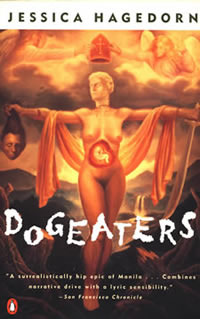
Title: Dogeaters
Author: Jessica Hagedorn
Publisher: Penguin Books
Publishing Date: 1991
No. of Pages: 251
Synopsis:
Welcome to Manila in the turbulent period of the Philippine’s late dictator. It is a world in which American pop culture and local Filipino tradition mix flamboyantly, and gossip, storytelling, and extravagant behavior thrive.
A wildly disparate group of characters—from movie stars to waiters, from a young junkie to the richest man in the Philippines—becomes caught up in a spiral of events culminating in a beauty pageant, a film festival, and an assassination. In the center of this maelstrom is Rio, a feisty schoolgirl who will grow up to live in America and look back with longing on the land of her youth.

Title: America is Not the Heart
Author: Elaine Castillo
Publisher: Atlantic Fiction
Publishing Date: 2018
No. of Pages: 406
Synopsis:
How many lives can one person lead in a single lifetime? When Hero De Vera arrives in America, disowned by her parents in the Philippines, she’s already on her third. Her uncle, Pol, who has offered her a fresh start and a place to stay, knows not to ask about the first and second, and his younger wife, Paz, has learned enough about the might and secrecy of the De Vera family to keep her head down. Only their seven-year-old daughter, Roni, asks Hero why her hands seem to scream with hurt at the steering wheel of the car she drives to collect her from school, and only Rosalyn, the fierce but open-hearted beautician, has any hope of bringing Hero back from the dead.
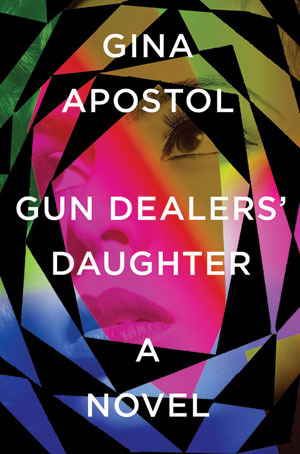
Title: Gun Dealer’s Daughter
Author: Gina Apostol
Synopsis:
A young woman pieces together her troubled past in this story of rebellion and romance set in the Marcos-era Philippines.
Soon after she leaves home for university in Manila, Soledad Soliman (Sol) transforms herself from bookish rich girl to communist rebel. But is her allegiance to the principles of Mao or to Jed, the comrade she’s in love with? Can she really be a part of the movement or is she just a “useful fool,” a spoiled brat playing at revolution?
Far from the Philippines, in a mansion overlooking the Hudson River, Sol confesses her youthful indiscretions, unable to get past the fatal act of communist fervor that locked her memory in an endless loop. Rich with wordplay and unforgettable imagery, Gun Dealers’ Daughter combines the momentum of an amnesiac thriller with the intellectual delights of a Borgesian puzzle. In her American debut, award-winning author Gina Apostol delivers a riveting novel that illuminates the conflicted and little-known history of the Philippines, a country deeply entwined with our own. (Source: Goodreads)

Title: Canal de la Reina
Author: Liwayway A. Arceo
Synopsis:
Canal de la Reina was Liwayway Arceo’s response to the call for committed writing as an aftermath of the violent head-on collisions of diverse forces in the 1970s. Arceo had not been known for engaged or “political” writing, where the writer deployed their craft to project a vision of a world in turmoil, where characters were fully engaged in the bloody struggle to effect radical change in society. This willful commitment to use literature to paint a canvas of a world in turmoil had been demonstrated by a long line of Filipino writers, from Jose Rizal to the generation of Lope K. Santos and Servando de los Angeles in the first half of the 20th century, to the generation of Rogelio Sicat and Ricky Lee in the post-war decades. This is a legacy which has pushed various writers to confront the burning issues of the day. (Source: Goodreads)
 The Pine-Scented Chronicles