
Happy Tuesday everyone! This also means a Top 5 Tuesday update. Top 5 Tuesday was originally created by Shanah @ the Bionic Bookworm but is now currently being hosted by Meeghan @ Meeghan Reads.
This week’s topic: Top 5 books set in Asia
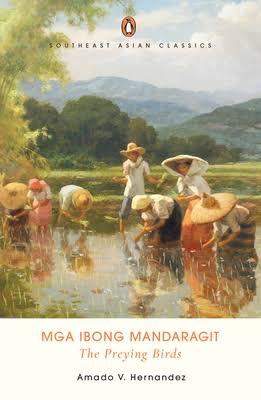
The Preying Birds by Amado V. Hernandez
Setting: The Philippines
Snippet from my review: Justice, however, is a rarity in a society corrupted by greed and selfish ambitions, where those who grew up in privilege are shielded from the ugly realities that sweep the rest of the nation. One is willing to compromise one’s moral compass especially if it entails getting undue advantage. Hernandez probes into the factors that contributed to these social maladies that pervade Philippine society. The legacies of colonialism – the archipelago was colonized by Spain for over three centuries, by the United States for nearly four decades, and by the Japanese for about four years – were among these factors. Being colonized by both the West and the East, the Philippines has lost some of its cultural identity. It is in a cultural quandary because it aims to emulate the West and be above its peers in the East. As a result, Filipino values have become convoluted.

Midnight’s Children by Salman Rushdie
Setting: India
Snippet from my review: As always, Rushdie’s depiction of his home country is admirable. India is a colorful country filled with numerous stories, and Midnight’s Children is just among them. Rushdie knows how to pay tribute to his roots like no other author does. He didn’t mince a word in describing its political system, its history, its social diversity and its prevailing social issues. But in spite of its growth, superstitious beliefs and tradition are still prominent. Rushdie’s fortitude in bringing all these things to light is truly astounding.

The Architect’s Apprentice by Elif Shafak
Setting: Constantinople (present-day Istanbul), Turkey
Snippet from my review: The streets of Constantinople and the halls of the palace were populated by vibrant characters who, in their own ways, influenced Jahan and helped in his development both as an individual and as an architect. Shafak created a vast ecosystem where real and fictional characters from various backgrounds interacted all captured through the lenses of a boy who ascended from his humble beginnings to become a reliable and dedicated apprentice. In his interactions with this eclectic cast of characters, Shafak highlighted the intricacies of human relationships. However, despite the prevalence of vibrant characters, most of them came across as merely backdrops, stepping stones integral to Jahan’s journey. On the other hand, they do not invite emotional investment and the novel’s pace does not allow them to flourish on their own.

A Wild Sheep Chase by Haruki Murakami
Setting: Tokyo and Hokkaido, Japan
Snippet from my review: Under the guise of an adventure and detective fiction is a journey of personal transformation and growth reminiscent of a coming-of-age novel. The protagonist’s emotional growth propelled the narrative forward. Murakami captured his transformation vividly, simultaneously underlining the importance of the process in obtaining full emotional growth. The protagonist’s escapade into the snow-capped mountains of Hokkaido led to encounters with unlikely characters who, in subtle ways, made him realize the most important things in life and what one must do to preserve them.

The Day Lasts More than a Hundred Years by Chingiz Aitmatov
Setting: Sarozek desert in Kazakhstan
Snippet from my review: This was just one of the novel’s several layers. Woven into the rich tapestry were details of folklore, myths, and legends interjected all over the story. We read about a local heroine the traditional burial ground was named after, Naiman-Ana. According to local lore, her son was captured by the fictional Zhuan’zhuan tribe. The tribe is known for brutally erasing their captive’s memories, thus, resulting in a mankurt; this is a fictional legend popularized by Aitmatov in his work. Bereft of identity and memory and identity, mankurts work as subservient slaves carrying out their master’s wishes and tending livestock. The mankurt, however, was no ordinary fictional creation as it was a depiction of how Soviet propaganda effectively muted the Central Asian identity. The region’s culture, language, and traditions were lost in the Soviet’s pursuit of conformity. Other folkloric elements detailed stories of forbidden love.

Human Acts by Han Kang
Setting: Primarily in Gwangju, South Korea
Snippet from my review: One character asks, “To be degraded, damaged, slaughtered – is this essential fate of humankind, one that history has confirmed as inevitable?” Kang poses seminal and essential questions central to understanding our identity as a race. How can we move on in light of such atrocity, or deal with the two faces of society? Will we be able to pierce the shroud of disillusion and estrangement that these events have covered us in? Human Acts gave us a special microscope upon which we can examine the definition of our own humanity.
Here are other books set in Asia that have become favorites of mine.


 The Pine-Scented Chronicles