
Happy Tuesday everyone! This also means a Top 5 Tuesday update. Top 5 Tuesday was originally created by Shanah @ the Bionic Bookworm but is now currently being hosted by Meeghan @ Meeghan Reads.
This week’s topic: Top 5 books set in Africa, Australia and New Zealand
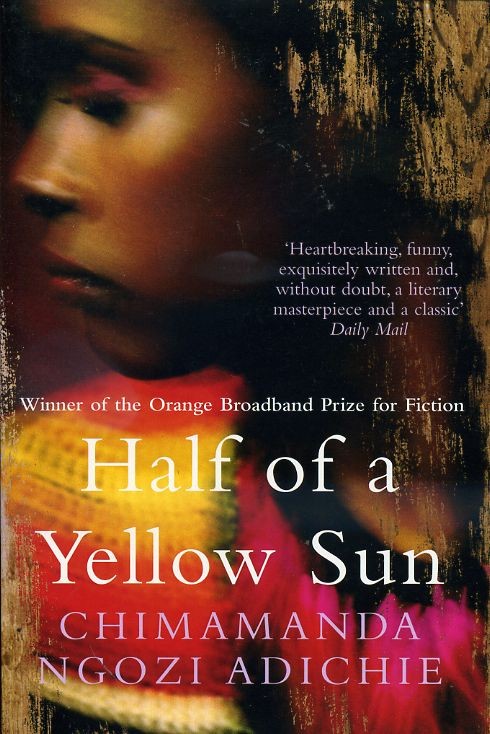
Half of a Yellow Sun by Chimamanda Ngozi Adichie
Setting: Nigeria
Snippet from my review: Through Half of a Yellow Sun, Ngozi Adichie swept readers. The narrative stirs emotions and provokes thoughts. The boldly imagined and conjured characters are the quintessence of Nigeria and its peoples. They represent all facets of the societal spectrum. The interesting plot was also complimented by Ngozi Adichie’s nostalgic writing. Ngozi Adichie’s conviction to deliver her message is admirable. The depth of the plot and the characters all converge to convey the unheard stories of Nigeria.

Stone Yard Devotional by Charlotte Wood
Setting: Australia
Snippet from my review: As we slowly immerse ourselves in the reflections of the unnamed narrator, we begin to understand that her anonymity was deliberate. Her reflections are slowly becoming our own. Her yearning for an escape from the bedlam of quotidian existence mirrors our own. Stone Yard Devotional is brimming with philosophical intersections and contemplation. The narrator reflects on how we can adversely impact the people around us, our parents, a stranger, or a schoolmate. Thus begins a quiet spiritual journey toward redemption. Beyond the pursuits of redemption and yearning for a different life, the novel grapples with a plethora of questions about life, existence, climate change, catastrophe, and even the past. All of these various elements were astutely woven together into a silently lush story by Charlotte Wood. Shortlisted for the 2024 Booker Prize, Stone Yard Devotional is a quietly powerful and thought-provoking book.

How Beautiful We Were by Imbolo Mbue
Setting: (Indirectly) Cameroon
Snippet from my review: A seminal intersection in the novel involved the question of belonging and identity. As more Africans move to other places to pursue opportunities, and education, as explored in Mbue’s debut novel Behold the Dreamers, the question of nationality and heritage came to the fore. Does one lose one’s heritage and birthright? It was while Thula was in New York City that the question of the motherland was raised, of what it means. Thula had to keep reassuring her friends in Kosawa that she had not lost her identity. She was born in Kosawa and to Kosawa she will return. Other aspects of one’s heritage were explored through Austin, a journalist of mixed heritage who was instrumental in raising the plight of the villagers to the attention of the world.

Palace Walk by Naguib Mahfouz
Setting: Egypt
Snippet from my review: While the first half of the novel captured the domestic life of the Abd al-Jawad family, there was a marked change in tone in the second half as the story went beyond the Abd al-Jawad household. As drama and tension unfolded within the Jawad household, social, political, and cultural changes were also taking place all over Egypt. Following Egypt’s declaration of war in 1914, and eventually, independence from the Ottoman Empire, it was declared a protectorate by the United Kingdom. However, it did not take long for nationalist sentiments to seize the denizens of Egypt. At the Paris Peace Conference of 1919, an Egyptian delegation known as the Wafd Delegation demanded the independence of Egypt. Their demand, however, was met with heavy opposition, resulting in the members of the delegation being deported to Malta.

Homegoing by Yaa Gyasi
Setting: Ghana and the United States
Snippet from my review: Homegoing is an ambitious and a massive undertaking, an impressive debut that encompasses a vast scope. To say that Gyasi accomplished a lot with her debut work is an understatement. She pulled off the right stops and she came up with a powerful narrative that dips into history and slowly trickles into the present. The exploration of the attitude vis-à-vis slavery and racism was one of the novel’s most defining aspects. However, it is no mundane slavery narrative. Through the powerful backstories, Gyasi managed to capture life, growth, and man’s ability to overcome changes. It is also about drawing the invisible threads of time and weaving one’s tale. Once these invisible threads are linked together, everything comes full circle.

The Road to the Country by Chigozie Obioma
Setting: Nigeria
Snippet from my review: Like all novels dealing with the Biafran War, The Road to the Country captured the atrocities of war. What makes the novel soar, however, is its vivid portrait of trench warfare. Obioma’s writing takes the readers to the heart of the war, reeling the readers in with his descriptive and graphic descriptions. This also captured the atmosphere that surrounded Kunle and the people of eastern Nigeria. Several battle scenes and acts of shocking violence permeate the story; the story is not for the faint of heart. Obioma, with his unflinching gaze, was relentless in painting a vivid portrait of the battlefield. It was dire and hope evaded the men and women at the frontline. Ambushes and explosions were ubiquitous. The intricacies of warfare were captured by Obioma. Details of artillery, logistics, and even army command structures were ubiquitous. The geopolitical nature of the war was underlined by Obioma. The Nigerian government heavily relied on the backing of the British government for its supply of artillery.
 The Pine-Scented Chronicles