
Happy Wednesday, everyone! Wednesdays also mean WWW Wednesday updates. WWW Wednesday is a bookish meme hosted originally by SAM@TAKING ON A WORLD OF WORDS.
The mechanics for WWW Wednesday are quite simple: you just have to answer three questions:
- What are you currently reading?
- What have you finished reading?
- What will you read next?

What are you currently reading?

It is already the middle of the week. How has your week been? I hope it’s going well and going in your desired direction. This reminds me that the fourth month of the year has already concluded. It is already May! How has the year been so far? I hope that it is going well for everyone. I hope it is going your way, that you are being showered with blessings and good news. I hope the rest of the year will be prosperous, brimming with wealth, and, more importantly, good health. I hope everyone is making progress on their goals. Reading-wise, I have several goals I want to achieve, primarily to complete 100 books for the fourth year in a row. Barring any major obstacles, I know I can end the year with at least 100 books. After a full quarter of reading exclusively works of East Asian writers, I am now venturing into the even more extensive world of Asian literature.
My current read takes me to one of the Philippines’ neighboring countries, Malaysia. I initially thought that Yeoh Jo-Ann was Korean. When I obtained a copy of her novel Deplorable Conversations With Cats and Other Distractions, it was with the intent of including it in my foray into East Asian literature. Imagine my surprise when I learned Yeoh was Malaysian. Nevertheless, I managed to fit the book into my current reading journey by making it part of my ongoing venture across Asian literature. The first thing about the book that caught my attention when I first encountered it was its title. I thought it was a collection of short stories (wrong again). At the heart of the book is Lucky Lee. Despite earning a degree in architecture, he works at a cafe for fun with his friends. As I just started reading the book, I wasn’t able to get far yet. Nevertheless, I will be sharing more of my impressions of the book in this week’s First Impression Friday update.
What have you finished reading?
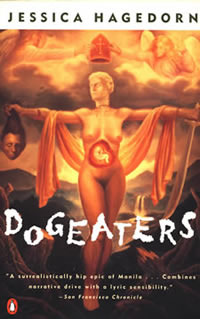
After a couple of slow reading weeks, I managed to pick up pace in the past week. I was able to complete three books. This underlines how my foray into Asian literature is in full swing. One part of the literary world that I have yet to explore further is my very own. A couple of years ago, I was apprehensive about venturing into Philippine literature. Now, I rue that because my own literature has been leaving me in awe. To redress this, I have been making it a point to read at least two works of Filipino writers in my annual reading journeys. After Lope K. Santos’ Banaag at Sikat (Radiance and Sunrise), Jessica Hagedorn’s Dogeaters is the second novel by a Filipino writer I read this year. I guess I have met my quota although I still plan to read more.
Originally published in 1990, Dogeaters is Hagedorn’s debut novel and is written from the point of view of various characters, starting with Rio Gonzaga who reminisced about her youth in Manila in 1956. The story primarily revolves around the Gonzaga family, an upper-middle-class family consisting of Rio; her older brother, Raul; her mother, Dolores; and her father, Freddie. Rio’s family is friends and is employed by the influential and affluent Alacran family. The Alacran patriarch, Severo, is a self-made man who runs a score of big businesses. But this just scratches the surface. The story weaves in and out of various periods. This can be disconcerting but the story eventually establishes a rhythm; this is on top of the polyvocal narrative. Interestingly, the first reference to dogeaters in the book is to an Igorot character; I am a member of the Igorot tribe. It is a derogatory term used to describe the natives like us Igorots but I don’t take offense because, from what I can surmise, the term is a metaphor for bigger concerns that the novel is addressing. Indeed, the novel is highly metaphorical. The novel is the convergence of satirical, roman à clef, and bildungsroman elements juxtaposed with historical and political contexts – most of which I am quite familiar with – that shaped the contemporary Philippine landscape. It is a lush and compelling read although the structure – while it is a nod to innovation – can be confusing at times. Nevertheless, Dogeaters is a thought-provoking novel about the Philippines, its history, its culture, and its people.
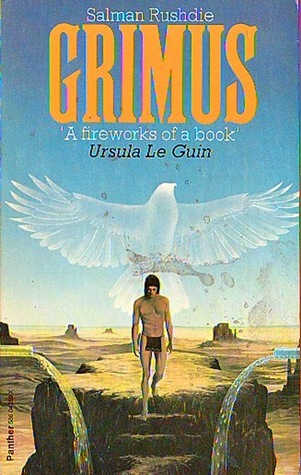
From the Philippine archipelago, my next read took me to a territory that is becoming quite familiar. Or maybe I am thinking too far ahead. Indian literature, after all, is quite vast and diverse. Regardless, like what I have been doing with Philippine and Chinese literature, I have been reading expanding my foray into this section of the literary world. One of the most prominent voices India has produced is Salman Rushdie who I first encountered through must-read lists. He has since become a favorite of mine and is my second-most-read writer in the past decade. Interestingly, I always assumed that Midnight’s Children was Rushdie’s debut novel. Imagine my horror when I learned it was his sophomore novel and that he debuted with a less obscure novel, Grimus.
Originally published in 1975, Grimus would eventually be the eleventh novel by Rushdie I read. Grimus is also often overlooked by critics and readers alike. Even Rushdie himself is known for disowning his first published work and considering Midnight’s Children as his debut work. At the heart of the story is Flapping Eagle, an Axona Indian. The crux of the story is the disappearance of his older sister Bird-dog who eloped with a mysterious man, leaving her younger brother with two vials. One elixir grants immortality while the other causes immediate death. Flapping-Bird took the elixir of immortality and commenced a journey to search for his immortal sister. After 777 years 7 months and 7 days, he fell through a hole in the Mediterranean Sea. Flapping Eagle found himself in a parallel dimension at the mystical Calf Island, a parallel dimension occupied by immortals tired of the world but ambivalent about giving up their immortality. They lived in K under a sinister authority. In K, Flapping Eagle got to meet different characters, among them Virgil Jones. Virgil Jones is an exiled associate of the titular Grimus, the creator of the dimension. Under Virgil Jones’ guidance, Flapping Eagle set out to challenge Grimus as he is the key to finding Bird-dog. Grimus is quite an interesting read coming from Rushdie. It has all the elements that would be the trademark of Rushdie’s oeuvre but one can surmise that they are a little underdeveloped; this is, after all, his debut novel. It also provides a different dimension upon which to appreciate Rushdie’s body of work although the novel reminds me of Rushdie’s other works, particularly Haroun and the Sea of Stories and Victory City.

With my venture into Asian literature in full swing, my next read took me to an unfamiliar name, at least unfamiliar to me. It was in early 2022 while I researching for books to include in my Books I Look Forward To List that I first encountered Quan Barry, a Vietnam-born American writer. She was about to release a new work When I’m Gone, Look for Me in the East. With my interest piqued, I added the book to my 2022 Top 10 Books I Look Forward To List. It was also supposed to be a part of my Year of Asian Literature list. However, obtaining a copy of the book proved to be a challenge. It was only in 2024 that I was able to obtain a copy of the book and when presented with the opportunity, I decided to include the book in my ongoing foray into Asian literature.
Barry’s third novel When I’m Gone, Look For Me in the East is actually set in Mongolia; it is one of the reasons why I wanted to read it in the first place. The voice of the novel is Chuluun, a novice monk. Along with his identical twin, Mun, he was in a remote monastery after they were “discovered” when they were eight years old; Mun had been recognized as the reincarnation of a deceased lama. In their twenties, Mun decided to leave their home and renounced the monastic life. Chuluun, who remained loyal to his calling, managed to persuade his twin to chauffeur him on a road trip. The goal is to search for a Buddhist teacher who has been reincarnated as a child. Across Central Asia, the brothers traveled in search for the reincarnation. However, what leaves an impression is not the journey – it was vividly captured by Barry – but the details of Central Asian and Buddhist culture embedded into the story. Buddhist scripture, rites, and concepts were evocatively drawn. Barry, with her descriptive prose, transported readers to Mongolia and Tibet. It was an immersive adventure novel. Nevertheless, the brothers remained in rein of the story. They have telepathic gifts that allow them to peek into each other’s thoughts. They are the antithesis of each other. Their contrasts made for an interesting read. The long wait was worth it because When I’m Gone, Look For Me in the East is a riveting read.
What will you read next?


 The Pine-Scented Chronicles